
What Spices Can Cats Eat?
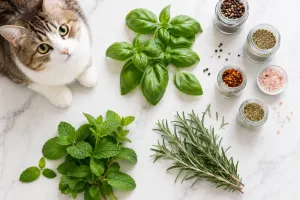
Why cats react differently to herbs & spices
A spice label rarely tells you what actually reaches a cat's bowl, and seasoning is riskier than the plain ingredient for three separate reasons, not one. First, concentration: drying and grinding remove water and pack more of a compound into the same volume, which is why onion or garlic powder is more potent per gram than the fresh vegetable, and why dried basil should be used more sparingly than fresh.
Second, cats have a genuinely reduced liver capacity, not folklore: they produce less glucuronyl transferase, the liver enzyme most mammals use to clear plant compounds and essential oils, which is why a spice's essential-oil form, clove and cinnamon oil among them, is consistently a harder hit than the ground spice or fresh leaf. Third, a seasoning is rarely eaten alone.
Basil in a skillet usually means garlic or onion nearby, and a spice blend is a label that can carry onion powder without the word ever appearing on a menu. None of that makes every spice dangerous. It means the plain herb and the seasoned dish are two different risk categories, and the dish is usually where the real hazard sits.
A few safe, several need caution
Which herbs & spices are safe for cats?
The verdict above covers herbs & spices as a whole. For the specific one in front of you, this is the breakdown.
| Item | Verdict | Note |
|---|---|---|
| Basil |
Safe
Fine as an occasional fresh leaf or a light sprinkle of dried basil, using less dried since drying concentrates it. Avoid basil essential oil, and watch for garlic or onion in the same dish. |
Fine as an occasional fresh leaf or a light sprinkle of dried basil, using less dried since drying concentrates it. Avoid basil essential oil, and watch for garlic or onion in the same dish. |
| Rosemary |
Safe
Fine as a trace seasoning or fresh sprig. ASPCA lists it non-toxic, and rosemary extract is a common cat-food preservative. Avoid rosemary essential oil, which cats metabolize poorly. |
Fine as a trace seasoning or fresh sprig. ASPCA lists it non-toxic, and rosemary extract is a common cat-food preservative. Avoid rosemary essential oil, which cats metabolize poorly. |
| Catnip |
Safe
A pinch of dried catnip, a catnip toy or the fresh plant is safe play, with effects that are temporary and non-addictive per VCA. Avoid concentrated catnip essential oil. |
A pinch of dried catnip, a catnip toy or the fresh plant is safe play, with effects that are temporary and non-addictive per VCA. Avoid concentrated catnip essential oil. |
| Parsley |
Caution
A garnish-sized fleck of curly or flat-leaf parsley is low-risk. ASPCA lists furanocoumarins that can cause photosensitization, but only from large amounts, so keep it occasional. |
A garnish-sized fleck of curly or flat-leaf parsley is low-risk. ASPCA lists furanocoumarins that can cause photosensitization, but only from large amounts, so keep it occasional. |
| Mint |
Caution
ASPCA lists garden mint as toxic via its essential oils, with vomiting and diarrhea tied to large ingestions. A stray fresh leaf is low risk. Never use mint essential oil around a cat. |
ASPCA lists garden mint as toxic via its essential oils, with vomiting and diarrhea tied to large ingestions. A stray fresh leaf is low risk. Never use mint essential oil around a cat. |
| Cinnamon |
Caution
ASPCA classifies the plant and spice as non-toxic, but larger amounts irritate the throat and stomach, and inhaled loose powder risks coughing or pneumonia. Never use cinnamon essential oil. |
ASPCA classifies the plant and spice as non-toxic, but larger amounts irritate the throat and stomach, and inhaled loose powder risks coughing or pneumonia. Never use cinnamon essential oil. |
| Black pepper |
Caution
A stray fleck from your plate isn't an emergency. Piperine irritates the gut and airway if used as a regular seasoning. Not classified as toxic by ASPCA or VCA, but still an active irritant. |
A stray fleck from your plate isn't an emergency. Piperine irritates the gut and airway if used as a regular seasoning. Not classified as toxic by ASPCA or VCA, but still an active irritant. |
| Ginger |
Caution
A trace in a cat-formulated treat is generally low-risk. Don't self-dose it as a remedy, and skip it for cats with gallbladder disease, a bleeding disorder, or anticoagulant or NSAID use. |
A trace in a cat-formulated treat is generally low-risk. Don't self-dose it as a remedy, and skip it for cats with gallbladder disease, a bleeding disorder, or anticoagulant or NSAID use. |
| Turmeric |
Caution
A trace pinch is unlikely to harm a healthy cat, but treat it as a supplement, not a seasoning. Oxalate-rich, so use caution with kidney or bladder-stone history, and skip pairing it with black pepper. |
A trace pinch is unlikely to harm a healthy cat, but treat it as a supplement, not a seasoning. Oxalate-rich, so use caution with kidney or bladder-stone history, and skip pairing it with black pepper. |
| Cumin |
Caution
True cumin is absent from ASPCA's, VCA's and Cornell's toxic lists, though more than a trace can cause vomiting. Never substitute caraway, sold as "Persian cumin," which is toxic via carvone. |
True cumin is absent from ASPCA's, VCA's and Cornell's toxic lists, though more than a trace can cause vomiting. Never substitute caraway, sold as "Persian cumin," which is toxic via carvone. |
| Cayenne & chili powder |
Caution
Not a documented poison, but capsaicin burns the mouth, throat and gut, causing drooling and vomiting. Inhaled powder irritates the airway the way pepper spray does. |
Not a documented poison, but capsaicin burns the mouth, throat and gut, causing drooling and vomiting. Inhaled powder irritates the airway the way pepper spray does. |
| Cloves |
Never
No established safe dose. Eugenol is a compound cats metabolize poorly, and Pet Poison Helpline names clove among the oils that poison cats. Keep whole, ground and clove oil out of reach. |
No established safe dose. Eugenol is a compound cats metabolize poorly, and Pet Poison Helpline names clove among the oils that poison cats. Keep whole, ground and clove oil out of reach. |
| Nutmeg |
Never
Its toxin, myristicin, can cause vomiting, agitation, pupil changes, a fast heart rate and hallucinations in a large amount, per ASPCA and Pet Poison Helpline. |
Its toxin, myristicin, can cause vomiting, agitation, pupil changes, a fast heart rate and hallucinations in a large amount, per ASPCA and Pet Poison Helpline. |
| Onion powder |
Never
No safe amount. The concentrated powder is more potent per gram than fresh onion and causes hemolytic anemia, per ASPCA and Cornell. It hides in broth, gravy and baby food. |
No safe amount. The concentrated powder is more potent per gram than fresh onion and causes hemolytic anemia, per ASPCA and Cornell. It hides in broth, gravy and baby food. |
| Garlic powder |
Never
No safe amount. One teaspoon of powder equals about eight cloves of fresh garlic per VCA, and cats are more Allium-sensitive than dogs. It hides in sauces and seasoning blends. |
No safe amount. One teaspoon of powder equals about eight cloves of fresh garlic per VCA, and cats are more Allium-sensitive than dogs. It hides in sauces and seasoning blends. |
Safe means fine as described here. Caution means keep it small, plain and occasional. Never means no safe amount, keep it out of reach.
How much herb or spice can a cat eat?
For anything marked safe or caution below, keep it to a light sprinkle or a single fresh leaf, not a seasoned dish, and offer it plain, with no oil, salt or sauce layered on top. Fresh generally beats dried for a first try, since drying concentrates a plant's compounds into less volume, so if dried is all you have, use less of it than the fresh amount would call for.
Skip essential oils and concentrated extracts entirely: cats clear them far more slowly than the whole herb or ground spice, so a form that looks like a small dose can act like a much larger one. Onion and garlic powder are worth training your eye to catch, since neither word has to appear for either to be present. "Seasoning," "natural flavor,"
"spice blend" and "granulated" are common label stand-ins, and gravy, bouillon, pre-made sauce and even some savory baby food, sometimes offered to tempt a sick cat to eat, are frequent carriers. Our vegetables guide covers the onion and garlic mechanism in full. When in doubt, read the ingredient list yourself rather than assuming a dish is plain, and treat any food you can't verify as an unknown rather than assuming a small amount makes it safe.
Signs of a bad reaction to watch for
- Pale or yellow gums, weakness, a fast heart rate or reddish urine in the days after onion or garlic powder, signs of the hemolytic anemia both cause
- Vomiting, agitation, dilated pupils or a wobbly gait after nutmeg, or drooling, vomiting and lethargy within a day of any concentrated essential oil
- Coughing or labored breathing after inhaled cinnamon, black pepper or nutmeg powder, or drooling and pawing at the mouth right after cayenne or chili powder
Any of these, or anything that seems off beyond what is listed here, is worth a call to your vet. Our guide to the early signs a cat is sick covers the wider list of what to watch for at any time, not just after eating something new.
Frequently asked questions
What spices can cats eat?
A trace of basil, rosemary or catnip is fine, and a garnish-sized amount of parsley, cinnamon, black pepper, ginger, turmeric or cumin is low-risk on their own. Onion powder, garlic powder, nutmeg and cloves are never safe to feed on purpose, in any amount.
Is nutmeg toxic to cats?
Yes, in a large amount. Nutmeg contains myristicin, a compound that can cause vomiting, agitation, pupil changes, a fast heart rate and hallucinations, per ASPCA and Pet Poison Helpline. A trace baked into a treat is unlikely to poison a cat, but there's no safe recreational dose, so it's never worth seasoning food with on purpose.
Is cinnamon safe for cats?
The plant and ground spice are classified non-toxic by ASPCA, but larger amounts irritate the throat and stomach and can raise heart rate, and loose powder can be inhaled and cause coughing or pneumonia. Cinnamon essential oil is a separate, higher-risk category cats metabolize poorly, so keep diffusers and concentrated oil away from a cat entirely.
How do I know if a spice blend has onion or garlic powder in it?
Read the ingredient list, not just the front label. "Seasoning," "natural flavor," "spice blend" and "granulated" are common stand-ins for onion or garlic powder, and gravy, bouillon, pre-made sauce and some savory baby food carry it too. If the ingredients aren't listed or you can't check them, treat the dish as unsafe rather than assuming a small amount is fine.
Sources for this guide
- ASPCA Animal Poison Control Center The reference list behind which human foods are genuinely toxic to cats.
- Cornell Feline Health Center Background on feline nutrition and why cats need a meat-based diet.
- WSAVA Global Nutrition Guidelines The nutritional framework behind why extras cannot replace a complete diet.
 By Ahsan Nawaz
Published Updated
