How many calories does your cat need a day? This free calorie calculator for cats uses the formula vets use: a resting energy figure based on weight, multiplied by a factor for life stage and lifestyle. Enter your cat's details above to get a daily calorie target and the portions it means in cups, cans or grams.
How many calories does a cat need per day?
Most healthy adult indoor cats need roughly 200 to 300 kcal a day, depending on size, activity and whether they are neutered. Using the vet formula, a typical 10 lb (4.5 kg) neutered adult cat at an ideal body condition needs about 260 kcal a day. Kittens, pregnant cats and nursing cats need much more; overweight and inactive cats need less. [Merck Veterinary Manual]
This table gives starting points for cats at an ideal body condition, in kcal per day.
| Weight | Resting (RER) | Neutered adult (1.2×) | Intact adult (1.4×) | Inactive (1.0×) | Kitten (2.5×) |
|---|---|---|---|---|---|
| 4 lb (1.8 kg) | 109 | 131 | 153 | 109 | 274 |
| 6 lb (2.7 kg) | 148 | 178 | 208 | 148 | 371 |
| 8 lb (3.6 kg) | 184 | 221 | 258 | 184 | 460 |
| 10 lb (4.5 kg) | 218 | 261 | 305 | 218 | 544 |
| 12 lb (5.4 kg) | 249 | 299 | 349 | 249 | 624 |
| 14 lb (6.4 kg) | 280 | 336 | 392 | 280 | 700 |
| 16 lb (7.3 kg) | 310 | 371 | 433 | 310 | 774 |
Factors from the Merck Veterinary Manual and the 2021 AAHA Nutrition and Weight Management Guidelines. [Merck Veterinary Manual] [AAHA, 2021] These are starting points: adjust by your cat's weight and body condition every 2 to 4 weeks.
How to calculate how many calories your cat needs
Vets use two steps.
Step 1: resting energy requirement (RER). This is what a cat burns at complete rest: RER = 70 × (body weight in kg)0.75. [Merck Veterinary Manual] For a 10 lb cat: 10 lb is 4.54 kg; 4.54 to the power of 0.75 is 3.11; and 3.11 × 70 is about 218 kcal.
Step 2: multiply by a life-stage factor to get the maintenance energy requirement (MER), the amount to feed. For the same cat, neutered: 218 × 1.2 = about 261 kcal a day. [AAHA, 2021]
The Merck Veterinary Manual stresses that any calculation is only a starting point and may need to change based on how the cat responds, [Merck Veterinary Manual] and the Pet Nutrition Alliance notes individual cats can differ from the prediction by as much as 50%. [Pet Nutrition Alliance] Cats vary a lot, even at the same weight.
How to use this cat calorie calculator
- Weight. Weigh your cat on a home scale: weigh yourself holding the cat, then subtract your own weight. A real number beats a guess.
- Life stage. Choose kitten, adult, senior, pregnant or nursing.
- Spay or neuter status. Neutered cats need less energy than intact ones.
- Activity. Low for a mostly sleeping indoor cat, moderate for daily play, high for a very active cat.
- Body condition score. The most important input. It tells the calculator whether to feed for your cat's current weight or its ideal weight. See the guide below.
- Goal. If your cat scores 6 or more, you can choose "Lose weight" for a slow, vet-style weight-loss target.
- Your food. Enter the kcal per cup or per can from your food label, so the portions match what you actually feed.
- Meals per day. The result is split into per-meal amounts.
Cat body condition score (BCS)
Vets score body condition on a 9-point scale developed by Dr Dottie Laflamme. A score of 5 is ideal, and the WSAVA chart notes that a 6 may be acceptable in some cats, especially older ones. [WSAVA] Each point above 5 means roughly 10% more weight than ideal. [AAHA, 2021]
| Score (9-point scale) | What you see and feel |
|---|---|
| 1 to 3: Underweight | Ribs, spine and hip bones easy to see or feel with little or no fat; obvious waist and deep belly tuck |
| 4: Lean | Ribs easy to feel with minimal fat; clear waist from above |
| 5: Ideal | Ribs easy to feel under a thin layer of fat; visible waist from above; slight belly tuck from the side |
| 6 to 7: Overweight | Ribs harder to feel; waist barely visible or gone; rounded belly with a fat pad |
| 8 to 9: Obese | Ribs can't be felt under heavy fat; no waist; belly clearly hangs or bulges; fat on the back and face |
How to check at home: run your flat hand gently along your cat's side. You should feel the ribs about as easily as the knuckles on the back of your hand. Then look from above for a waist behind the ribs, and from the side for a belly that tucks up rather than hangs.
The calculator uses this score to estimate your cat's ideal weight and feeds for that weight, because an overweight cat fed for its current weight will stay overweight. Ask your vet to confirm the score at your cat's next check-up, and to help you set an ideal body weight. [Cornell Feline Health Center]
Indoor vs outdoor cats
Indoor cats usually move less than cats with outdoor access, so many need fewer calories than the standard estimate. AAHA lists a lower factor, 1.0 × RER, for inactive or obesity-prone cats, and stresses that intake should be adjusted by monitoring body weight and body condition. [AAHA, 2021] That's why the calculator uses a lower factor (1.0) for low-activity cats and a higher one for very active cats.
Indoor cats can burn more with play: two or three short sessions with a wand toy each day help keep weight steady and make mealtimes more interesting.
Cat calorie needs by life stage
| Life stage | Factor (× RER) | 10 lb cat | Notes |
|---|---|---|---|
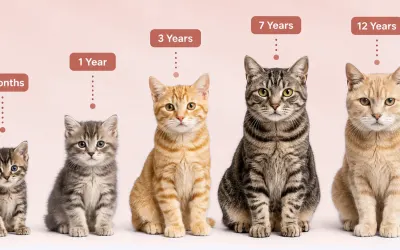
| Kitten (under 12 months) | 2.5 | About 323 kcal at 5 lb | Growing kittens can also be fed free choice. Weigh weekly. |
| Adult, neutered | 1.2 (range 1.2–1.4) | 261 kcal | The usual starting point for a pet cat. |
| Adult, intact | 1.4 (range 1.4–1.6) | 305 kcal | Intact cats burn more energy than neutered ones. |
| Inactive or obesity-prone adult | 1.0 | 218 kcal | Common for indoor cats that sleep most of the day. |
| Senior (10+ years) | Start with the adult factor | 218–305 kcal | Some seniors need less; others lose weight and need more. Unexplained weight loss needs a vet. |
| Pregnant | 1.6 rising to 2.0 | 348–435 kcal | Needs rise through pregnancy, most in the last third. |
| Nursing | 2.0 to 6.0 | 435–1,305 kcal | Depends on litter size and age of the kittens. Feed free choice; never restrict a nursing cat. |
Factors from the 2021 AAHA guidelines and the Merck Veterinary Manual. [AAHA, 2021] [Merck Veterinary Manual] If your cat is pregnant, our cat pregnancy calculator shows which week she's in, and our guide to how long cats are pregnant explains each stage.
Cat calorie calculator for weight loss
Feeding an overweight cat for its current weight keeps it at that weight. Vets instead base weight-loss feeding on the cat's ideal weight, using a lower factor of 0.8 × RER. [AAHA, 2021]
Example: a 14 lb neutered cat with a body condition score of 7 is about 20% over ideal, so its ideal weight is roughly 11.7 lb (5.3 kg).
- Maintenance at its current weight: about 336 kcal a day
- Weight-loss target, 0.8 × RER at ideal weight: about 195 kcal a day
Lose weight slowly. A cat that eats too little, or stops eating, can develop hepatic lipidosis (fatty liver disease), which is life-threatening. [Merck Veterinary Manual] A safe pace is about 0.5% to 1% of body weight a week, and no more than about 2%. [Pet Nutrition Alliance] [VCA Animal Hospitals] Plan weight loss with your vet, weigh your cat every 2 weeks, and call your vet if your cat refuses food for more than a day.
To help it work: measure every meal, count treats inside the daily total, use a puzzle feeder, and add daily play. Ask your vet about a weight-management diet, since cutting a normal food too far can leave your cat short on nutrients. In the calculator, choose "Lose weight" when your cat scores 6 or more to get this 0.8 × RER target.
How to turn calories into food portions
Find the calorie content on your food label. US labels must state it as kcal per kg and kcal per familiar measure, such as a cup or a can. [WSAVA] Then divide your cat's daily calories by that number. "kcal" on a pet food label is the same as a food "Calorie" with a capital C. [Merck Veterinary Manual]
- Dry food: 261 kcal a day ÷ 380 kcal per cup = 0.69 cups, a little over two-thirds of a standard 8 oz measuring cup. For grams: 261 ÷ 3.8 kcal per gram (3,800 kcal/kg) = 69 g. A kitchen scale is more accurate than a cup.
- Wet food: 261 kcal ÷ 170 kcal per can = about 1.5 cans a day. Can calories vary widely: in a Tufts study of weight-control foods alone, cat foods ranged from 235 to 480 kcal per cup and from 78 to 172 kcal per can. [Tufts University] Always use your own label.
- Mixed feeding: split the calories, for example half and half: 130 kcal from dry (0.34 cups at 380 kcal per cup) plus 130 kcal from wet.
- Treats: keep treats under 10% of the daily total. [WSAVA] For a 261 kcal cat, that's about 26 kcal of treats, and the meals should shrink to match.
No calories on the label? How to estimate them
If a food only shows the guaranteed analysis, you can estimate calories with the modified Atwater factors used for pet food: 3.5 kcal per gram of protein, 8.5 per gram of fat and 3.5 per gram of carbohydrate. [AAFCO]
Example dry food: protein 32%, fat 15%, fiber 3%, moisture 10%, ash about 7%. Carbohydrate = 100 − 32 − 15 − 3 − 10 − 7 = 33%. Calories per 100 g = (32 × 3.5) + (15 × 8.5) + (33 × 3.5) = 112 + 127.5 + 115.5 = about 355 kcal, or 3,550 kcal/kg.
The guaranteed analysis lists minimums and maximums, not exact values, so treat this as an estimate. The manufacturer can tell you the real figure.
How this compares with Purina, Hill's and Pet Nutrition Alliance
People often search for a "Purina cat calorie calculator" or a "Hill's calorie calculator". Pet food brands offer tools linked to their own products, and the Pet Nutrition Alliance offers a chart built for vet teams. The Pet Nutrition Alliance chart uses the same RER × factor method as the vet references here, with the same cat factors: 1.2 for neutered adults and 1.4 for intact adults. [Pet Nutrition Alliance]
This calculator works with any food, because the portion maths uses the calories from your own label. Whichever tool you use, the result is a starting point: your cat's weight and body condition over the next few weeks tell you whether it's right.
Signs you're feeding your cat too much or too little
Too much: steady weight gain, ribs getting harder to feel, a disappearing waist, a belly that sways when your cat walks, and less interest in play.
Too little: ribs, spine or hip bones becoming visible, a sharp waist, low energy and a dull or thin coat. Weight loss in a cat should never just be watched: a cat that eats too little for even a few days is at risk of hepatic lipidosis. [Cornell Feline Health Center]
What to do: weigh your cat and check body condition every 2 to 4 weeks. Change the daily amount by about 10% at a time, and see your vet if the trend doesn't correct within a month, or if weight changes when you haven't changed the food. Our cat weight checker keeps a weight log on your device.
Frequently asked questions
How many calories should a cat eat per day?
Most healthy adult indoor cats need about 200 to 300 kcal a day. Using the vet formula, a 10 lb neutered adult needs about 260 kcal. Kittens, pregnant and nursing cats need much more; inactive and overweight cats need less.
How do I calculate my cat's calorie needs?
Work out the resting energy requirement (RER = 70 × weight in kg to the power of 0.75), then multiply by a factor: 1.2 for a neutered adult, 1.4 for an intact adult, 1.0 for an inactive cat, 2.5 for a kitten, or 0.8 × the RER of the ideal weight for weight loss.
Do neutered cats need fewer calories?
Yes. Vet guidelines use 1.2 × RER for neutered adults compared with 1.4 for intact adults, about 14% fewer calories. Many cats gain weight after neutering if portions aren't adjusted.
How many calories are in a can of cat food?
It varies widely by brand, recipe and can size, so check the calorie statement on the label, which lists kcal per kg and per can. In one Tufts study of weight-control cat foods alone, cans ranged from 78 to 172 kcal.
How many calories are in a cup of dry cat food?
It varies a lot. In a Tufts study of weight-control cat foods, dry foods ranged from 235 to 480 kcal per cup. The exact figure is on your bag.
How many calories does a kitten need per day?
About 2.5 times its resting energy requirement. A 5 lb kitten needs roughly 320 kcal a day. Kittens can also be fed free choice. Weigh them weekly and move to adult portions as growth slows near 12 months.
How many calories should my cat eat to lose weight?
Vets often use 0.8 × the RER of your cat's ideal weight. For a 14 lb cat with an ideal weight near 11.7 lb, that's about 195 kcal a day. Lose weight slowly, about 0.5% to 1% of body weight a week, under vet guidance, because rapid weight loss can cause liver disease in cats.
Are kcal and calories the same on cat food?
Yes. "kcal" on a pet food label means the same as a dietary "Calorie" with a capital C on human food labels.
Can I feed my cat the same amount every day?
Yes, a consistent, measured amount is best. Recheck weight and body condition every few weeks, and adjust by about 10% if needed. Needs change with age, activity, season and neutering.
What happens if I underfeed my cat?
Your cat will lose weight and muscle, and may become lethargic with a dull coat. A cat that eats too little for even a few days can develop hepatic lipidosis, a serious liver disease. See your vet if your cat is losing weight or eating less.
Related reading
- How much should I feed my cat?
- Best food for indoor cats
- Cat pregnancy calculator
- Signs your cat is happy
Where this comes from
- Merck Veterinary Manual: Daily maintenance energy requirements for dogs and cats. The cat factors: neutered 1.2, intact 1.4, obesity-prone 1.0 and kittens 2.5 × RER.
- Merck Veterinary Manual: Nutritional requirements of small animals. The RER formula, and kcal as the dietary Calorie.
- AAHA: 2021 Nutrition and Weight Management Guidelines for Dogs and Cats, energy requirement calculations. Life-stage factors for cats, including weight loss, pregnancy and nursing, and the 10% rule per body condition point.
- Pet Nutrition Alliance: MER and RER factors. The same RER × factor method, and how much individual cats can vary.
- Pet Nutrition Alliance: Calorie calculator. A healthy weight-loss rate for cats.
- VCA Animal Hospitals: Tips for successful weight loss in dogs and cats. Weekly weight-loss guideline.
- WSAVA: Body condition score chart for cats. The 9-point scale, based on Laflamme (1997).
- WSAVA: Feeding treats to your cat. Keeping treats under 10% of daily calories.
- WSAVA: Interpreting pet food labels. How calorie content appears on a label.
- AAFCO: Calorie content. The modified Atwater factors for estimating calories.
- Tufts University: Wide variation in calorie content among low-calorie pet foods. How much calorie density varies between foods.
- Merck Veterinary Manual: Feline hepatic lipidosis. Why food deprivation is dangerous for overweight cats.
- Cornell Feline Health Center: Feeding your cat. Working with your vet on an ideal body weight.
- Cornell Feline Health Center: Obesity. The risk of sudden starvation diets.
 By Ahsan Nawaz
Published Updated
This is general information, not veterinary advice. A calculator can't examine your cat. If your cat is a kitten, pregnant, nursing, overweight, losing weight or unwell, talk to your vet.