How Much Should I Feed My Cat? A Feeding Guide

On this page
The feeding guide on the back of the bag is written for an average cat, at an average activity level, eating that exact food. Your cat is not that cat, and the company printing the guide is also selling the food, which is not a reason to distrust every bag but is a reason to treat the number as a starting point rather than an instruction.
Working it out properly takes about the same effort as reading the bag anyway. Here is how.
This guide is written from published veterinary sources, named and linked as they come up and listed again at the bottom. It is a starting point for your own cat, not a substitute for a vet who has actually weighed and examined them.
How much does my cat actually need?
Vets calculate a baseline called resting energy requirement, or RER, from body weight, then adjust it for life stage and activity. The formula looks more technical than it is: 70 times your cat's weight in kilograms, raised to the power of 0.75, the exponential formula set out in the Merck Veterinary Manual. That number is roughly what a cat burns doing nothing at all.
A typical neutered, moderately active indoor adult needs somewhere around 1.2 times that baseline. A kitten, a pregnant or nursing cat, or a very active cat needs more; a cat who needs to lose weight needs less, ideally worked out with a vet rather than guessed at. If you are not sure which category your own cat falls into, our cat weight checker scores body condition and estimates where they actually stand before you start adjusting portions.
Rather than doing that arithmetic by hand, our cat calorie calculator runs the full formula for you, factoring in life stage, activity, indoor or outdoor living and body condition, then converts the result into cups, cans or grams for the food you actually feed.

At a glance, here is roughly what that works out to by weight, for a typical neutered adult cat:
| Body weight | Roughly per day |
|---|---|
| 6 lb (2.7 kg) | About 175 kcal |
| 8 lb (3.6 kg) | About 220 kcal |
| 10 lb (4.5 kg) | About 260 kcal |
| 12 lb (5.4 kg) | About 300 kcal |
| 15 lb (6.8 kg) | About 355 kcal |
Treat this as a starting range, not a target. An indoor cat who sleeps most of the day needs less than these figures; a young, active cat needs more. Check the calorie content on your specific food's label to convert this into an actual amount to serve.
Does it matter if I feed wet or dry food?
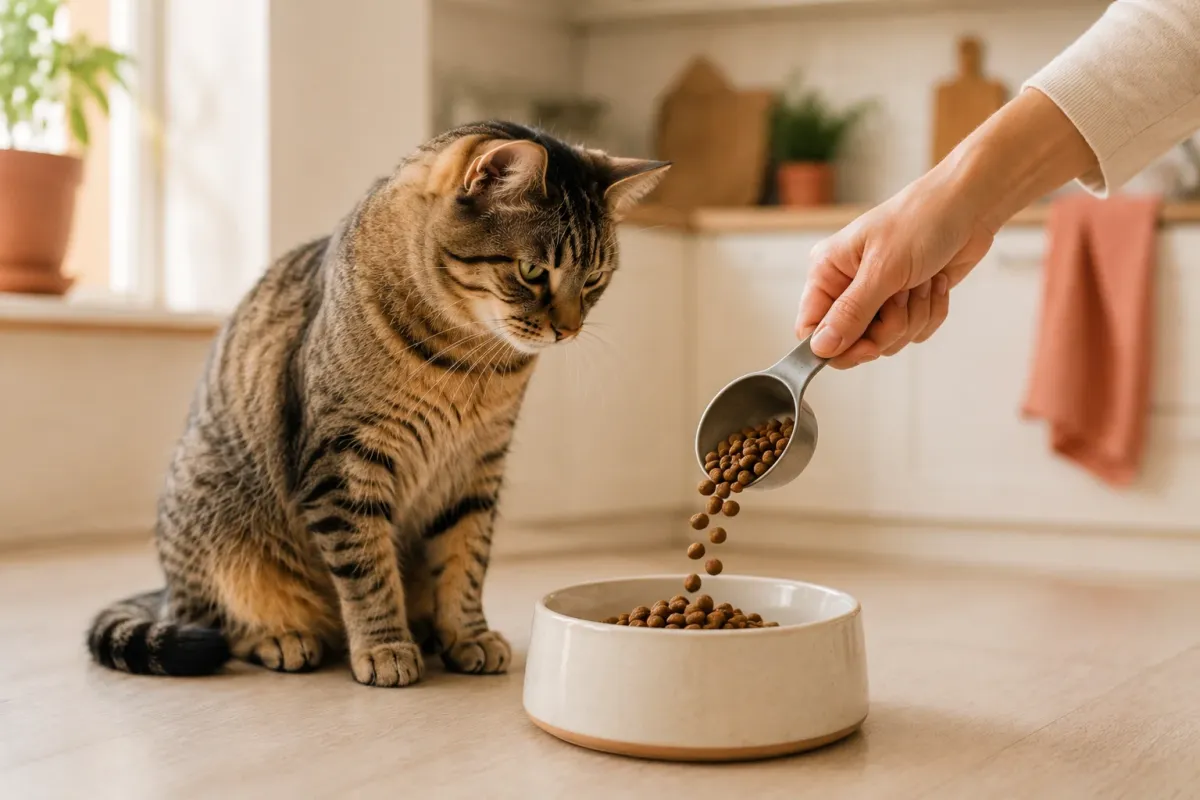
Both can be nutritionally complete, and neither is automatically better, but they are not interchangeable cup for cup. Dry food is only 6 to 10 percent water, while canned food is at least 75 percent, according to the Cornell Feline Health Center. The same volume of each is nowhere near the same number of calories, which is why measuring by weight or by the calorie count on the label matters more than measuring by the cup.
Some owners feed a mix of both, which is fine as long as the calories from each are added together rather than treated as two separate full portions. Whichever you choose, a complete and balanced formula appropriate to your cat's life stage is the part that actually matters.
If your cat spends all or most of their time indoors, our guide to the best food for indoor cats goes into what actually differs about their needs versus what the label promises.
How many meals a day should my cat eat?
Two measured meals a day is the most commonly recommended pattern, and it tends to avoid the slow weight gain that comes with leaving dry food out all day for a cat to graze on whenever they like. Cats are natural grazers by instinct, so splitting the same daily total across three or four smaller meals is also fine if it suits your schedule better. What matters is the total across the day, not how it is divided.
Feeding a kitten
Kittens need meaningfully more calories per pound than adults because they are growing, along with a kitten-specific formula that carries more protein and calories than an adult diet. Smaller, more frequent meals suit them better than two large ones, since a kitten's stomach is small and growing is demanding work.
Most cats can move onto adult food around twelve months old. If you are not sure exactly where yours is in that stretch, our cat age calculator converts an age into human years and the life stage that determines how they should be eating.
Feeding a senior cat
Older cats often need fewer calories as they become less active, but that is not universal: some senior cats lose weight and need more, particularly if an underlying condition like kidney disease or an overactive thyroid is involved. Weight change in either direction in a senior cat is worth mentioning to a vet rather than adjusting food alone, since the cause matters as much as the fix.
My cat is overweight. How do I feed them less safely?
Gradually, and ideally with a vet setting the target. Cutting a cat's food too fast is not just unkind, it carries a genuine medical risk: if an overweight cat's calorie intake drops sharply and they do not eat enough for even a few days, their body can develop a serious liver condition called hepatic lipidosis. This is one of the few situations in routine cat care where the cautious, slower approach is also the medically correct one.
A safe rate of weight loss is usually around one to two percent of body weight a week, the pace a Cornell nutritionist recommends to avoid hepatic lipidosis, worked out from a target weight a vet sets based on body condition rather than a number you pick yourself.

How do I know if I'm feeding the right amount?
Body condition tells you more than the scale on its own. Run your hands along your cat's sides: you should be able to feel their ribs under a light layer of fat without pressing hard, and see a waist when you look down at them from above. That three-step check, ribs, side profile and a view from above, is the body condition scoring Cornell describes, and the WSAVA publishes free charts for it. Weigh your cat every few weeks if you can. Gradual, unexplained weight change in either direction, more than the food amount alone, is the signal that something is worth adjusting or mentioning to a vet.
Weight and appetite are also two of the more telling early signs something is wrong more broadly; our guide to the early signs a cat is sick covers how appetite and weight changes fit alongside the wider pattern.
What about treats?
Fine in moderation. The usual guidance is to keep treats under about 10 to 15 percent of daily calories, the Cornell Feline Health Center's rule of thumb, and to count them as part of the day's total rather than adding them on top of a full meal plan. Treats are one of the most common quiet causes of gradual, easy-to-miss weight gain, precisely because each one feels too small to matter. Plain cooked chicken is a common choice; our guide to feeding cats chicken covers how to do it safely.
Frequently asked questions
Why is the feeding guide on the bag not accurate?
It is written for an average cat at an average activity level, and your cat is not an average. It is also written by the brand selling the food, and a generous guide sells more of it. Treat the number on the bag as a starting point to weigh against your cat's actual body condition, not a target.
How many calories does my cat actually need?
A common starting point is around 20 calories per pound of body weight for an average neutered adult indoor cat, though the more precise version vets use is a formula based on weight, adjusted up for kittens and pregnant or nursing cats, and down for weight loss. It is a starting point either way, not a fixed number.
Should I feed my cat wet food or dry food?
Both can be nutritionally complete; they are not interchangeable cup for cup. Wet food is roughly 75 to 80 percent water, dry food closer to 10 percent, so the same volume is not the same number of calories. What matters is total calories and a complete, balanced formula, not which texture you choose.
How many times a day should I feed my cat?
Two measured meals a day is the most commonly recommended pattern, and it tends to prevent the weight gain that free-feeding dry food, available all day, often causes. Kittens need more frequent, smaller meals; some adult cats do fine on three or four if that suits your schedule better.
My cat is overweight. How do I safely feed them less?
Gradually, and ideally with a vet involved. Cutting calories too fast in an overweight cat can cause a serious liver condition called hepatic lipidosis if the cat does not eat enough during the transition. A vet can set a target weight and a safe rate of loss, which is usually only around one to two percent of body weight a week.
How do I know if I am feeding the right amount?
Body condition, not the scale alone. You should be able to feel your cat's ribs under a light layer of fat without pressing hard, and see a waist when looking down at them. Weigh your cat every few weeks: gradual, unexplained weight change in either direction is the signal to adjust the amount or see a vet.
Are treats okay, and how many can I give?
Yes, in moderation. The common guidance is to keep treats under about ten percent of daily calories and subtract them from the day's food rather than adding them on top. Treats are one of the most common quiet causes of slow, unnoticed weight gain.
Does a kitten need to eat differently from an adult cat?
Yes, meaningfully. Kittens need more calories per pound than adults because they are growing, along with a kitten-specific formula higher in protein and certain nutrients, and more frequent small meals rather than two large ones. Most cats can transition to adult food around twelve months.
Sources
- Merck Veterinary Manual: Nutritional Requirements of Small Animals The resting energy requirement formula and how it is adjusted.
- Cornell Feline Health Center: Feeding Your Cat Water content of dry and canned food, and the rule of thumb for treats.
- Cornell Feline Health Center: Obesity Body condition scoring, and safe weight loss of one to two percent a week.
- WSAVA Global Nutrition Guidelines Body condition score charts and calorie needs for healthy adult cats.
General information, not veterinary advice. If your cat's behavior has changed suddenly, speak to a vet rather than an article.
How this guide was researched and checked is set out in how our guides are written.

Want an answer in seconds?
The calculators handle age, due dates and portions without an account.