
Cat Weight Checker
Is your cat at a healthy weight?
Score your cat's body condition, see an estimated ideal weight range, and get a cautious food adjustment if one is needed. Log weight over time and watch the trend, right in your browser.
- Vet-style scoring
- Free weight log and chart
- Nothing leaves your browser
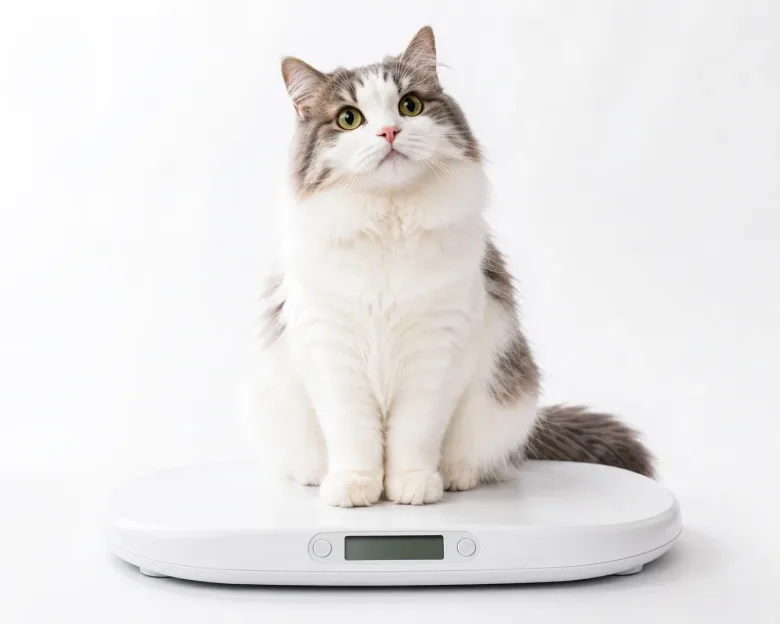
Check your cat's weight
Not sure what your cat weighs? See how to weigh your cat at home.
Your cat's results will appear here
Fill in the weight and body condition, then check.
Body condition
Estimated ideal weight
–
An estimate from weight and body condition together, not a diagnosis. A vet visit gives the precise number.
Unexplained weight change in a senior cat is worth a vet visit before a diet change. It's as often a symptom as it is overfeeding. See our senior cat care guide.
Weight log
Saved only in this browser, nothing is sent anywhere. Log a weight above, or add one directly below.
No entries yet
Log at least two weights to see a trend line here.
Nothing logged yet.
On this page: How the checker works, how to weigh your cat, body condition score, healthy weight, why weight matters, an overweight cat, an underweight cat, the weight log, questions and sources.
How the cat weight checker works
The cat weight checker estimates whether your cat is at a healthy weight by combining two things: the number on the scale and a hands-on body condition score. You enter your cat's current weight and, if you like, its age, then pick the description that best matches how your cat feels and looks. The checker shows the body condition score, an estimated ideal weight range and, if your cat is above or below ideal, a cautious change to daily food.
Body condition matters more than weight on its own, because a healthy weight depends on frame size. A 12-pound cat can be lean and a 10-pound cat can be overweight. That is why vets score body condition by touch and by eye and treat the scale as one input, and why this tool asks for both.
How the estimate is worked out
Each score is turned into an approximate distance from ideal weight: about 22 percent below ideal for underweight, 9 percent below for lean, ideal for ideal, 17 percent above for overweight and 30 percent above for obese. Your ideal range is your cat's current weight adjusted by that amount, shown as a range of plus or minus five percent. For food, the checker starts from a typical maintenance estimate for an adult cat, which is the resting energy requirement multiplied by 1.4, and suggests about 20 percent less for an overweight or obese cat or about 20 percent more for a lean or underweight one. These are rules of thumb, not measurements, which is why the result is a range and should always be checked against a vet's exam. The cat calorie calculator gives a fuller daily target.
Who it is for
The checker is designed for healthy adult cats. It is not meant for kittens, which are still growing, or for pregnant or nursing cats, whose weight is expected to change. A cat with a medical condition, or one on a diet prescribed by a vet, should follow the vet's plan instead. Nothing here is a diagnosis.
Your data
Everything runs in your browser. The weight log is stored on your own device, nothing is sent to us, and there is no account. Clearing your browser data clears the log.
How to weigh your cat at home
A real number matters here. A pound of error changes the ideal range the checker shows, so it is worth getting a proper weight before you start. There are three ways to do it.
- The hold-and-subtract method. Weigh yourself alone on a bathroom scale, then weigh yourself holding your cat. Subtract the first number from the second. Works with any household scale, though it rounds to whatever precision your scale offers, which matters more for a small cat or kitten.
- Carrier or box method. Place an empty carrier or box on a kitchen or baby scale and tare it to zero, then put your cat inside. More precise than the hold method, especially for kittens and cats under about 8lb (3.6kg).
- Ask your vet's office. Most veterinary clinics will let you bring a cat in to use their scale for free, no appointment needed. It is the most accurate option, and worth doing at least once to check your home method against.
Whichever method you use, use it the same way each time. Weigh at a similar time of day on the same scale, because a change in method can look like a change in your cat. Write the number down, or add it to the weight log above so it is there next time.
How to score your cat's body condition
Vets use a body condition score, or BCS, to judge whether a cat carries too little, too much or about the right amount of body fat. Most clinics use a nine-point scale, such as the one in the WSAVA Global Nutrition Guidelines. This tool uses a simplified five-point version so it is quick to use at home. Cornell Feline Health Center describes the same three checks used below: across the ribs, from the side and from above.
Three checks, in this order
- Feel the ribs. With your cat standing and relaxed, run your palms lightly along both sides of the ribcage. In a cat at a healthy weight you can feel the ribs easily under a thin layer of fat. If you have to press to find them, there is likely extra fat cover. A thick coat can hide a lot, so rely on touch before sight.
- Look from above. Stand over your cat while it is standing. A healthy cat has a visible waist behind the ribs. In an overweight cat the waist is barely visible or gone.
- Look from the side. A healthy cat has a small tuck where the belly meets the hind legs. A belly that hangs or sags points to extra weight. A loose flap of skin under the belly, sometimes called a primordial pouch, is normal in many cats and is not the same as fat.
Check while your cat is calm and standing normally. A curled or stretched posture can make a lean cat look rounder, or a heavy one look thinner, than it is.
What each score looks like
- 1, Underweight: Ribs, spine and hip bones are visible from across the room, with no fat cover felt over them. An obvious waist and abdominal tuck are visible from above and the side.
- 2, Lean: Ribs are easily felt with only a thin layer over them, and are sometimes visible. A clear waist is visible from above, behind the ribs.
- 3, Ideal: Ribs are easily felt with a slight fat cover, not visible. A visible waist is behind the ribs, and a small tucked-up abdomen is present.
- 4, Overweight: Ribs are difficult to feel under a moderate fat cover. The waist is barely visible or absent from above, and the abdomen may sag slightly.
- 5, Obese: Ribs cannot be felt under a heavy fat cover. There is no waist, and a prominent, rounded abdomen with a heavy fat pad hangs underneath.
If your cat sits between two descriptions, choose the closer one. If you are not sure, ask your vet to score your cat at the next visit and use that as your starting point.
What is a healthy weight for a cat?
There is no single healthy weight for cats. Frame size and build both matter, which is why the same number can be right for one cat and too much for another. Cornell Feline Health Center defines obesity in cats as body weight that is 20 percent or more above normal weight. The checker's overweight and obese descriptions sit at roughly 17 and 30 percent above ideal.
Extra weight is common. The Association for Pet Obesity Prevention's 2022 U.S. survey found 61 percent of cats were overweight or had obesity. In its 2024 survey of pet owners, 33 percent of cat owners described their own cat that way. The two surveys asked different groups, so they are not a like-for-like comparison, but the gap suggests that extra weight is easy to miss at home. Your cat's age also changes how weight is read, and the cat age calculator shows which life stage yours is in.
Why your cat's weight matters
Extra weight is not only cosmetic. Cornell Feline Health Center links obesity in cats to osteoarthritis, hip dysplasia and diabetes mellitus, and to extra strain on the heart and blood vessels. Keeping a cat at a healthy weight is one of the most practical things an owner can do for its long-term health.
The reverse matters as well. A cat that is losing weight without being on a diet is a different situation from one that is simply lean, and it can point to illness. Both cases are covered below.
If your cat is overweight
Talk to your vet first. A vet can confirm the score, rule out medical causes and set a target and a food plan, which matters most for a cat with diabetes, kidney disease or arthritis.
The goal is slow loss. Cornell Feline Health Center describes a gradual loss of roughly one to two percent of body weight per week, and the checker keeps its advice at or below one to one and a half percent. For a 14-pound cat, one percent is about two ounces a week.
Do not fast an overweight cat or cut its food sharply. A cat that stops eating is at risk of hepatic lipidosis, or fatty liver disease, in which the liver becomes overloaded with fat. VCA Animal Hospitals notes the risk is greater in cats that were overweight or obese before they stopped eating, and Cornell warns against sudden starvation diets for the same reason. If a cat on a diet stops eating, call your vet the same day rather than waiting.
Day to day, measure food rather than estimating it, and count treats, which are generally kept to about ten percent of daily calories. Our feeding guide covers portions and label reading, the guide to food for indoor cats covers what to look for when a cat is prone to gaining weight, and the treats and snacks guide shows how quickly extras add up.
If your cat is underweight or losing weight
Some cats are simply lean by build, but unexplained weight loss deserves attention. VCA Animal Hospitals describes weight loss despite an increased appetite as the most common sign of hyperthyroidism, a condition that typically affects middle-aged and older cats, with an average age around 12. PetMD lists diabetes, kidney disease and cancer among the other causes, alongside intestinal parasites and simply not getting enough food.
Because of this, the checker treats weight loss in a cat aged ten or over as something to raise with a vet rather than a feeding question. Call your vet if your cat loses weight without a diet, eats noticeably less, drinks or urinates more, or seems unwell. Our guide to the signs a cat is sick and the senior cat care guide cover what else to watch for.
Using the weight log
A cat's weight moves by a few ounces from day to day with food and water, so a single reading tells you less than the trend. Logging about once a month is usually enough to see a real change on the chart. If your vet has put your cat on a diet, follow the schedule they give you.
The Download PDF button turns your current result, and any logged weights, into a one-page summary you can bring to a vet visit. It is a way to start the conversation, not a diagnosis or a substitute for the exam. If you are also keeping vaccine records for the same visit, the cat vaccination tracker keeps them in one place.
Frequently asked questions
How do I weigh my cat at home without a pet scale?
Weigh yourself alone on a bathroom scale, then weigh yourself holding your cat, and subtract the difference. For a more precise number, especially for a kitten or a cat under about 8 pounds, put an empty carrier or box on a kitchen or baby scale, set it to zero, then place your cat inside. A free weigh-in at your vet's office is the most accurate option.
What is a body condition score (BCS) for cats?
BCS is a hands-on scale vets use to judge whether a cat carries too little, too much or about the right amount of body fat, based on how easily you can feel the ribs, whether a waist is visible from above and the shape of the belly from the side. Many clinics use a nine-point scale; this tool uses a simplified five-point version. It matters more than weight alone, since a healthy weight for one cat's frame can be overweight for another.
How can I tell if my cat is overweight?
Run your hands along both sides of the ribs. If you cannot feel them easily under a moderate layer of fat, and there is little or no visible waist when you look down at your cat from above, your cat is likely carrying extra weight. A belly that hangs or sags is a sign of more excess, though a loose flap of skin under the belly is normal in many cats and is not the same thing as fat.
What is the ideal weight for a cat?
There is no single number. Ideal weight depends on frame size and build as much as on species, so the same weight can be right for one cat and too much for another. The better question is body condition. This tool estimates an ideal range from your cat's current weight and body condition score together, and shows it as a range rather than a single figure. Your vet can give you an exact target.
How much weight should a cat lose per week?
Slowly. Cornell Feline Health Center describes a gradual loss of roughly one to two percent of body weight per week as the goal, and warns against sudden starvation diets. This tool keeps its advice at or below one to one and a half percent. Cats that lose weight too fast, or stop eating, are at risk of hepatic lipidosis, a serious liver condition, so a weight-loss plan for a cat should be agreed with a vet.
Can I put my overweight cat on a diet myself?
Talk to your vet first. A vet can confirm the body condition score, rule out medical causes for the weight, and set a target and a food plan, which matters most if your cat has diabetes, kidney disease or arthritis. Never fast a cat or cut its food sharply, and call your vet the same day if a cat on a diet stops eating.
Why is my senior cat losing weight?
In an older cat, unexplained weight loss is taken more seriously than in a younger one, because it is often a symptom of an underlying condition rather than simply eating less. VCA Animal Hospitals describes weight loss despite a good appetite as the most common sign of hyperthyroidism, which typically affects middle-aged and older cats. Diabetes, kidney disease and cancer are other possible causes. It is worth a vet visit rather than a diet change.
How often should I weigh my cat?
About once a month is enough for most cats to show a real trend. A cat's weight moves by a few ounces from day to day with food and water, so daily weighing mostly records noise. If your vet has put your cat on a weight-loss or weight-gain plan, follow the schedule they give you.
Can I use this tool for a kitten, or for a pregnant or nursing cat?
It is designed for healthy adult cats. A kitten is still growing, so its weight is not compared with an adult ideal, and a pregnant or nursing cat is expected to change weight. For those cats, and for any cat with a medical condition or a vet-prescribed diet, follow your vet's advice instead.
How common is overweight in cats?
Very common. The Association for Pet Obesity Prevention's 2022 U.S. prevalence survey found 61 percent of cats were overweight or had obesity. In its 2024 survey of pet owners, 33 percent of cat owners described their own cat that way. The two surveys asked different groups, so they are not a like-for-like comparison, but the gap suggests that extra weight is easy to miss at home.
How does this tool work out the ideal weight and the food change?
Each body condition score is turned into an approximate distance from ideal weight: about 22 percent below ideal for underweight, 9 percent below for lean, ideal for ideal, 17 percent above for overweight and 30 percent above for obese. The ideal range is your cat's current weight adjusted by that amount, shown as plus or minus five percent. The food suggestion starts from a typical maintenance estimate for an adult cat and changes it by about 20 percent up or down. These are rules of thumb, not measurements.
Does this tool store my cat's weight anywhere?
No. Every entry in the weight log is saved only in your own browser's local storage, on your device. Nothing is sent to a server, there is no account, and clearing your browser data clears the log too.
Related tools and guides
- Cat Calorie Calculator: A full daily calorie target once you know where your cat stands.
- Cat Age Calculator: Puts your cat's age into human years and a life stage, which changes how weight is read.
- Cat Vaccination Tracker: Keep vaccine records in one place for the same vet visit that weighs your cat.
- Cat Pregnancy Calculator: A pregnant cat is expected to gain weight, so use this for her due date and timeline rather than the weight checker.
- How Much Should I Feed My Cat?: Portions, meal timing and how to read a food label.
- Best Food for Indoor Cats: What to look for when an indoor cat is prone to gaining weight.
- Senior Cat Care: Why weight changes get extra attention after age ten.
- Signs Your Cat Is Sick: What else to watch for besides the number on the scale.
- Treats and snacks food guide: How much extra is too much, since treats count toward daily calories.
- All food guides: What cats can and cannot eat, with the verdict first.
Sources
- Cornell Feline Health Center: obesity: How feline obesity is defined, the conditions linked to it, how to check a cat by hand and by eye, and why weight loss should be gradual.
- VCA Animal Hospitals: hepatic lipidosis (fatty liver) in cats: Why a cat that stops eating, especially an overweight one, is at risk of fatty liver disease.
- VCA Animal Hospitals: hyperthyroidism in cats: Weight loss despite a good appetite as the most common sign, and the typical age of affected cats.
- PetMD: why is my cat losing weight?: Common medical causes of weight loss in cats, including in older cats, and when to call a vet.
- WSAVA Global Nutrition Guidelines: body condition score: The nine-point body condition scoring framework this tool's five-point scale is simplified from.
- AAHA: 2021 Nutrition and Weight Management Guidelines for Dogs and Cats: Veterinary guidance on assessing body condition and managing weight, published in the Journal of the American Animal Hospital Association.
- Association for Pet Obesity Prevention: pet obesity survey results: The 2022 U.S. pet obesity prevalence survey, including the share of cats found overweight or with obesity.
- Association for Pet Obesity Prevention: 2024 pet obesity and nutrition survey summary: How many cat owners described their own cat as overweight.
This tool and page give general information and an estimate. They are not veterinary advice and do not replace an examination. If you are worried about your cat's weight, talk to your vet.
 By Ahsan Nawaz
Published Updated
More Tools You Will Love
View all tools
Cat Pregnancy Calculator
Work out your cat’s due date and follow the pregnancy week by week.
Open tool
Cat Age Calculator
Turn your cat’s age into human years, using the life-stage curve vets actually use.
Open tool
Cat Calorie Calculator
Work out how much to feed each day from weight, life stage, activity and body condition.
Open tool