
Cat Vaccination Tracker
Enter your cat's birth date and lifestyle, tell us what they have already had, and get a complete FVRCP, rabies and FeLV schedule with next due dates, plus a record you can print or save.
- AAFP & WSAVA guidelines
- Free, no sign-up
- Runs in your browser
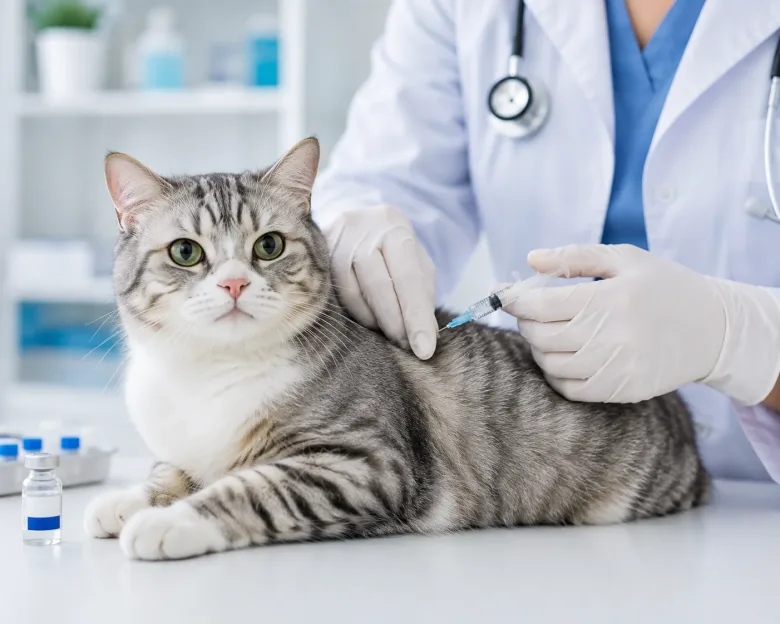
Vaccination Tracker
Your cat's profile
Nothing is sent anywhere. This runs entirely in your browser.
Used to estimate a birth date for scheduling. It is a starting point, not a diagnosis.
Vaccination history
Mark what your cat has already had. Not sure? Choose "Due / unknown".
How this works
- 1 Your cat's profile Age, living situation and household, so we know which vaccines actually apply.
- 2 Vaccination history Mark what has already been given. Not sure about one? Leave it as due.
- 3 Full record A color-coded schedule, suggested visits, and a card you can print or save.
AAFP 2020 & WSAVA 2024 Every schedule and interval on this page traces back to a named source, listed in full below the tool.
Why FeLV and Bordetella appear or don't
FVRCP and rabies show for every cat: they are core vaccines under AAFP guidance. FeLV, Bordetella and Chlamydophila only show up when they apply to your cat, based on age, whether they go outside, and the household you described in step 1.
Cat Vaccination Schedule: Complete Guide
Feline vaccines split into two groups. Core vaccines, FVRCP and rabies, are recommended for every cat regardless of lifestyle, because the diseases they prevent are common, severe, or a legal requirement. Lifestyle (non-core) vaccines, like FeLV, Bordetella and Chlamydophila, are recommended based on a cat's actual risk: whether they go outside, live with other cats, or are boarded regularly.
That split, and the schedules below, follow the 2020 AAFP Feline Vaccination Advisory Panel report, the most recent comprehensive US guideline on feline vaccination.
Kitten Vaccination Schedule (Week by Week)
| Age | Vaccine | Notes |
|---|---|---|
| 6 to 8 weeks | FVRCP (dose 1) | First core vaccine |
| 10 to 12 weeks | FVRCP (dose 2), FeLV (dose 1) | FeLV if outdoor, multi-cat, or simply as a kitten-core vaccine |
| 14 to 16 weeks | FVRCP (dose 3), FeLV (dose 2) | Third FVRCP dose is standard for kittens |
| 12 to 16 weeks | Rabies | Legally required in most US states |
| 1 year | FVRCP booster, rabies booster, FeLV booster | Closes out the kitten series |
| Ongoing | Per adult schedule | FVRCP every 3 years, rabies per local law, FeLV annually if at risk |
Kittens get a series rather than one shot because of maternal antibody interference. A nursing kitten carries antibodies from their mother that fade at an unpredictable rate, anywhere from 6 to 16 weeks old. While those antibodies are still present, they can neutralize a vaccine before it has a chance to work, without actually protecting the kitten for long. Spacing doses every three to four weeks through that window means at least one dose lands after maternal antibodies have faded enough to let it work.
Sources: 2020 AAFP Feline Vaccination Advisory Panel Report, Cornell Feline Health Center.
Adult Cat Vaccination Schedule
| Vaccine | Frequency | Notes |
|---|---|---|
| FVRCP | Every 3 years | After the kitten series and a 1-year booster |
| Rabies | Every 1 to 3 years | Set by the product used and by state law, not by preference |
| FeLV | Annually if at risk | Outdoor access, multi-cat household, or an FeLV-positive housemate |
| Bordetella | Annually | Cats boarded or groomed regularly |
| Chlamydophila | Annually | Multi-cat households with a history of outbreaks |
Cats with an unknown vaccination history are treated as unprotected. The standard approach under AAHA/AAFP guidance is two FVRCP doses three to four weeks apart, plus a rabies dose, then the normal adult cycle from there, rather than assuming an unknown past means a cat is already covered.
Indoor vs Outdoor Cats: Which Vaccines Do They Need?
| Vaccine | Indoor only | Outdoor / indoor+outdoor |
|---|---|---|
| FVRCP | Required | Required |
| Rabies | Required (law) | Required (law) |
| FeLV | Optional after age 1 | Strongly recommended, annually |
| Bordetella | Boarding only | Recommended |
Indoor cats still need the core vaccines because the diseases they prevent do not require a trip outdoors. FVRCP-related viruses spread through airborne droplets and shared surfaces, and a carrier walking in on shoes or clothing is a real if uncommon route. Rabies exposure most often comes from a bat getting into a home, and an indoor cat that slips out an open door or window even once is exposed to the same risk as one that lives outside.
Sources: 2020 AAFP Feline Vaccination Advisory Panel Report, WSAVA Vaccination Guidelines.
Core Vaccines Explained: FVRCP, Rabies, FeLV
FVRCP: What It Covers
FVRCP is a combination vaccine against three separate pathogens. FHV-1 (feline herpesvirus, rhinotracheitis) causes upper respiratory infection and can lead to lifelong intermittent flare-ups. FCV (calicivirus) causes oral ulcers and respiratory signs, and some strains are severe. FPV (panleukopenia, feline distemper) is the most dangerous of the three: unvaccinated kittens that catch it have a reported mortality rate above 90%. The kitten series plus a booster at one year, then every three years in adulthood, is the standard protection against all three. Common non-adjuvanted options include Nobivac and Purevax.
Rabies
Rabies vaccination is a legal requirement in most US states, even for cats that never go outdoors, because rabies is fatal once symptoms appear and is transmissible to people. Products come in 1-year and 3-year formulations, and which one your vet uses, plus what your state or county requires, decides the actual interval; the product label does not automatically override local law.
FeLV (Feline Leukemia Virus)
FeLV suppresses the immune system and is spread through close, sustained contact: mutual grooming, shared food and water bowls, or bite wounds. The 2020 AAFP guidelines classify it as core for every kitten under a year old, since a kitten's future lifestyle and exposure risk are hard to predict early on. For adults, it becomes a lifestyle vaccine, recommended for cats with outdoor access or multi-cat households, and it is often skipped for cats confirmed strictly indoor and single-cat. A cat should be tested with a combination FeLV/FIV test (commonly the SNAP test) before their first dose.
Non-Core (Lifestyle) Vaccines
| Vaccine | Who needs it | Schedule |
|---|---|---|
| Bordetella | Boarding, multi-cat households | Annual, intranasal |
| Chlamydophila | Multi-cat households with outbreak history | Annual |
| FIV | High-risk outdoor, unneutered males | 3-dose series, less commonly used now |
| FIP | Generally not recommended | Low demonstrated efficacy |
Injection Site Safety: The 3-2-3 Rule
Feline injection-site sarcoma (FISS) is a rare but serious tumor that can develop at a vaccination site, historically linked to inflammation from older adjuvanted vaccines. Modern non-adjuvanted vaccines have measurably lowered the risk, and the risk that remains is still far smaller than the risk of the diseases these vaccines prevent, which is why the guidance below is about monitoring, not skipping vaccination.
AAFP-recommended injection sites, standardized so a reaction can be traced to the vaccine that caused it:
- FVRCP: Right shoulder, above the elbow.
- Rabies: Right hind leg, below the knee.
- FeLV: Left hind leg, below the knee.
The 3-2-3 rule, from the Vaccine-Associated Feline Sarcoma Task Force, flags a lump at an injection site for biopsy if any of these are true: it is still there 3 months after the injection, it is 2 centimeters or larger, or it is still growing 3 months after the injection. A lump that shrinks and disappears within a few weeks is a normal, common reaction and not a 3-2-3 concern.
A lump present after 3 months, 2cm or larger, or still growing at 3 months: call your vet.
Source: AAFP/VAFSTF Vaccine-Associated Feline Sarcoma Guidelines.
How to Keep Cat Vaccination Records
A complete record notes the vaccine name, manufacturer, lot number, injection site, date given, and the vet or clinic that gave it. That level of detail matters more than it seems: a boarding facility or groomer will often ask for proof, a border crossing or airline can require it, cat shows have their own entry requirements, and a new vet meeting your cat for the first time works faster and safer with real history instead of "I think they're up to date."
The tracker above builds this record as you go, and its printable card includes blank fields for the lot number and vet name your own vet will fill in at each visit. Keeping a paper copy in addition to whatever your vet's system stores is worth doing: clinic records do not always follow a cat that changes vets or moves.
Frequently Asked Questions
When do kittens get their first shots?
The first FVRCP dose is usually given around 6 to 8 weeks old, with two more doses spaced three weeks apart after that. Rabies is typically added around 12 to 16 weeks, depending on the product and local law. Kittens need the full series rather than one shot because antibodies from their mother can block a single early dose from working, without necessarily protecting the kitten themselves.
Do indoor cats need vaccinations?
Yes. Both FVRCP and rabies are core vaccines recommended for every cat regardless of lifestyle, and rabies is a legal requirement in most US states even for cats that never go outside. Airborne virus, a cat slipping out an open door, or exposure carried in on shoes or clothing are all real routes, and the AAFP guidelines do not exempt strictly indoor cats from the core vaccines.
How often does an adult cat need FVRCP?
After the kitten series and a one-year booster, most healthy adult cats move to an FVRCP booster every three years. That interval assumes an otherwise-standard course was completed; a cat with an unknown or incomplete history is usually restarted with two doses three to four weeks apart before settling into the same three-year cycle.
What is FeLV and does my cat need it?
Feline leukemia virus is a contagious virus that suppresses the immune system and is spread mainly through close, prolonged contact such as mutual grooming, shared bowls, or bite wounds. The AAFP classifies it as core for every kitten under a year old, since exposure risk is hard to predict that early, and as a lifestyle vaccine for adults, recommended if a cat goes outdoors, lives with other cats, or shares a home with an FeLV-positive cat.
Is rabies vaccine required for indoor cats?
In most US states, yes, by law, regardless of whether a cat goes outside. Rabies is fatal once symptoms appear and is transmissible to people, which is why it is regulated more strictly than any other feline vaccine. Requirements and booster intervals are set at the state or local level, so checking with a local vet is the only way to know the exact rule where you live.
What happens if my cat missed a booster?
A booster given late does not usually mean starting the whole series over for an adult cat; most vets simply give the booster and resume the normal schedule from that date. For a kitten series interrupted partway through, a vet will typically pick up where it left off rather than restart it, though a long enough gap can change that judgment. Either way, a missed booster is worth a call to the vet rather than a guess.
Can I vaccinate my cat at home?
Core vaccines like rabies generally have to be given by, or under the supervision of, a licensed veterinarian for the vaccination to count as legally valid, and a vet visit is also when a cat gets examined for anything a vaccine reaction could complicate. Some non-core vaccines are sold for lay administration, but skipping the exam that comes with a vet visit trades a small convenience for a real gap in what gets caught early.
How much does a cat vaccination cost?
In the US, individual core vaccines typically run somewhere between 20 and 60 dollars each at a standard vet clinic, with low-cost clinics and shelters often charging less. A full kitten series across several visits, combined with an exam fee each time, commonly totals a few hundred dollars over the first year. Cost varies a lot by region and clinic, so a local quote is the only reliable number.
What are signs of a vaccine reaction in cats?
Mild, short-lived soreness at the injection site, a slight fever, or a day of low energy are common and not usually a concern. Facial swelling, hives, vomiting, difficulty breathing, or collapse within minutes to hours of a vaccine are signs of a more serious allergic reaction and need urgent veterinary care. A firm lump at the injection site that lasts more than three months, or that grows, is a separate and rarer concern covered by the 3-2-3 rule.
What is the 3-2-3 rule for injection-site sarcoma?
It is a guideline from the Vaccine-Associated Feline Sarcoma Task Force for deciding when a lump at an injection site needs a biopsy rather than just watching: if it is still present 3 months after the injection, if it is 2 centimeters or larger, or if it is still growing 3 months after the injection, it should be investigated. Injection-site sarcoma is rare, and modern non-adjuvanted vaccines have lowered the risk further, but the 3-2-3 rule exists so a genuine concern is not missed while waiting to see.
Where this comes from
- 2020 AAFP Feline Vaccination Advisory Panel Report The core vs. lifestyle vaccine split and dosing intervals this tracker is built from.
- WSAVA Vaccination Guidelines International consensus on core and non-core feline vaccines.
- Cornell Feline Health Center: vaccinations Background on individual vaccines and what each protects against.
- AAFP/VAFSTF Vaccine-Associated Feline Sarcoma Guidelines Recommended injection sites and the 3-2-3 rule for a lump at an injection site.
 By Ahsan Nawaz
Published Updated
This schedule is for reference only. Always confirm with your veterinarian: local laws, especially for rabies, vary by state and country, and your vet can account for your cat's actual health and history.
More Tools You Will Love
View all tools
Cat Pregnancy Calculator
Work out your cat’s due date and follow the pregnancy week by week.
Open tool
Cat Age Calculator
Turn your cat’s age into human years, using the life-stage curve vets actually use.
Open tool
Cat Calorie Calculator
Work out how much to feed each day from weight, life stage, activity and body condition.
Open tool