
Can Cats Eat Grains and Seeds?
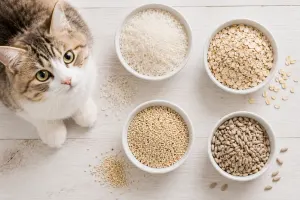
Why cats react differently to grains & seeds
Cats are obligate carnivores. Cornell's Feline Health Center describes a cat's ancestral diet as prey containing high protein, moderate fat, and only a minimal amount of carbohydrate, and a cat's dietary needs still reflect those proportions. Peer-reviewed feline nutrition research goes further, concluding plainly that there is no minimum dietary carbohydrate requirement for cats: cats have an unusually high capacity for gluconeogenesis, building the glucose their brain and body need directly from protein rather than pulling it from dietary starch the way an omnivore does.
That is the accurate version of "cats don't need carbs," and it is narrower than it sounds. It means a cat does not need grains to meet its energy needs, not that grains actively harm a cat's body; the same research finds healthy cats keep normal glucose regulation across a range of carbohydrate intake, and that excess calories overall, not carbohydrate specifically, drive feline obesity. A cooked grain is mostly digestible starch a cat's gut can process in small amounts, it just isn't doing anything nutritionally necessary once it's there.
The marketing case against grains rests on a different claim: that grains commonly trigger allergies in cats. VCA Animal Hospitals addresses this directly, describing grain and gluten allergies in cats as very rare, and noting that grains aren't the nutritional filler marketing implies, whole grains contribute real iron, calcium and B vitamins. The allergens actually documented in cats are protein sources, not grains: beef, fish and chicken account for the large majority of confirmed feline food allergy cases, with dairy also implicated.
That doesn't mean no cat is ever grain-sensitive, individual cats can react to almost anything, but "grain-free" as a blanket label is solving a problem most cats don't have. The honest summary for this category: nothing here is dangerous the way onion or chocolate is. The two real caveats are mechanical, a whole corn cob or raw yeast dough, not the grain itself.
Unnecessary, not dangerous
Which grains & seeds are safe for cats?
The verdict above covers grains & seeds as a whole. For the specific one in front of you, this is the breakdown.
| Item | Verdict | Note |
|---|---|---|
| White rice (cooked, plain) |
Safe
Bland, low-fiber and easy to digest, which is why a spoonful is sometimes used to help settle mild stomach upset. Cook it in plain water only, no butter, salt or broth, and keep the portion to a spoonful, not a meal. |
Bland, low-fiber and easy to digest, which is why a spoonful is sometimes used to help settle mild stomach upset. Cook it in plain water only, no butter, salt or broth, and keep the portion to a spoonful, not a meal. |
| Brown rice (cooked, plain) |
Safe
Same basic profile as white rice with more fiber and a firmer texture. Fine in the same small, occasional amount; the extra fiber is a plus for people, it doesn't do much extra for a cat. |
Same basic profile as white rice with more fiber and a firmer texture. Fine in the same small, occasional amount; the extra fiber is a plus for people, it doesn't do much extra for a cat. |
| Plain oats / oatmeal (cooked in water) |
Safe
Not toxic, and used as a fiber source in some commercial cat foods, but a bowl of oats does little for an obligate carnivore's actual nutrient needs. Cook in water only, skip milk, sugar and flavor packets. |
Not toxic, and used as a fiber source in some commercial cat foods, but a bowl of oats does little for an obligate carnivore's actual nutrient needs. Cook in water only, skip milk, sugar and flavor packets. |
| Quinoa (cooked, plain) |
Safe
Rinse it well before cooking to remove saponins, a bitter, mildly irritating coating on raw quinoa seeds, then serve fully cooked and unsalted. A small spoonful once or twice a week is a reasonable ceiling. |
Rinse it well before cooking to remove saponins, a bitter, mildly irritating coating on raw quinoa seeds, then serve fully cooked and unsalted. A small spoonful once or twice a week is a reasonable ceiling. |
| Corn (kernels, off the cob) |
Safe
Plain cooked kernels are digestible and already used as a starch source in many commercial cat foods; the corn itself isn't the hazard here, the cob is. |
Plain cooked kernels are digestible and already used as a starch source in many commercial cat foods; the corn itself isn't the hazard here, the cob is. |
| Whole corn on the cob |
Never
Rigid, fibrous and essentially indigestible. Corn cobs are a common cause of gastrointestinal obstruction in pets, sometimes requiring surgery to remove. Keep whole cobs out of reach entirely, not just cut into smaller pieces. |
Rigid, fibrous and essentially indigestible. Corn cobs are a common cause of gastrointestinal obstruction in pets, sometimes requiring surgery to remove. Keep whole cobs out of reach entirely, not just cut into smaller pieces. |
| Wheat and bread |
Safe
True wheat allergy is rare in cats, and a small piece of plain bread is generally low risk. See our full bread guide for yeast dough, seasoned breads and portion detail. |
True wheat allergy is rare in cats, and a small piece of plain bread is generally low risk. See our full bread guide for yeast dough, seasoned breads and portion detail. |
| Barley (cooked, plain) |
Safe
A whole grain with the same basic story as rice and oats: digestible, not toxic, and not nutritionally necessary. Keep it plain and unsalted, in a small, occasional amount. |
A whole grain with the same basic story as rice and oats: digestible, not toxic, and not nutritionally necessary. Keep it plain and unsalted, in a small, occasional amount. |
| Sunflower seeds (shelled, plain, unsalted) |
Caution
A few shelled, unsalted kernels are fine occasionally; sunflower is non-toxic to cats. Never offer them in the shell, which is sharp-edged and can scratch or lodge in the throat or gut. |
A few shelled, unsalted kernels are fine occasionally; sunflower is non-toxic to cats. Never offer them in the shell, which is sharp-edged and can scratch or lodge in the throat or gut. |
| Chia seeds |
Caution
Safe in a tiny amount, best softened in a little water first since dry chia seeds absorb liquid and swell. Keep it to a pinch; there's no established feline need for them. |
Safe in a tiny amount, best softened in a little water first since dry chia seeds absorb liquid and swell. Keep it to a pinch; there's no established feline need for them. |
| Flax seeds |
Caution
Whole flaxseed largely passes through undigested since a cat can't break the hard seed coat. Ground or cold-pressed flaxseed, in a quarter-teaspoon amount at most, is the only version worth offering. |
Whole flaxseed largely passes through undigested since a cat can't break the hard seed coat. Ground or cold-pressed flaxseed, in a quarter-teaspoon amount at most, is the only version worth offering. |
| Pasta (plain, cooked) |
Safe
Same logic as rice or bread: a wheat product that's digestible and not toxic, just nutritionally pointless for a cat. Keep it plain, no sauce, cheese, garlic or salt, and to a bite-sized amount. |
Same logic as rice or bread: a wheat product that's digestible and not toxic, just nutritionally pointless for a cat. Keep it plain, no sauce, cheese, garlic or salt, and to a bite-sized amount. |
| Raw bread dough (unbaked, with yeast) |
Never
A real toxin, not just a texture problem: yeast keeps fermenting in a cat's warm stomach, producing gas that distends the stomach and alcohol absorbed fast enough to cause genuine poisoning. Covered fully on our toxic foods guide. |
A real toxin, not just a texture problem: yeast keeps fermenting in a cat's warm stomach, producing gas that distends the stomach and alcohol absorbed fast enough to cause genuine poisoning. Covered fully on our toxic foods guide. |
Safe means fine as described here. Caution means keep it small, plain and occasional. Never means no safe amount, keep it out of reach.
How much grain can a cat eat?
For the plain, cooked, unseasoned versions, portion size is what keeps this category harmless: a teaspoon or two of cooked white rice, oats or quinoa mixed into a meal, offered occasionally rather than daily, is a reasonable ceiling for an average adult cat, since none of it does nutritional work a cat's regular food isn't already doing. Plain cooked white rice is bland and low-fiber enough that some vets suggest it to help settle a mild upset stomach, while brown rice, oats, quinoa, barley and plain pasta carry more fiber and are fine in the same small quantities, just not a fix for digestive upset the way white rice can be.
What actually separates a fine grain from a problem one is not the grain itself, it's what rides along with it: butter, cream sauce, cheese, added sugar or a seasoning blend are where the real risk sits, since salt, fat and onion or garlic powder are genuine hazards layered on top of an otherwise harmless base. A plain oatmeal packet is a different food from a maple-and-brown-sugar one, and cereal marketed to kids is a sugar delivery vehicle, not a grain one, treat it accordingly.
Seeds follow a similar rule with one addition: shell and whole-kernel texture matters as much as seasoning does. A few plain, unsalted, shelled sunflower kernels, a small pinch of chia seeds, better softened in water first since dry chia swells once it absorbs liquid, or a quarter teaspoon of ground flaxseed are all low-risk in that small an amount. Sunflower shells are a different story: sharp-edged and essentially indigestible, and a cat that swallows one whole risks a scratched throat or gut lining, not just an upset stomach.
Whole flaxseed passes through largely undigested since a cat can't break the hard seed coat, so ground flaxseed is the only version worth offering. Salted, seasoned or snack-mix seeds add sodium and sometimes onion or garlic seasoning on top, and offer nothing a plain seed doesn't already cover better. Legumes like chickpeas sit in this same unnecessary-but-not-dangerous category and get their own full breakdown: our chickpeas guide.
How to introduce grain to your cat safely
Try a new grain or seed the way any new food gets introduced: one item, in a genuinely small amount, on its own, not folded into three new things at once. A teaspoon of plain cooked rice or a few plain sunflower kernels is enough for a first try, offered once and then watched, not repeated the same day. What you are watching for at first is straightforward: vomiting, diarrhea or obvious discomfort in the following 24 hours would point to that specific item not agreeing with your cat, and is a reason to drop it, not push through.
The more useful watching happens over the following weeks, not the first bite. A true grain sensitivity in a cat tends to show up as a pattern across repeated exposure, not a single reaction: itchy skin, recurring ear infections, or soft stool that shows up consistently after that grain is a more reliable signal than anything from one meal.
That is also why offering one new item at a time matters here, more than it might seem to for a single small taste: introduce rice, oats and a new seed in the same week, and if something changes, there is no way to tell which one caused it. Space new items out by at least several days each, so a real pattern, if there is one, has a chance to point at a specific cause rather than a whole shopping list.
Which grains & seeds should cats never eat?
- Raw, unbaked yeast dough: keeps fermenting in a warm stomach, producing both a dangerous gas buildup and genuine alcohol poisoning. See our toxic foods guide.
- Whole corn on the cob: rigid and essentially indigestible, a common cause of gastrointestinal obstruction in pets.
- Sunflower seed shells, or any whole, unshelled seed: sharp-edged and a choking or internal-injury risk.
- Salted, seasoned or flavored seeds and snack mixes: added sodium and often onion or garlic seasoning.
- Sugary cereal or flavored oatmeal packets: sugar and additives with no nutritional upside.
- Popcorn kernels, and buttered or salted popcorn: covered in depth on our treats and snacks guide.
Full guides: Can Cats Eat Bread?, Can Cats Eat Chickpeas?, Can Cats Eat Popcorn?
Signs of a bad reaction to watch for
- Itchy skin, recurring ear infections, or soft stool that shows up consistently after a specific grain, a possible sensitivity pattern rather than a one-off reaction.
- Gagging, drooling, or repeated swallowing after seeds, corn on the cob, or any hard kernel, a sign it may be stuck rather than swallowed cleanly.
- Bloating or a visibly distended, tense belly after a larger-than-usual portion of any grain.
- Vomiting, retching, disorientation or a distended abdomen after any known or suspected raw dough ingestion, treat this as an emergency, not a wait-and-see.
Any of these, or anything that seems off beyond what is listed here, is worth a call to your vet. Our guide to the early signs a cat is sick covers the wider list of what to watch for at any time, not just after eating something new.
Frequently asked questions
Can cats eat rice?
Yes. Plain cooked white or brown rice, with nothing added, is harmless for most cats in small amounts, a spoonful rather than a meal. It's sometimes used to help settle mild stomach upset because it's bland and low-fiber, but it offers no nutrition a cat's regular food isn't already providing.
Is wheat bad for cats?
No, not inherently. True wheat allergy is rare in cats, and plain bread or pasta in small amounts is generally low risk. The real caveats are raw yeast dough, a genuine toxin, and heavily seasoned or sugary wheat products.
Can cats eat oats or oatmeal?
Yes, a small amount of plain oats cooked in water is not toxic and won't hurt most cats. It's not a meaningful fiber source for an obligate carnivore though, and any milk, sugar, butter or flavor packet turns a harmless food into an unnecessary one.
Can cats eat quinoa?
Yes, in small amounts. Rinse raw quinoa well to remove its bitter saponin coating, then serve it fully cooked, plain and unsalted, never straight from the box. A small spoonful once or twice a week is a reasonable ceiling, since quinoa offers no nutrient a cat's regular diet doesn't already supply.
Can cats eat corn?
Plain cooked corn kernels, off the cob, are digestible and already used as a starch source in some commercial cat foods, so a few kernels are low risk. Whole corn on the cob is different: it's rigid and indigestible, and a common cause of intestinal obstruction in pets.
Is grain-free cat food necessary?
Usually not for allergy reasons. VCA Animal Hospitals describes true grain and gluten allergy in cats as very rare; documented feline food allergies are mostly protein-based, beef, fish and chicken, not grains. Grain-free formulas aren't harmful, they're just solving a problem most cats don't have.
Can cats eat sunflower seeds or chia seeds?
A few plain, unsalted, shelled sunflower kernels, or a soaked pinch of chia seeds, are low risk occasionally; sunflower itself is non-toxic to cats. Never offer sunflower seeds still in the shell, which is sharp-edged and indigestible, and skip salted or flavored versions of either seed.
Can cats eat popcorn?
Plain, fully popped, unbuttered popcorn in tiny amounts is low risk for most healthy adult cats, but unpopped or partially popped kernels are a real choking hazard, and buttered or salted popcorn adds fat and sodium. Our <a href="/food-guides/treats-and-snacks" class="font-semibold text-primary underline decoration-line-strong underline-offset-4">treats and snacks guide</a> covers popcorn in full detail.
Sources for this guide
- ASPCA Animal Poison Control Center The reference list behind which human foods are genuinely toxic to cats.
- Cornell Feline Health Center Background on feline nutrition and why cats need a meat-based diet.
- WSAVA Global Nutrition Guidelines The nutritional framework behind why extras cannot replace a complete diet.
 By Ahsan Nawaz
Published Updated
