Can Cats Eat Popcorn? What to Know Before Sharing

On this page
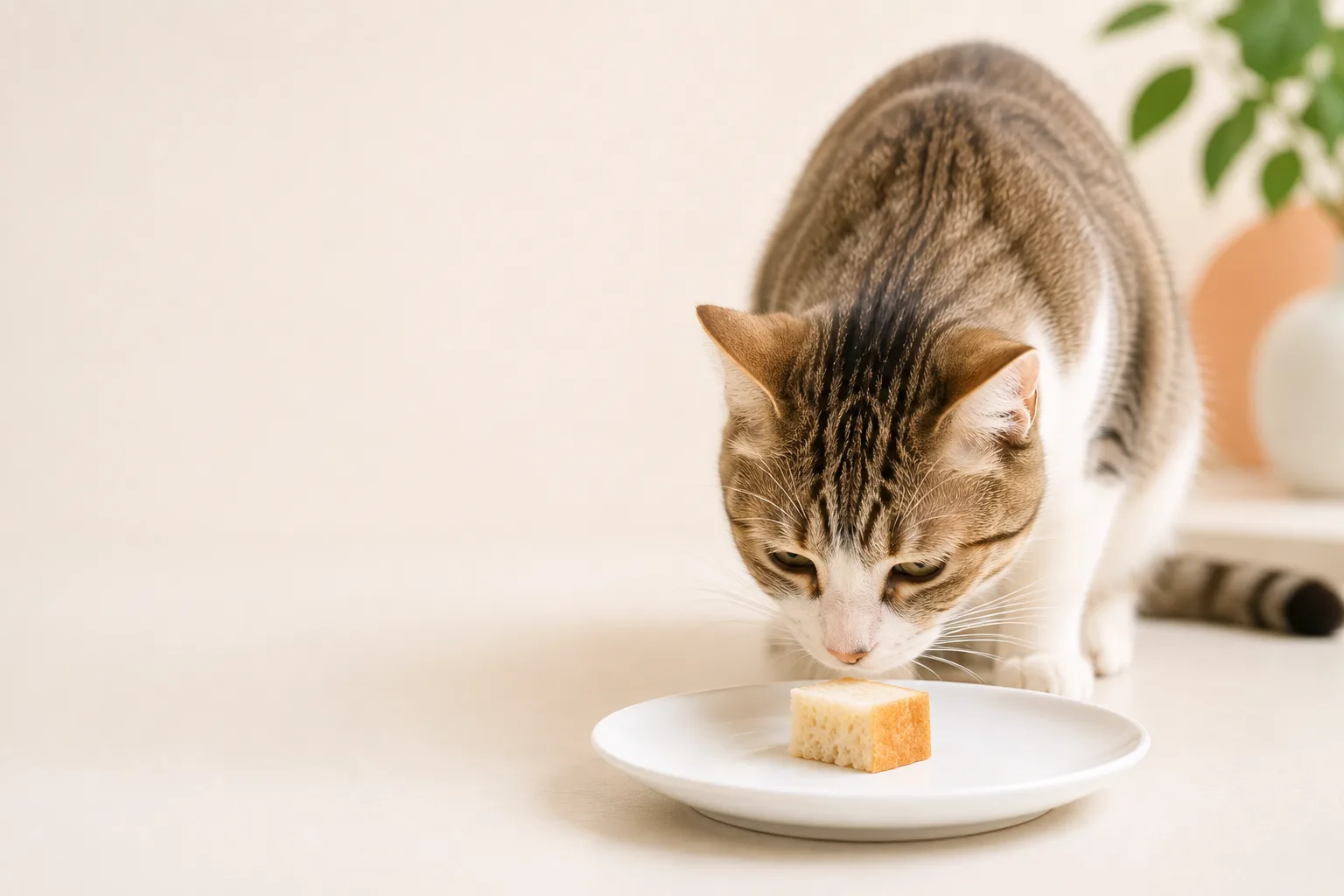
Popcorn is not a food worth offering a cat on purpose. Plain, fully air-popped kernels are not toxic in a stray piece here or there, but the popcorn most households actually eat, and the kernels themselves, both carry real problems for a cat. Unlike most items in food guides on this site, the concern here is not only what popcorn is made of; it is also its size, shape and texture, which is a different kind of risk than a rich sauce or a bit of salt.
A lot of foods on this site come down to preparation: cook the meat plainly, skip the seasoning, watch the portion, and it is fine. Popcorn does not fit that pattern as neatly, because even the "correctly prepared" version has nothing to offer and the incorrectly prepared version, the one sitting in most bowls, is genuinely worth avoiding.
This guide is written from published veterinary sources, named and linked as they come up and listed again at the bottom.
Is popcorn safe for cats?
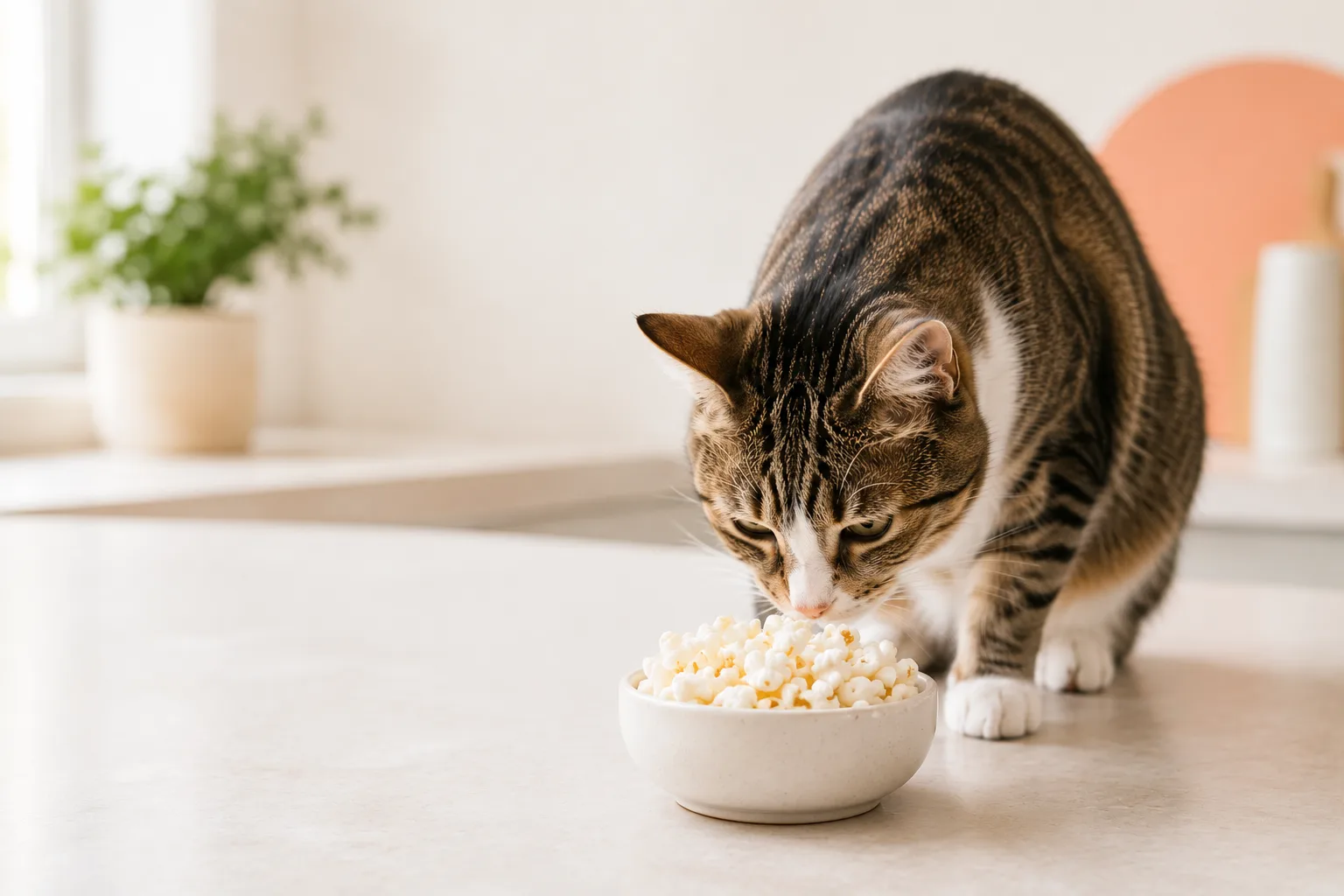
Only in a very narrow sense. Plain, fully air-popped popcorn, with no butter, salt, oil or seasoning, and with every kernel completely popped so there is nothing hard left in the bowl, is not toxic to a cat in a tiny amount. If a cat steals one clean, fully popped piece off the floor during a quiet movie night, it is not a reason to panic or call anyone.
But "not toxic" is not the same as "worth feeding." Popcorn has no protein a cat's diet is missing and no nutritional advantage over any other empty-calorie carbohydrate. A cat's diet is built around animal protein, and popcorn, plain or otherwise, does not contribute anything toward that. There is no upside to seeking it out as a treat, even in its cleanest possible form, and nothing about it does a job that a proper cat treat does not do better. That is part of why this guide leans more cautious than most of the other food guides on this site: there is simply nothing on the other side of the scale to weigh against the risks below.
What about buttered or salted popcorn?
Keep it away from your cat. Movie theater popcorn and bagged snack popcorn are not plain popcorn; they are heavily salted and coated in butter or oil, sometimes both, and that combination of high sodium and high fat puts them in the same category of concern as other salty, fatty snack foods that show up as "avoid" items across cat food guides in general.
That combination can cause an upset stomach on its own, and excess fat, especially a sudden amount a cat is not used to, is hard on a cat's digestion. A fatty meal is a well-known pancreatitis trigger in dogs, but VCA Animal Hospitals notes that cats do not appear to develop pancreatitis from a high-fat diet the same way; vomiting and diarrhea are reason enough to keep it away. This is the popcorn most people are actually thinking of when they ask whether cats can eat popcorn, since it is the version sitting in the bowl during a movie or left out on the counter after a party, not the plain kind made specifically with a cat in mind. Kettle corn, cheese-flavored popcorn and caramel corn all fall into this same category, since each one adds salt, fat, sugar or all three on top of the kernel itself.
It should be treated as something to keep away from a cat rather than something to share, even as a one-off handful. There is no safe amount of the buttered or salted version the way there might be a safe amount of a plain cooked treat, because the problem is baked into the preparation, not the portion size.
Why are unpopped kernels dangerous?
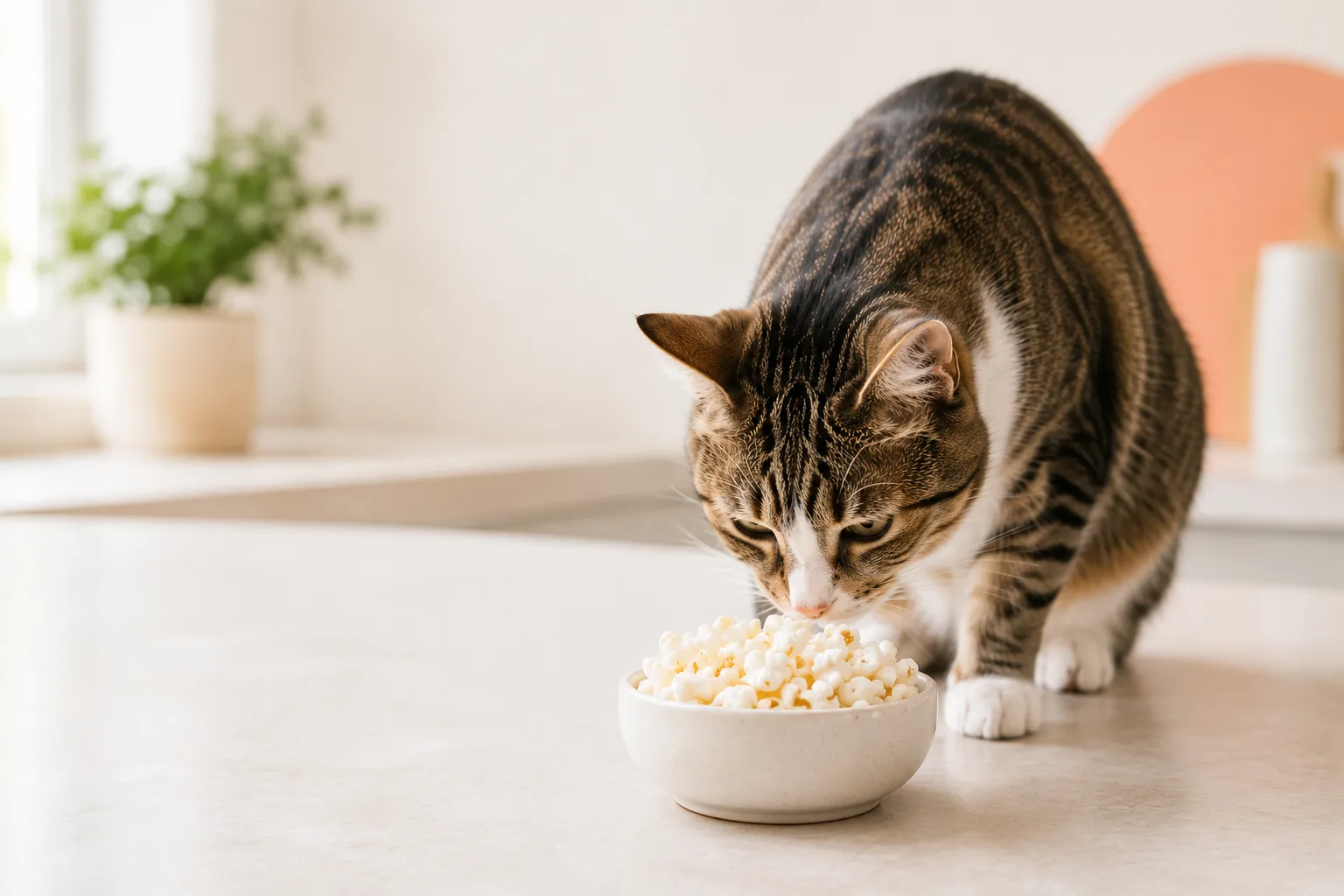
Unpopped kernels, the "old maids" left in the bottom of almost every bowl of popcorn, are a genuine physical hazard, and this concern is separate from anything about salt or fat. They are hard, small, and shaped in a way that makes them easy for a cat to swallow without chewing properly, especially if a cat is grabbing at spilled popcorn on the floor rather than eating calmly from a bowl.
Swallowed that way, an unpopped kernel creates a real choking risk in the moment, and a possible intestinal blockage risk afterward if it is swallowed whole and does not pass through on its own. This is a mechanical danger, not a nutritional one, and it makes unpopped kernels a bigger practical worry than most single items covered in food guides on this site. It is also a hazard that exists even inside a bowl of otherwise plain, unsalted, unbuttered popcorn that would pass the "is this safe" test on ingredients alone, which is exactly why sorting popcorn by ingredients is not enough on its own.
In practice, unpopped kernels do not stay neatly in the bowl. They end up on the floor, between couch cushions, and under furniture during a movie night, which is exactly where a curious cat is likely to find and swallow one without anyone noticing. Cleaning up spilled popcorn thoroughly matters as much as anything about the bowl itself.
Is popcorn a choking risk generally?
Yes, and not only because of unpopped kernels. Popcorn's size, shape and texture make it an awkward food for a cat to eat safely in the way a small piece of cooked meat is. A piece of chicken breaks down in the mouth and swallows predictably; a piece of popcorn is light, irregular, and full of air pockets, and it does not behave the same way going down.
Cats tend to gulp small items rather than chew them thoroughly, which works fine for the kind of small, soft pieces their diet is built around, but is a poor match for something shaped like popcorn. Combined with the risk of leftover unpopped kernels mixed in, popcorn is simply not an easy or natural food for a cat to eat safely, on top of the sodium and fat concerns already covered above. None of those three problems, the lack of nutrition, the salt and fat, and the physical shape, needs the others to be a reason to leave popcorn alone; any one of them is enough on its own.
How much popcorn is safe?
The honest answer is none, intentionally. Popcorn is not a moderation food the way lean cooked meat or a small piece of cooked fish is; it belongs closer to "avoid" than "safe in small amounts." A single stray piece of unbuttered, unsalted, fully popped popcorn that a cat grabs off the floor before you can stop it is not an emergency, but that is different from choosing to offer popcorn as a treat, and it is worth keeping bowls and spilled kernels out of reach rather than treating popcorn as something to share on purpose.
Treats and extras are generally kept under about 10 to 15 percent of a cat's daily calories. Our feeding guide covers how to work out a cat's daily calorie total, and that allowance is much better spent on a treat that actually has something to offer a cat, whether that is protein, moisture or genuine enrichment, than on popcorn, which offers none of those things and adds a choking and blockage risk on top. If popcorn night is a regular habit in the house, the simplest fix is not a smaller portion for the cat; it is keeping the bowl, the spills and the stray kernels somewhere a cat cannot get to them at all.
How much salt actually crosses into dangerous territory?
The Merck Veterinary Manual gives no separate figure for cats, but in dogs signs of salt toxicosis can appear after roughly 2 to 3 grams of salt per kilogram of body weight, with around 4 grams per kilogram lethal. For a typical 4 kilogram cat, that is a meaningfully small amount of salt relative to what a person eating the same bowl of buttered, salted popcorn would need to worry about. Signs, according to the Pet Poison Helpline, usually start with vomiting and diarrhea, then can progress to stumbling, tremors and in severe cases seizures. A bowl shared at movie night, eaten steadily rather than in one sitting, is a different exposure than a single handful, but the arithmetic is the same: a cat's small body size means the same salted snack humans eat casually carries proportionally more weight for a cat.
Are some cats more likely to choke on kernels?
No study has measured choking risk by breed. It is still sensible to take extra care with flat-faced breeds such as Persians, whose shorter jaws can make chewing less efficient, and with any cat that gulps its food rather than chewing it. That does not make popcorn safe for other cats; it means the margin for error is smaller for some.
This guide goes into more depth than Can Cats Eat Grains and Seeds?, Can Cats Eat Junk Food or Fast Food? and Can Cats Eat Treats & Snacks?, which compare the whole group side by side.
Frequently asked questions
Can cats eat plain popcorn?
Plain, fully air-popped popcorn with no butter, salt, oil or seasoning is not toxic to a cat in a tiny amount, as long as every kernel is completely popped. It does not offer any nutritional benefit though, since it contains no protein a cat's diet needs. It is not a food worth offering on purpose, even in this cleanest form.
Is buttered or salted popcorn bad for cats?
Yes. Movie theater and bagged snack popcorn is heavily salted and coated in butter or oil, and that combination of high sodium and high fat can cause an upset stomach and is a recognized trigger for pancreatitis in cats. This is the type of popcorn most people are actually asking about, and it should be kept away from cats rather than shared, even as a one-off treat.
Why are unpopped popcorn kernels dangerous for cats?
Unpopped kernels, often called old maids, are hard and small enough for a cat to swallow without chewing them properly. That creates a real choking risk in the moment and a possible intestinal blockage if a kernel is swallowed whole and does not pass through on its own. This hazard exists even in a bowl of otherwise plain, unsalted, unbuttered popcorn.
Can popcorn cause a cat to choke?
Yes. Popcorn's light, irregular shape and air-pocketed texture make it an awkward food for a cat to swallow safely compared with something like a small piece of cooked meat. Cats tend to gulp small items rather than chew thoroughly, which raises the choking risk further when unpopped kernels are mixed in with the popped pieces.
How much popcorn can I give my cat?
The honest answer is none, intentionally. Popcorn is not a moderation food the way lean cooked meat is; it is closer to something to avoid altogether. A single stray piece of clean, fully popped popcorn is not an emergency, but that is different from choosing to offer popcorn as a treat, since it carries choking and blockage risks with no nutritional benefit in return.
How much salted popcorn is actually dangerous for a cat?
Toxicology sources put salt toxicosis at around 2 to 3 grams of sodium chloride per kilogram of body weight, with 4 g/kg potentially fatal. For an average cat, that is a small amount relative to a typical bowl of salted popcorn. Signs can start within about three hours, beginning with vomiting.
Sources
- Merck Veterinary Manual: Salt Toxicosis in Animals Toxic and lethal doses of salt, measured in dogs.
- Pet Poison Helpline: Salt Signs of salt poisoning in pets.
- ASPCA: People Foods to Avoid Feeding Your Pets Why salty foods are a risk for pets.
- VCA Animal Hospitals: Nutrition and Pancreatic Disease in Cats How dietary fat affects cats differently from dogs.
- Cornell Feline Health Center: Feeding Your Cat The rule of thumb for treats.
General information, not veterinary advice. If your cat's behavior has changed suddenly, speak to a vet rather than an article.
How this guide was researched and checked is set out in how our guides are written.

Want an answer in seconds?
The calculators handle age, due dates and portions without an account.