
Can Cats Eat Dairy and Eggs?
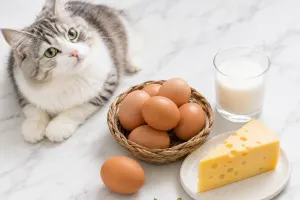
Why cats react differently to dairy & eggs
Lactose intolerance in cats isn't an allergy or something that develops over time, it's a straightforward enzyme shortfall built into normal feline development. Nursing kittens produce plenty of lactase, the enzyme that breaks milk sugar down into digestible sugars, because milk is their entire diet. Once a kitten is weaned onto solid food, around 12 weeks old, the body has no more use for that enzyme and production drops off.
By adulthood, Cornell Feline Health Center puts the number at roughly 65% of cats with meaningfully reduced lactase activity, enough to qualify as lactose intolerant. In one of those cats, undigested lactose passes into the large intestine, where gut bacteria ferment it, producing gas, and where it also pulls water into the bowel by osmosis, the same basic mechanism behind most diarrhea. That combination is why a saucer of milk so reliably produces loose stool within about 8 to 12 hours, not immediately and not days later.
It isn't dangerous the way onion or chocolate is, just a predictable, avoidable stomach upset. Eggs run on a different mechanism entirely, and cooked, they're a genuinely better story. Egg is a complete, highly digestible protein with an amino acid profile well suited to a cat's biology, closer to what a cat is built to eat than dairy is.
The real risk with eggs isn't a built-in digestive limitation, it's specific to raw egg: bacterial contamination, salmonella in particular, and a protein in raw egg white called avidin, which binds the B vitamin biotin and blocks its absorption. Cooking neutralizes both problems at once, heat kills the bacteria and denatures the avidin protein, so a properly cooked egg carries neither risk. That's the split this whole category comes down to: dairy is a mixed bag because of how a normal adult cat's gut works, eggs are fine specifically because they're cooked.
Eggs are fine, most dairy isn't
Which dairy & eggs are safe for cats?
The verdict above covers dairy & eggs as a whole. For the specific one in front of you, this is the breakdown.
| Item | Verdict | Note |
|---|---|---|
| Whole milk |
Caution
Cow's milk carries the highest lactose load of any common dairy item, and roughly 65% of adult cats lack enough lactase to digest it, so a saucer routinely causes gas and diarrhea within 8 to 12 hours. |
Cow's milk carries the highest lactose load of any common dairy item, and roughly 65% of adult cats lack enough lactase to digest it, so a saucer routinely causes gas and diarrhea within 8 to 12 hours. |
| Cream |
Caution
Higher in fat than milk but still meaningfully lactose-rich, so it carries the same GI-upset risk milk does, plus its extra fat and calories make a regular habit of it worth avoiding even in tolerant cats. |
Higher in fat than milk but still meaningfully lactose-rich, so it carries the same GI-upset risk milk does, plus its extra fat and calories make a regular habit of it worth avoiding even in tolerant cats. |
| Hard cheese (cheddar, parmesan, swiss) |
Caution
Around 90% of milk's lactose is removed with the whey during hard-cheese making, leaving these close to lactose-free. A pea-sized cube is the dairy item cats most often tolerate without loose stool. |
Around 90% of milk's lactose is removed with the whey during hard-cheese making, leaving these close to lactose-free. A pea-sized cube is the dairy item cats most often tolerate without loose stool. |
| Soft cheese (brie, cream cheese) |
Caution
Not aged or pressed the way hard cheese is, so soft cheese keeps more of its original lactose and fat. It behaves closer to milk than to cheddar in how likely it is to upset a sensitive cat. |
Not aged or pressed the way hard cheese is, so soft cheese keeps more of its original lactose and fat. It behaves closer to milk than to cheddar in how likely it is to upset a sensitive cat. |
| Plain yogurt |
Caution
Live cultures consume some lactose during fermentation, which is why lactose-intolerant cats sometimes tolerate a small spoonful of plain yogurt better than milk. Always skip flavored or sweetened varieties, plain and unsweetened only. |
Live cultures consume some lactose during fermentation, which is why lactose-intolerant cats sometimes tolerate a small spoonful of plain yogurt better than milk. Always skip flavored or sweetened varieties, plain and unsweetened only. |
| Cottage cheese |
Caution
A fresh cheese, not aged or pressed, so it keeps roughly 2 to 4 grams of lactose per serving, meaningfully more than hard cheese. Treat it like milk, an occasional taste, not a regular topper. |
A fresh cheese, not aged or pressed, so it keeps roughly 2 to 4 grams of lactose per serving, meaningfully more than hard cheese. Treat it like milk, an occasional taste, not a regular topper. |
| Cooked egg (whole) |
Safe
A complete, highly digestible protein cats handle well. Cooking, scrambled or hard-boiled with nothing added, kills any bacteria and neutralizes avidin, the raw-white protein that otherwise blocks biotin absorption. A genuinely good small addition. |
A complete, highly digestible protein cats handle well. Cooking, scrambled or hard-boiled with nothing added, kills any bacteria and neutralizes avidin, the raw-white protein that otherwise blocks biotin absorption. A genuinely good small addition. |
| Raw egg |
Never
Carries a real salmonella and campylobacter risk, and raw egg white contains avidin, which binds biotin and blocks its absorption. Cooking eliminates both problems, so there's no upside to feeding it raw over cooked. |
Carries a real salmonella and campylobacter risk, and raw egg white contains avidin, which binds biotin and blocks its absorption. Cooking eliminates both problems, so there's no upside to feeding it raw over cooked. |
| Egg yolk (cooked, alone) |
Safe
Fine cooked, and actually a good natural source of biotin, but it carries most of an egg's fat and calories. Count it toward the same small treat portion as a whole egg, not on top of it. |
Fine cooked, and actually a good natural source of biotin, but it carries most of an egg's fat and calories. Count it toward the same small treat portion as a whole egg, not on top of it. |
| Butter |
Caution
Almost pure milkfat, so it carries only trace lactose, but a regular lick adds calories a cat's diet doesn't need and can contribute to pancreatitis risk over time. Not toxic, just nutritionally pointless. |
Almost pure milkfat, so it carries only trace lactose, but a regular lick adds calories a cat's diet doesn't need and can contribute to pancreatitis risk over time. Not toxic, just nutritionally pointless. |
| Sour cream |
Caution
Fermented like yogurt but carries more fat and still meaningful lactose. A small lick off a spoon is low-risk as a one-off; treating it as a regular topper risks the same loose stool milk causes. |
Fermented like yogurt but carries more fat and still meaningful lactose. A small lick off a spoon is low-risk as a one-off; treating it as a regular topper risks the same loose stool milk causes. |
| Goat milk |
Caution
Often marketed as easier to digest, but its lactose content is close to cow's milk, only slightly lower, not a meaningful difference for a lactose-intolerant cat. It causes much the same GI upset milk does. |
Often marketed as easier to digest, but its lactose content is close to cow's milk, only slightly lower, not a meaningful difference for a lactose-intolerant cat. It causes much the same GI upset milk does. |
| Lactose-free cat milk products |
Safe
Commercial cat-milk treats are formulated without lactose, or with lactase added, so they sidestep the digestive issue entirely. See our treats and snacks guide for more on treat-specific products like these. |
Commercial cat-milk treats are formulated without lactose, or with lactase added, so they sidestep the digestive issue entirely. See our treats and snacks guide for more on treat-specific products like these. |
Safe means fine as described here. Caution means keep it small, plain and occasional. Never means no safe amount, keep it out of reach.
How much dairy can a cat eat?
Treat plain cooked egg, scrambled or hard-boiled with nothing added, no salt, butter or seasoning, as a legitimate small addition rather than an occasional novelty. A tablespoon or two of chopped cooked egg a couple of times a week is reasonable for an average adult cat, well within the roughly 10% of daily calories that treats and extras should stay under; use our calorie calculator to check where that lands for a specific cat's weight, and see our eggs guide for more on eggs specifically.
Egg yolk carries more fat and calories than the white, so it should count toward that same treat budget, not sit on top of a full egg serving. Dairy deserves a more cautious default. Milk and cream carry the most lactose per serving and cause the most predictable upset, so they're worth skipping for any cat with unknown tolerance, and worth dropping entirely once a cat has reacted to either.
Hard, aged cheeses like cheddar or parmesan are a different case: most of the lactose in milk is removed with the whey during cheesemaking, so these cheeses carry only a trace of it, which is why some cats tolerate a pea-sized cube where they couldn't tolerate milk; see our cheese guide for the full picture. Plain yogurt sits in a similar middle ground, since its live cultures consume some lactose during fermentation, so a small spoonful is tolerated by some cats that react to milk.
Cottage cheese and soft cheeses are fresher and less fermented, so they keep more of their original lactose and behave closer to milk than to hard cheese. None of this is a reason to build dairy into a routine: even a well-tolerated cheese or yogurt is best kept to an occasional, teaspoon-scale taste, not a daily habit, since the fat also adds calories a cat's diet doesn't need on top of a complete food.
How to introduce dairy to your cat safely
When trying any dairy or egg item for the first time, start with a genuinely small amount, a pea-sized piece of cooked egg or a half-teaspoon of plain yogurt or hard cheese, not a full serving, and offer only one new item at a time. Introducing several new foods together makes it impossible to tell which one caused a problem if a cat's stomach reacts.
After that first taste, watch the next 24 hours rather than just the first few minutes: lactose-related diarrhea from dairy typically shows up within 8 to 12 hours, not immediately, so a cat that seems fine right after eating can still develop loose stool later the same day. If nothing unusual shows up, small, occasional amounts along the lines described above are reasonable going forward.
If loose stool, gas or vomiting does appear, that's a reasonable item to drop from that cat's diet rather than testing it again to see if the first reaction was a fluke, since lactase levels don't recover with repeated exposure. The same small-amount-first approach is worth applying to a new cheese, milk or yogurt brand too, since fat content and any added ingredients can vary even when the base food looks the same.
Which dairy & eggs should cats never eat?
- Raw eggs in any form, including raw yolk mixed into food: a real salmonella and campylobacter risk, plus the avidin protein in raw white that blocks biotin absorption. Cook eggs through before offering them.
- Ice cream, flavored yogurt, and anything with added sugar or chocolate: these stack a dairy lactose problem on top of a separate sugar or chocolate risk. See our sweets guide for what makes those specifically dangerous.
- Milk or cream offered as a daily habit rather than an occasional taste, since that pattern is the one most likely to produce chronic loose stool in a lactose-intolerant cat.
- Seasoned, salted or buttered eggs and cheese meant for a human plate, garlic and onion powder especially, which carry their own separate toxicity entirely apart from the dairy or egg itself.
- Any dairy for a cat with a known history of loose stool after milk or cheese: a past reaction is a reliable predictor, not a fluke worth retesting.
Full guides: Can Cats Eat Eggs?, Can Cats Eat Cheese?
Signs of a bad reaction to watch for
- Diarrhea or noticeably loose stool within 8 to 12 hours of milk, cream or a large amount of any dairy, the classic sign of lactose passing through undigested.
- Vomiting after raw egg specifically, which can point to a bacterial issue like salmonella rather than an ordinary stomach upset.
- Excess gas or a bloated, uncomfortable abdomen after cheese or yogurt, a milder version of the same lactose-fermentation reaction.
- Repeated GI upset after the same dairy item on more than one occasion, a sign to drop that item rather than test it again.
- Lethargy, reduced appetite or diarrhea lasting more than 24 hours after any dairy or egg exposure, worth a vet call rather than waiting it out.
Any of these, or anything that seems off beyond what is listed here, is worth a call to your vet. Our guide to the early signs a cat is sick covers the wider list of what to watch for at any time, not just after eating something new.
Frequently asked questions
Can cats drink milk?
Not safely as a regular habit. Roughly 65% of adult cats lose most of the lactase enzyme needed to digest milk sugar after weaning, per Cornell Feline Health Center, so a saucer of milk typically causes gas and diarrhea within 8 to 12 hours. Healthy adult cats have no nutritional need for milk at all, so skip it as a default, not just when it upsets a particular cat.
Which dairy foods carry the least lactose?
Hard, aged cheeses such as cheddar, parmesan and swiss, which lose around 90 percent of milk's lactose with the whey during cheesemaking, and butter, which is almost pure milkfat. Plain yogurt sits in the middle, since its live cultures consume some lactose during fermentation. Whole milk, cream, goat milk and fresh cheeses like cottage and cream cheese carry the most.
Can cats have yogurt?
A small spoonful of plain, unsweetened yogurt is reasonable for many cats. Fermentation consumes some of the lactose during yogurt-making, which is why lactose-intolerant cats sometimes tolerate it better than milk. Always skip flavored, sweetened or chocolate-swirled varieties, and start with a half-teaspoon to see how an individual cat's stomach reacts.
Can kittens have milk, cheese or egg?
Kittens make plenty of lactase, the enzyme that digests milk sugar, because they nurse, so they handle milk better than adult cats do. That production falls away from around 12 weeks old and most cats never regain it, which is why the saucer that suited a kitten upsets a grown cat. Cooked egg suits both; raw egg suits neither, for the salmonella and avidin reasons above.
What are the signs a cat did not tolerate dairy?
Gas, loose stool or diarrhea, usually within a day of the taste, because undigested lactose ferments in the gut and draws in water. Roughly 65 percent of adult cats lack enough lactase to avoid that. A cat that has reacted once is likely to react again, so a past upset is a reliable signal rather than a fluke worth retesting.
Can cats eat butter?
A lick isn't dangerous, but there's no reason to offer it on purpose. Butter is nearly pure milkfat with only trace lactose, so it won't typically trigger the diarrhea milk does, but it adds calories a cat's diet doesn't need and, as a habit, can contribute to pancreatitis and weight gain over time.
Can cats eat sour cream?
A small lick as a one-off is low-risk for most cats. Sour cream is fermented like yogurt but carries more fat and still meaningful lactose, so treating it as a regular topper risks the same loose stool a lactose-intolerant cat gets from milk. Keep it occasional, not routine.
Can cats eat ice cream?
Not a good idea beyond an accidental lick. Ice cream stacks a lactose problem on top of added sugar, and some flavors, chocolate and coffee especially, contain genuine toxins on top of that. See <a href="/food-guides/sweets" class="font-semibold text-primary underline decoration-line-strong underline-offset-4">our sweets guide</a> for which flavors are actually dangerous rather than just an upset stomach.
Sources for this guide
- ASPCA Animal Poison Control Center The reference list behind which human foods are genuinely toxic to cats.
- Cornell Feline Health Center Background on feline nutrition and why cats need a meat-based diet.
- WSAVA Global Nutrition Guidelines The nutritional framework behind why extras cannot replace a complete diet.
 By Ahsan Nawaz
Published Updated
