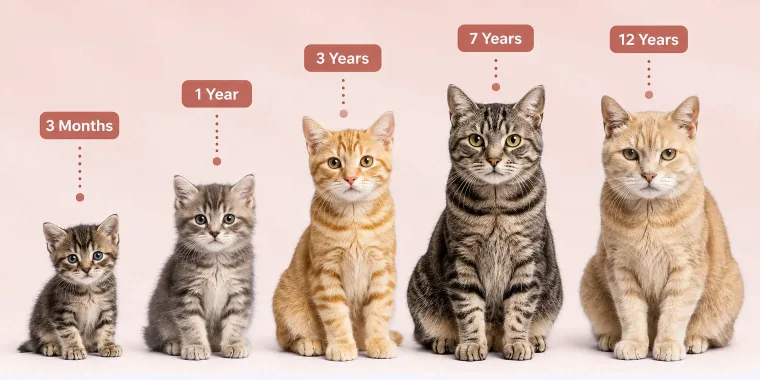
Quick answer: a 1-year-old cat is about 15 in human years and a 2-year-old cat is about 24. After that, each cat year equals roughly 4 human years, so a 10-year-old cat is about 56 and a 15-year-old cat is about 76.
How cat years are calculated
Cats grow up very fast and then age steadily. The conversion used by vets and feline welfare groups, from the AAHA/AAFP life stage charts and the Feline Advisory Bureau (now International Cat Care), works in three steps. [iCatCare]
- First year = about 15 human years. By 12 months a cat is fully grown and sexually mature, like a mid-teen.
- Second year = about 9 more, so a 2-year-old cat is about 24 in human years.
- Every year after = about 4 human years.
As a formula for cats aged 2 or older:
Human years = 24 + (cat's age − 2) × 4
Example: a 7-year-old cat is 24 + (5 × 4) = 44 human years.
Is one cat year really seven human years?
No. The "multiply by 7" rule is a myth borrowed from dogs, and it doesn't fit cats at either end. It would make a 1-year-old cat only 7, when it's actually an adult, and a 15-year-old cat 105, when it's closer to 76.
How accurate is a cat age calculator?
It's a helpful comparison, not a medical measurement. Every chart is an approximation, and cats age differently by breed, weight, genetics and health. What matters most is the life stage your cat is in, because that decides its food, vet checks and the health problems to watch for.
How to use the cat years to human years calculator
- Choose a tab: Birthday if you know the date, Age if you know the years and months, or Not sure to estimate it.
- Enter the age in years and months, or pick a birth or adoption date. For a rescue cat, use your vet's estimate, or the adoption date plus the age the shelter gave you.
- Add breed and lifestyle, and open Advanced inputs for weight, body condition, food, activity and health if you like. These personalize the notes, not the human-age result.
- Press Calculate. You'll see the human-age equivalent, the life stage, how often your cat should see a vet, and what to focus on now.
Human years to cat years
Want it the other way round? Use this rule:
- Up to 15 human years: under 1 cat year (10 human years is about 6 months).
- 15 to 24 human years: 1 to 2 cat years.
- Over 24: cat years = 2 + (human years − 24) ÷ 4.
So a 40-year-old person is at roughly the same life stage as a 6-year-old cat, and a 60-year-old person is roughly an 11-year-old cat.
Cat age in human years: the full chart
Kittens: the first year, month by month
| Cat age | Human age |
|---|---|
| 1 month | up to 1 year |
| 2 months | 2 years |
| 3 months | 4 years |
| 4 months | 6 years |
| 5 months | 8 years |
| 6 months | 10 years |
| 7 months | 12 years |
| 12 months | 15 years |
| 18 months | 21 years |
Adult and senior cats, year by year
| Cat age | Human age | Life stage |
|---|---|---|
| 1 year | 15 | Young adult |
| 2 years | 24 | Young adult |
| 3 years | 28 | Young adult |
| 4 years | 32 | Young adult |
| 5 years | 36 | Young adult |
| 6 years | 40 | Young adult |
| 7 years | 44 | Mature adult |
| 8 years | 48 | Mature adult |
| 9 years | 52 | Mature adult |
| 10 years | 56 | Mature adult |
| 11 years | 60 | Senior |
| 12 years | 64 | Senior |
| 13 years | 68 | Senior |
| 14 years | 72 | Senior |
| 15 years | 76 | Senior |
| 16 years | 80 | Senior |
| 17 years | 84 | Senior |
| 18 years | 88 | Senior |
| 19 years | 92 | Senior |
| 20 years | 96 | Senior |
| 21 years | 100 | Senior |
| 22 years | 104 | Senior |
| 25 years | 116 | Senior |
Human-age equivalents follow the AAHA/AAFP and Feline Advisory Bureau (now International Cat Care) life stage charts. [iCatCare] Life stages follow the 2021 AAHA/AAFP Feline Life Stage Guidelines. [AAHA/AAFP 2021]
The feline life stages and what each one changes
A human-age number is a fun comparison, but the life stage is the useful part. The 2021 AAHA/AAFP Feline Life Stage Guidelines, written by a task force of feline vets, define four age-based stages, plus an end-of-life stage that can come at any age. [AAHA/AAFP 2021]
Kitten (birth to 1 year)
Growing fast and learning everything at once.
- Vet visits: Every 3 to 4 weeks for vaccines until about 16 to 20 weeks old, then as your vet advises.
- Feed a complete kitten food, which is higher in calories and protein than adult food.
- Finish the core vaccines and agree a parasite plan with your vet.
- Neutering is usually discussed around 4 to 6 months.
- Handle paws, ears and mouth early so grooming and vet visits stay easy later.
Young adult (1 to 6 years)
Fully grown and at their physical peak. The easiest years to coast through.
- Vet visits: At least once a year, even when nothing seems wrong.
- Switch to adult food and measure portions; this is when quiet weight gain starts.
- Keep up dental care. Dental disease is common and often starts silently.
- Use the yearly visit to record a baseline, so later changes mean something.
- Keep them busy with play, height to climb and something to scratch.
Mature adult (7 to 10 years)
Middle age. Changes start here, and they are easy to miss.
- Vet visits: At least once a year; ask about baseline blood and urine tests.
- Watch weight in both directions. Gaining and losing both matter.
- Note any change in drinking or litter box habits and mention it to your vet.
- Keep food, water and litter boxes easy to reach as your cat slows down.
Senior (over 10 years)
Older and worth watching closely. Many problems that appear now are treatable when caught early.
- Vet visits: At least every 6 months, and more often for cats with ongoing conditions.
- Weigh your cat regularly. Weight loss in an older cat is a reason to call your vet, not to wait.
- Arthritis is common and rarely obvious. Watch for reluctance to jump.
- Low-sided litter boxes and steps up to favorite spots help more than you would think.
- Increased thirst, appetite changes, night-time yowling, confusion or hiding all warrant a visit.
Feeding changes with each stage too. Our cat calorie calculator works out how much your cat needs at its age and weight.
How long do cats live?
The largest recent study of cat lifespans, from the Royal Veterinary College's VetCompass program, looked at 7,936 cats that died in UK vet practices between January 2019 and March 2021. It found an average life expectancy of 11.7 years. Female cats lived about 1.3 years longer than males (12.5 vs 11.2 years), and purebred cats, entire (unneutered) cats and cats with a non-ideal body weight had shorter lives. [VetCompass 2024]
| Group | Average life expectancy |
|---|---|
| Burmese | 14.4 years |
| Birman | 14.4 years |
| Crossbreed (mixed-breed) cats | 11.9 years |
| All cats in the study | 11.7 years |
| Siamese | 11.7 years |
| Persian | 10.9 years |
| All purebred cats | 10.4 years |
| Ragdoll | 10.3 years |
| Norwegian Forest Cat | 10.0 years |
| Maine Coon | 9.7 years |
| Russian cats (incl. Russian Blue) | 9.7 years |
| British cats (incl. British Shorthair) | 9.6 years |
| Bengal | 8.5 years |
| Sphynx | 6.7 years |
These are averages. Many cats live well into their late teens or twenties, especially with good weight control and regular vet care. The oldest cat on record, Creme Puff from Austin, Texas, lived to 38 years and 3 days, about 168 in human years by this chart. [Guinness]
Do indoor cats live longer? Indoor cats avoid traffic, fights and some infectious diseases, which is why many vets recommend indoor living or supervised outdoor access. Indoor cats need extra play and climbing space to stay fit, because weight gain also shortens life.
How to tell how old a cat is
If you've adopted a stray or rescue cat, you may not know its birthday. A vet can estimate age from several clues; this is the same approach to use before entering an age in the calculator.
| Clue | What it tells you |
|---|---|
| Teeth (most reliable in young cats) | Baby incisors appear at 2 to 4 weeks and baby premolars at 5 to 6 weeks; adult teeth usually come through at about 4 to 7 months. Kittens have 26 baby teeth; adults have 30. [Merck] In adults, tartar, wear and gum changes give a rough guide, but dental care affects them a lot. |
| Eyes | Young cats usually have bright, clear eyes. A slight bluish haze in the lens (lenticular sclerosis) is a normal aging change from middle age, and it is not the same as a cataract. [VCA] |
| Coat | Kittens have soft, fine fur. Older cats may have a coarser or thinner coat, gray hairs and less tidy grooming. |
| Body and muscle | Young adults are muscular. Seniors often lose muscle over the spine and hips and may be bonier even at a normal weight. |
| Behavior | Kittens and young cats are playful and agile; seniors tend to sleep more and jump less. |
In kittens, a vet can usually estimate age to within a few weeks. In adults, the estimate is a range, such as "probably 3 to 6 years". Use the middle of the range in the calculator.
Frequently asked questions
How do you convert cat years to human years?
Count the first cat year as about 15 human years, the second as about 9 more (24 in total), and each year after that as about 4. A 5-year-old cat is about 36, a 10-year-old about 56 and a 15-year-old about 76 in human years.
Is one cat year really seven human years?
No. The "times seven" rule comes from dogs and doesn't fit cats. Cats mature much faster at first (15 human years by age 1) and then age more slowly (about 4 human years per year).
How old is a 10-year-old cat in human years?
About 56. A 10-year-old cat is at the end of the mature adult stage; the guidelines count cats over 10 as seniors.
How old is a 15-year-old cat in human years?
About 76. A 16-year-old cat is about 80, a 17-year-old about 84 and an 18-year-old about 88.
What are the feline life stages?
The 2021 AAHA/AAFP guidelines define kitten (birth to 1 year), young adult (1 to 6 years), mature adult (7 to 10 years) and senior (over 10 years), plus an end-of-life stage that can come at any age.
When is a cat considered senior?
Once it is over 10 years old, under the 2021 AAHA/AAFP Feline Life Stage Guidelines. That is about 56 to 60 in human years.
How can I tell how old a rescue cat is?
Ask your vet to estimate it. Teeth are the best guide in kittens: baby teeth arrive at 2 to 6 weeks and adult teeth come through at around 4 to 7 months. In adults, vets combine teeth, eyes, coat and muscle to give an age range.
How long do cats live?
The average in the largest recent UK study was 11.7 years, but it ranged from about 14.4 years for Burmese and Birman cats to 6.7 years for Sphynx cats. Many cats live into their late teens or twenties.
How old is the oldest cat on record?
Creme Puff, from Austin, Texas, lived to 38 years and 3 days, according to Guinness World Records.
How often should my cat see a vet?
Kittens every 3 to 4 weeks during their vaccine course, until about 16 to 20 weeks old. Adults at least once a year. Seniors at least every 6 months, and more often if they have ongoing health problems.
Is this calculator accurate?
It gives a reliable comparison based on vet life stage charts, but it can't measure your individual cat's health. Breed, weight, genetics and care all affect how a cat ages. Use it as a guide, and let your vet assess your cat in person.
Related reading
Where this comes from
- Quimby J, Gowland S, Carney HC, et al. 2021 AAHA/AAFP Feline Life Stage Guidelines. Journal of Feline Medicine and Surgery 23(3):211–233. The life stages and visit frequency used here.
- 2020 AAHA/AAFP Feline Vaccination Guidelines: vaccine schedule. Kitten core vaccines every 3 to 4 weeks until 16 to 20 weeks of age.
- Teng KT, et al. (2024). Life tables of annual life expectancy and risk factors for mortality in cats in the UK. Journal of Feline Medicine and Surgery. Royal Veterinary College VetCompass study of 7,936 cats.
- International Cat Care: How to tell your cat's age in human years. The cat-to-human age chart (formerly the Feline Advisory Bureau).
- Merck Veterinary Manual: Dental development of cats. When baby and adult teeth come through.
- VCA Animal Hospitals: Lenticular sclerosis in cats. The normal age-related lens haze in older cats.
- Guinness World Records: Oldest cat ever. Creme Puff, 38 years and 3 days.
 By Ahsan Nawaz
Published Updated
This is general information, not veterinary advice. A calculator can't examine your cat. If something about your cat's health has changed, speak to your vet.