15 Signs Your Cat Is Happy (and How to Tell for Sure)
 By Ahsan Nawaz
Published:
By Ahsan Nawaz
Published:
On this page
A happy cat slow-blinks at you, holds its tail up when it greets you, has relaxed ears, eyes and whiskers, and purrs, kneads and rubs against you in calm moments. It also eats, plays, grooms and uses the litter box normally. Those are the main signs your cat is happy, and a sudden change in any of them is the clearest sign that something is wrong. [VCA Animal Hospitals]
Cats don't wag their tails like dogs or smile like people, so it is natural to wonder: is my cat happy? Many owners ask, "How do I know if my cat is happy, or just putting up with me?" The good news is that cats tell us a lot. This guide turns the research on cat body language, cat-human bonds and cat welfare into a simple checklist, with the study or veterinary source behind each sign.
Key facts about happy cats:
- A 2020 study found that cats narrow their eyes more when their owners slow-blink at them, a likely form of positive communication.
- A tail held straight up is a friendly greeting that seems to have evolved in domestic cats.
- In a 2019 study, 65.8% of adult cats were securely attached to their owners, close to the rate in human babies.
- Feline vets describe five "pillars" of a healthy cat environment, and meeting them is the best way to keep a cat happy.
- Hiding, overgrooming and litter box changes are common signs of stress, and they can also mean illness.
How to tell if your cat is happy: 15 signs
No single sign proves a cat is happy. Look for several of these together, and compare them with your own cat's normal habits. The first eight are about how your cat behaves with you; the rest are about its daily routine and health.
1. It slow-blinks at you
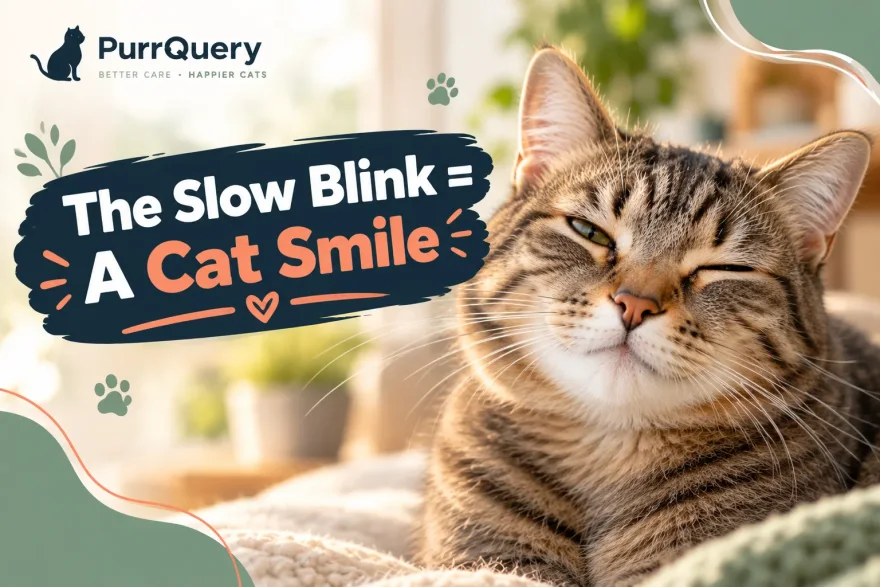
The slow blink is often called the "cat smile". Your cat looks at you, half-closes its eyes in a series of slow blinks, then narrows or closes them for a moment.
In 2020, psychologists at the Universities of Sussex and Portsmouth, led by Tasmin Humphrey and Karen McComb, became the first to test this experimentally. In the first experiment, with 21 cats from 14 households, cats narrowed their eyes more when their owners slow-blinked at them. In the second, cats were more likely to approach an unfamiliar person after a slow-blink interaction than when the person kept a neutral expression. The team concluded that slow blinking may be a form of positive emotional communication between cats and people. [Humphrey et al., Scientific Reports, 2020]
Try it: look at your cat with a relaxed face, narrow your eyes as you would in a soft smile, then close them for a second or two. If your cat blinks back, that is a good sign.
2. It holds its tail up when it sees you
A cat that walks towards you with its tail held straight up, often with a small curl at the tip, is saying a friendly hello. A University of Southampton study found that domestic cats use this tail-up signal as a friendly greeting, while the small wild cats studied did not, and concluded it probably evolved during domestication. [Cameron-Beaumont, 1997] A 2021 study found cats approached people tail-up in about 94% of interactions, usually right before rubbing against them. [Deputte et al., 2021]
3. Its body and face look relaxed
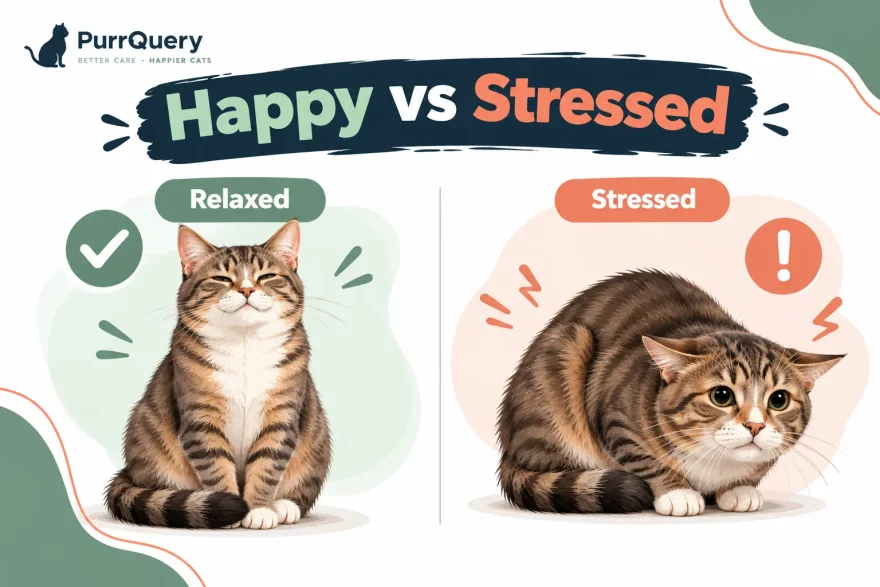
A happy cat's ears point forward or gently to the side, its eyes are soft rather than wide, its whiskers rest loosely, and its body is loose rather than crouched. Compare this with the facial signs vets use to spot pain on the Feline Grimace Scale: flattened ears, squinted eyes, a tense muzzle, whiskers pushed forward and a lowered head. [Feline Grimace Scale, 2019] A relaxed face is the opposite of all of these.
4. It purrs in calm moments
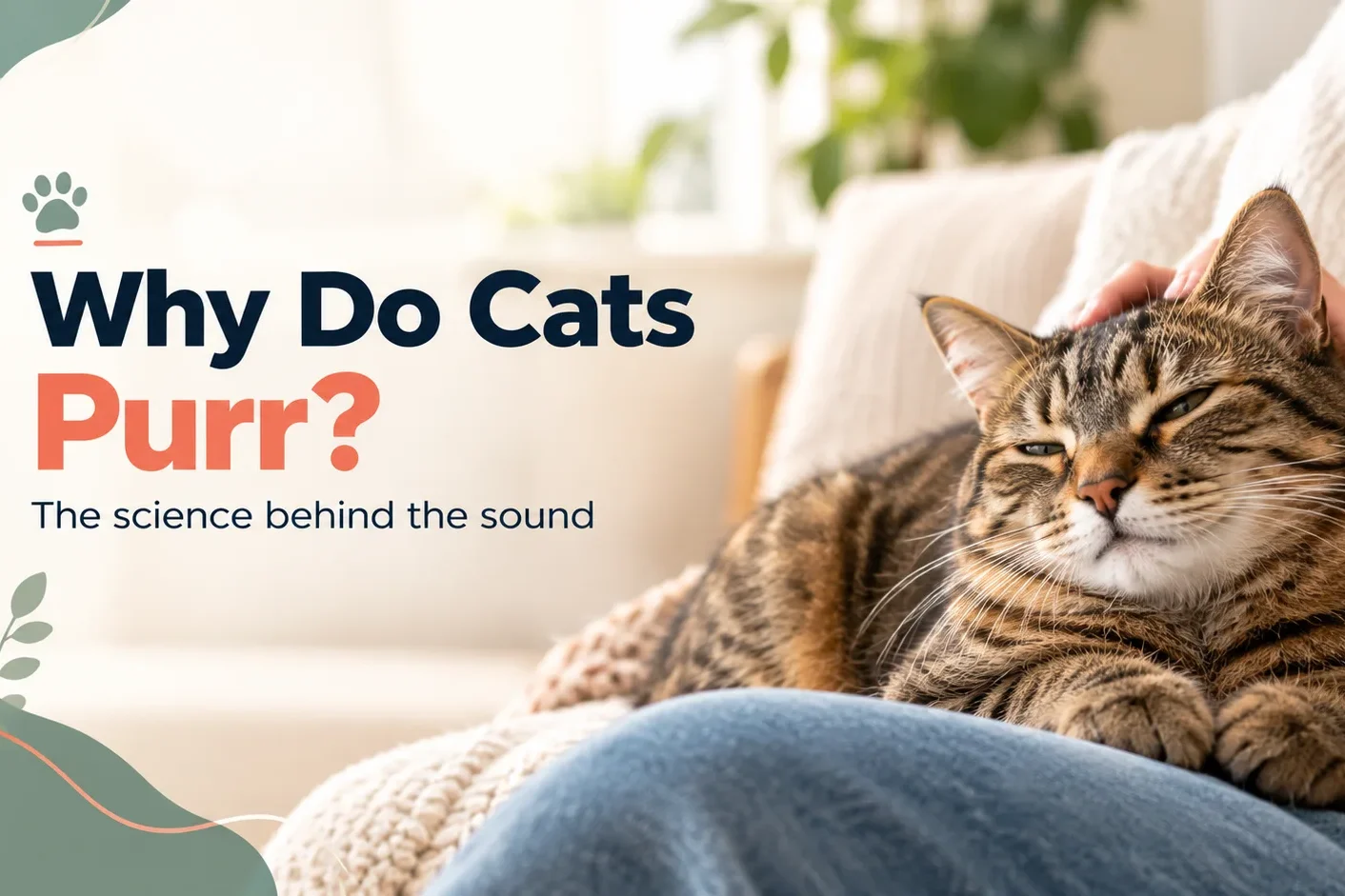
A cat purring on your lap with soft eyes and a loose body is usually content. But purring alone is not proof of happiness, because cats also purr when stressed, hungry or in pain, so read the purr together with the rest of the body. Our guide to why cats purr explains the different kinds of purr.
5. It kneads you or soft blankets
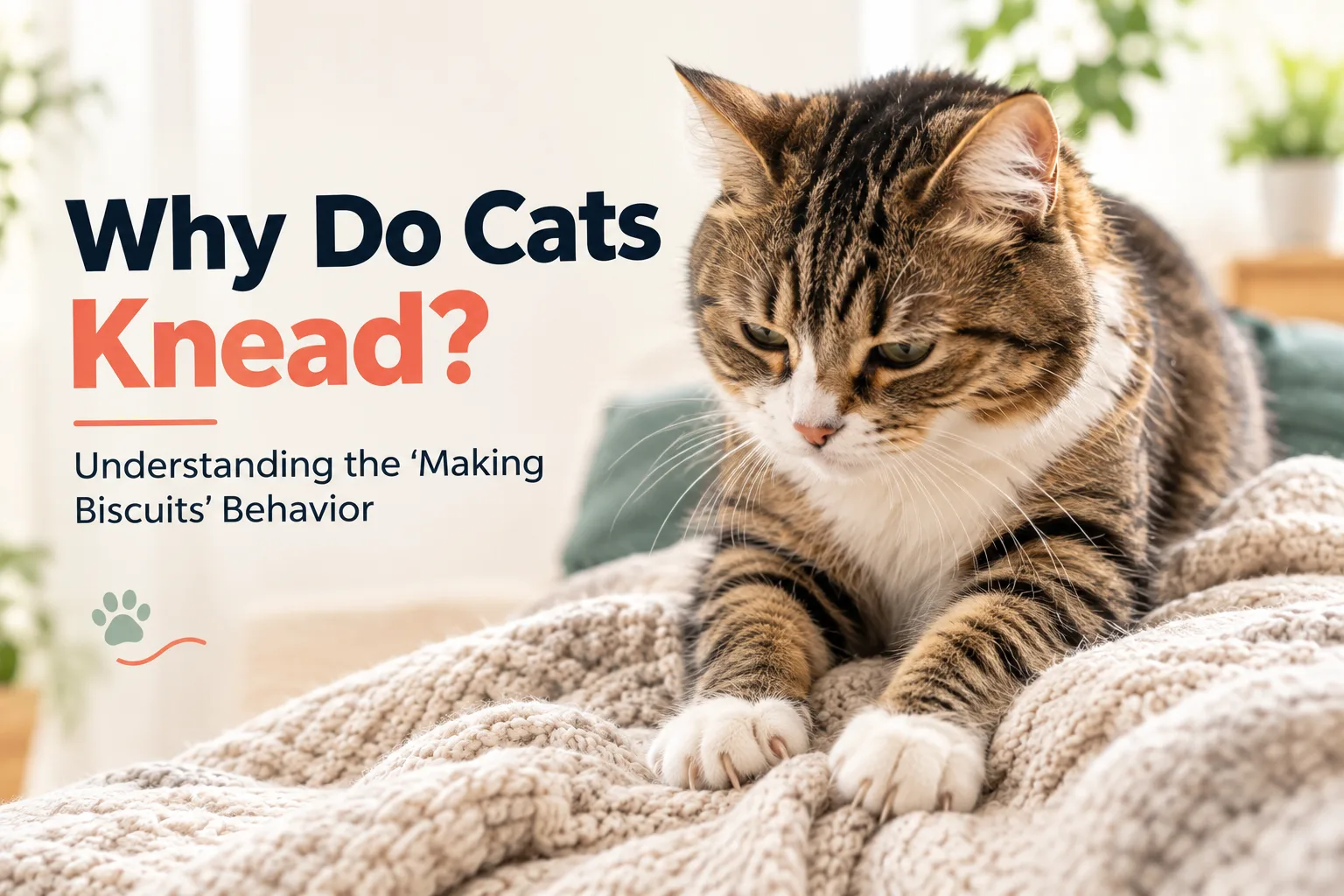
Kneading, or "making biscuits", is the rhythmic pushing of the front paws against something soft. Kittens knead their mother while nursing, and many adult cats keep the habit for moments when they feel safe and comfortable, often while purring on your lap. Our guide to why cats knead covers what each kind of kneading means.
6. It head-butts and rubs against you
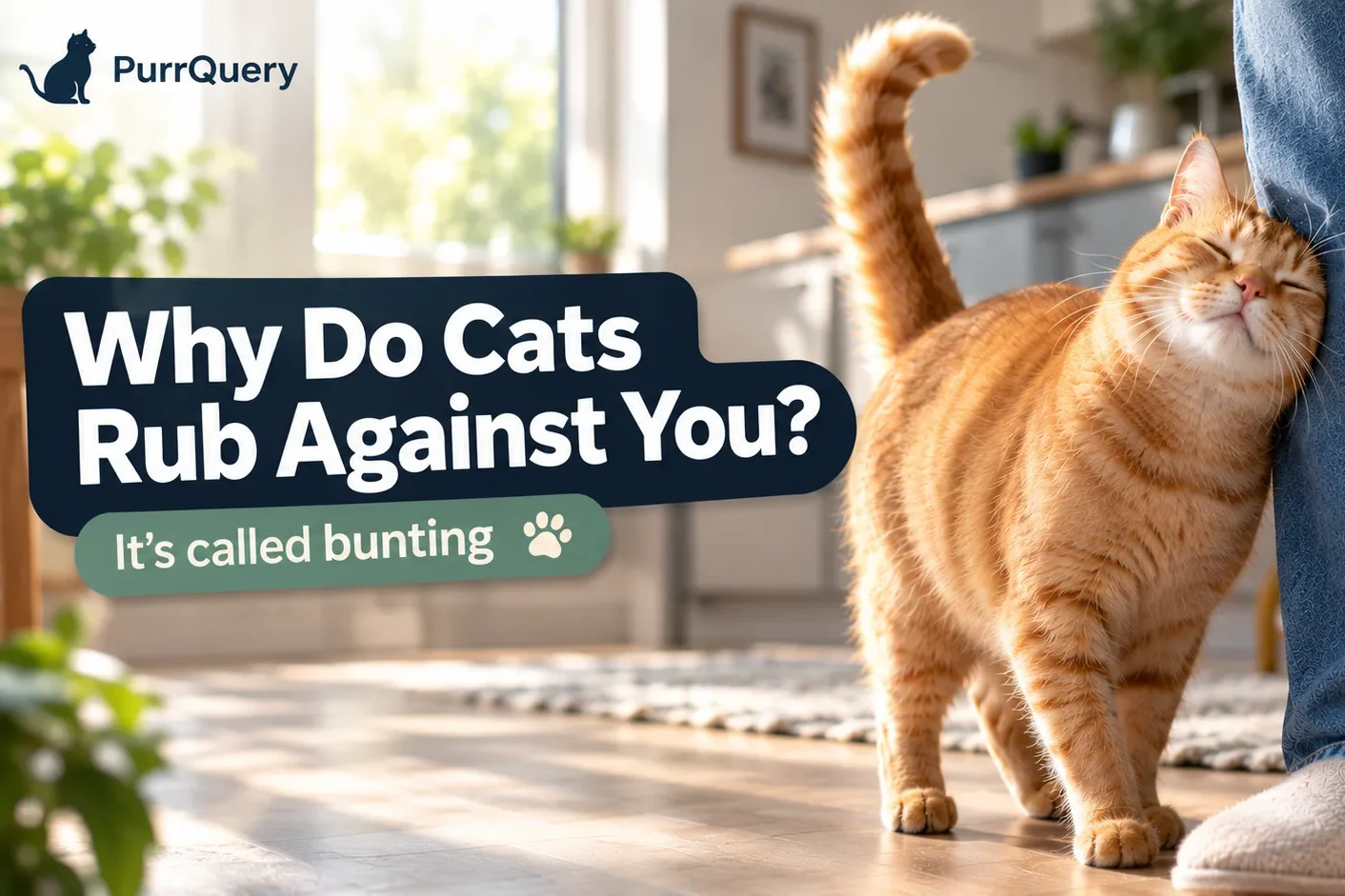
When a cat rubs its cheeks or forehead against you, it is leaving its scent on you and marking you as part of its safe, familiar group. [VCA Animal Hospitals] Cats in friendly groups do the same to each other, a behavior researchers call allorubbing, which veterinary behaviorist Sharon Crowell-Davis has described as "probably the feline equivalent of hugging and handshaking in people." [dvm360] Learn more in our guide to why cats rub against you.
7. It greets you and wants to be near you
A happy cat often comes to meet you at the door, follows you from room to room, or chooses to sit near you even when it doesn't want to be touched. In 2019, Oregon State University researchers led by Kristyn Vitale tested cats with the "secure base" test used for babies and dogs. Of the adult cats, 65.8% were securely attached to their owners (64.3% of kittens), close to the 65% of human infants who are securely attached to their caregivers. [Vitale et al., Current Biology, 2019; Oregon State University]
"The majority of cats use their owner as a source of security," Vitale said. "Your cat is depending on you to feel secure when they are stressed out." [Oregon State University]
8. It chirps and trills at you
Short, bright trills and chirrups are friendly greeting calls that cats use with each other and sometimes direct at people too. [International Cat Care] A cat that "talks" to you with these soft sounds, especially when you come home or at mealtime, is usually relaxed and engaged.
9. It sleeps in relaxed, open positions
Cats sleep a lot, and how they sleep can hint at how safe they feel. When a cat sleeps on its back with its belly exposed, it usually means it feels safe and comfortable in its environment. [PetMD] Relaxed cats also stretch right out when they are fully comfortable. [International Cat Care] Treat sleeping positions as a hint rather than proof, since every cat has its own habits.
10. It shows you its belly
Rolling onto its back near you is usually a friendly greeting, showing that the cat is relaxed and comfortable or in a playful mood. [International Cat Care] But it is rarely an invitation: many cats don't like being touched on the tummy, and most would rather be greeted with a stroke on the head or cheeks. [Cats Protection]
11. It plays and "hunts"
Happy cats play. They chase toys, stalk, pounce and invite you to join in. The feline environmental needs guidelines from the American Association of Feline Practitioners (AAFP) and the International Society of Feline Medicine (ISFM) list the opportunity for play and predatory behavior as one of the five essentials of a healthy cat environment. [AAFP and ISFM, 2013] A cat that suddenly stops playing may be stressed, bored or unwell.
12. It eats and drinks normally
A steady appetite is one of the most reliable signs that a cat is well. Low appetite and low water intake are common signs of stress, and PetMD advises a vet visit if they come with vomiting or diarrhea. [PetMD]
13. It grooms itself normally
A happy cat keeps a clean, smooth coat without overdoing it. Both extremes are warning signs. Many cats with arthritis stop grooming as well as they used to, and some cats in pain over-groom instead. [VCA Animal Hospitals] Licking patches of fur thin is also one of the common signs of stress. [PetMD]
14. It uses the litter box normally
Regular, relaxed use of the litter box is a quiet but important sign of a contented cat. Urinating outside the box is one of the most common signs of stress, but any medical condition that affects urination can cause it too, and cats with medical conditions may not act sick, so always check with your vet first. [Cornell Feline Health Center] Our guide to cat UTI symptoms explains which bladder signs are urgent.
15. It is curious and confident in its home
A happy cat explores, watches the window, investigates new boxes and spends time in the open rooms of the house. Stressed cats, by contrast, spend more time hiding under furniture or in wardrobes. [PetMD] Every cat needs hiding spots, but a happy cat doesn't live in them.
What does a happy cat look like?
Read a happy cat from nose to tail:
- Eyes: soft, often half closed, with slow blinks and normal-sized pupils.
- Ears: upright and facing forward, or turned gently to the side.
- Whiskers: relaxed and slightly out from the face, not pulled back or pushed forward.
- Body: loose and open, whether lying stretched out, sitting upright or rolling on its side.
- Tail: held up when walking towards you, or lying still and relaxed when resting.

Happy cat vs unhappy cat
This table shows the most common differences between a contented cat and a stressed or unwell one.
| Area | Happy cat | Stressed or unhappy cat |
|---|---|---|
| Eyes | Soft, slow blinks | Wide open with large pupils, or squinting |
| Ears | Forward and relaxed | Flattened, turned sideways or back |
| Tail | Held up in greeting, still when resting | Tucked under the body, thrashing or twitching |
| Body | Loose, stretched out, rolls over | Crouched, hunched, low to the ground |
| Social | Greets you, rubs against you, stays near | Hides, avoids you, or is suddenly very clingy |
| Sounds | Purrs, chirps, trills | Hissing, growling, or yowling more than usual |
| Appetite | Eats and drinks normally | Eats much less or much more |
| Grooming | Clean, smooth coat | Bald patches from licking, or a messy, unkempt coat |
| Litter box | Normal use | Peeing or pooping outside the box |
| Play | Plays and explores | Stops playing, sleeps more, hides |
A 2-minute weekly happiness check
The easiest way to know if your cat is happy is to learn its normal, then notice changes early. Once a week, run through these questions. If the answer to most of them is "yes, as usual", your cat is very likely content.
- Did your cat greet you with its tail up, or come to find you, at least once a day?
- Did it slow-blink at you, purr, knead or rub against you in calm moments?
- Did it eat its usual amount and drink normally?
- Did it play, or at least watch and chase a toy, most days?
- Is its coat clean and smooth, with no thin or bald patches?
- Did it use the litter box as usual, with normal-looking urine and stools?
- Did it spend time in the open rooms of the house, not only in hiding spots?
A "no" to one question on one day is rarely a worry. A "no" that lasts several days, or several "no" answers at once, is worth a closer look and, if it continues, a call to your vet.
Happy kitten vs happy senior cat
Happiness looks different at different ages. A happy kitten is busy: it plays in short, wild bursts, explores every corner, pounces on anything that moves and then falls deeply asleep. Lots of energy, a big appetite and constant curiosity are exactly what you want to see.
A happy senior cat is calmer. It may play for a minute rather than ten, nap more, and prefer a warm, low spot to the top of the cat tree. That slower pace is normal, but some changes are not. Many cats with arthritis stop grooming as well as they used to, and a cat in pain may stop jumping up or start avoiding being touched. [VCA Animal Hospitals] If your older cat seems "just old", ask your vet whether pain could be part of it, because treating it can bring back a lot of normal, happy behavior. Our senior cat care guide covers what changes after age ten.
Is my cat happy with my other cat?
In multi-cat homes, it helps to know what a friendly pair looks like. Cats that belong to the same social group groom each other (allogrooming), rub against each other (allorubbing), and often rest or sleep touching. [Crowell-Davis et al., 2004] Approaching each other with tails up before rubbing is another good sign.
Cats that only tolerate each other look different. They may avoid sharing rooms, stare at each other, block doorways, food bowls or the litter box, or have one cat that hides whenever the other appears. In that case, the second pillar above, separate key resources in different places, matters even more, so that no cat has to pass another to eat, drink or use the litter box.
Signs your cat is unhappy or stressed
Cats hide discomfort well, so stress often shows up as a change in routine rather than an obvious signal. Common signs include excessive hiding, aggression towards people or other animals, a lack of appetite, over-grooming and going to the toilet outside the litter tray. [Woodgreen Pets Charity] Common causes include a new pet or baby, building work, a house move, unfamiliar cats outside the window, or conflict with another cat at home.
Many signs of stress overlap with medical problems. Aggression, for example, can come from painful conditions like arthritis or dental disease. [PetMD] Any sudden change in behavior should alert you that your cat needs veterinary attention, so see your vet before assuming it is "just stress". [VCA Animal Hospitals] Our guide to the signs your cat is sick covers what to watch for.
Can cats feel happy?
Cats cannot tell us how they feel, so scientists study their emotions through behavior, body language and health. The research above shows that cats have clear positive social signals, such as slow blinks, tail-up greetings and rubbing, and that most form secure bonds with their owners.
Feline vets now talk about well-being in a broad sense. The AAFP uses "well-being concepts" as a term that covers welfare, well-being, quality of life and happiness, and describes quality of life as "an individual's satisfaction with its physical and psychological health, its physical and social environment and its ability to interact with that environment." [AAFP, 2021]
In plain terms, cats very likely experience contentment, comfort and pleasure, even if their version of happiness is quieter than a dog's. You see it in how they behave, not in a smile.
How to make your cat happier
The AAFP and ISFM feline environmental needs guidelines, written by a panel of feline vets and behavior experts, set out five pillars of a healthy feline environment, and state that meeting these needs is "essential (not optional)" for every cat. [AAFP and ISFM, 2013]
- A safe place. Give your cat at least one quiet hiding spot it can reach easily, such as a covered bed, a box on its side or a high shelf.
- Multiple, separated key resources. Put food, water, litter boxes, scratching posts, play areas and beds in different places, with extras in multi-cat homes so no cat has to compete.
- Play and "hunting". Play with wand toys for a few short sessions a day, letting your cat stalk, chase and catch. Food puzzles let it "hunt" for meals.
- Positive, consistent and predictable contact with people. Keep a steady routine for meals and play, and let your cat choose when to be touched.
- Respect for smell. Cats live by scent. Avoid strong air fresheners and scented litter, and don't wash every blanket at once, so your cat's own scent stays in its space.
How you touch your cat matters too. A 2021 study found cats were friendlier and less aggressive when people gave them choice and control, paid attention to their body language, and kept touch mainly to the temporal region, between the eyes and ears. [Haywood et al., 2021]
Is my cat happy indoors? Indoor cats can be very happy when these five needs are met. Window perches, cat trees, climbing shelves and daily play make a big difference. If you have just brought a cat home, our guide for new cat owners covers setting up a cat-friendly home from day one.
And don't forget the simplest step: slow-blink at your cat, and let it come to you.
The bottom line
A happy cat shows it in small, quiet ways: a slow blink across the room, a tail raised as you walk in, a cheek pressed against your leg, and a normal, steady routine of eating, playing, grooming and sleeping. Learn your own cat's normal, give it the five essentials of a good home, and watch for sudden changes. That is the most reliable way to know your cat is happy.
Want to understand more of your cat's signals? Read why cats purr, knead and rub against you.
This article is general information and does not replace advice from a veterinarian. If your cat's behavior changes suddenly, contact your vet.
Frequently asked questions
How do I know if my cat is happy?
Look for slow blinks, a tail held up when it greets you, relaxed ears and whiskers, purring and kneading in calm moments, and rubbing against you. A happy cat also eats, plays, grooms and uses the litter box normally.
How can you tell if a cat is happy with you?
A cat that is happy with you greets you, follows you, sits near you, slow-blinks at you and rubs its cheeks on you. Research shows most cats form secure bonds with their owners and use them as a source of security.
What do cats do when they are happy?
Happy cats play, explore, nap in relaxed positions, purr, knead, trill at their people and greet them with their tails up. They also keep normal eating, grooming and litter habits.
How do cats show happiness?
Mostly through body language: soft eyes, slow blinks, forward ears, a raised tail and a loose body. They also show it through touch, by rubbing, head-butting and kneading, and through friendly sounds like purrs and trills.
Do cats feel happiness?
Cats very likely feel contentment and pleasure. Scientists measure it through behavior, such as slow blinks, tail-up greetings and secure attachment to owners, because cats cannot tell us directly.
Is a purring cat always happy?
No. Cats also purr when stressed, hungry or in pain. Check the rest of the body: relaxed eyes and a loose posture usually mean contentment.
Is my cat happy if it sleeps all day?
Cats naturally sleep many hours a day, so lots of sleep is normal, and relaxed, open sleeping positions are a good sign. A cat that suddenly sleeps much more, hides or stops playing may be stressed or unwell.
Can a cat be happy as an only cat?
Yes. Many cats are happy as the only cat in a home, as long as they have play, a predictable routine and positive time with their people. Some cats enjoy a companion, but introductions need to be slow and careful.
Sources
- Humphrey et al. (2020), Scientific Reports: The role of cat eye narrowing movements in cat-human communication Cats return slow blinks and approach people who slow-blink.
- Vitale, Behnke & Udell (2019), Current Biology: Attachment bonds between domestic cats and humans Most cats are securely attached to their owners.
- Oregon State University: Cats, like children and dogs, develop attachments to their caregivers The 64.3% and 65.8% secure attachment figures, and Vitale's comments.
- Ellis et al. (2013), Journal of Feline Medicine and Surgery: AAFP and ISFM feline environmental needs guidelines The five pillars of a healthy feline environment.
- AAFP (2021): General principles of feline well-being Definitions of well-being and quality of life in cats.
- Cameron-Beaumont (1997), University of Southampton PhD thesis The tail-up greeting in domestic cats.
- Deputte et al. (2021), Animals: Heads and tails, an analysis of visual signals in cats Cats approach people tail-up before rubbing against them.
- Haywood et al. (2021), Frontiers in Veterinary Science: Best-practice handling guidelines for human-cat interactions Choice, attention and touch on the temporal region.
- Evangelista et al. (2019), Scientific Reports: Feline Grimace Scale The facial signs of pain in cats.
- International Cat Care: Cat communication Trills, the social roll and relaxed body language.
- Cats Protection: Why cats show their tummies Belly showing as a greeting, and why many cats dislike tummy rubs.
- PetMD: Cat sleeping positions and what they mean Sleeping belly up as a sign of feeling safe.
- PetMD: Signs your cat is stressed Common stress signs and their overlap with medical problems.
- Woodgreen Pets Charity: Moving house with a cat Common signs of stress in cats.
- Cornell Feline Health Center: House soiling Medical causes of litter box problems.
- VCA Animal Hospitals: How do I know if my cat is in pain? Grooming changes in cats in pain.
- VCA Animal Hospitals: Recognizing signs of illness in cats Why any sudden change needs a vet's attention.
- dvm360: Dispelling the myth of the asocial cat (Sharon Crowell-Davis) Allorubbing as the feline equivalent of hugging.
- VCA Animal Hospitals: Why do cats rub their faces on you and objects? Rubbing as scent marking.
General information, not veterinary advice. If your cat's behavior has changed suddenly, speak to a vet rather than an article.
How this guide was researched and checked is set out in how our guides are written.

Want an answer in seconds?
The calculators handle age, due dates and portions without an account.