Why Do Cats Rub Against You? What Science Says It Means
 By Ahsan Nawaz
Published:
By Ahsan Nawaz
Published:
On this page
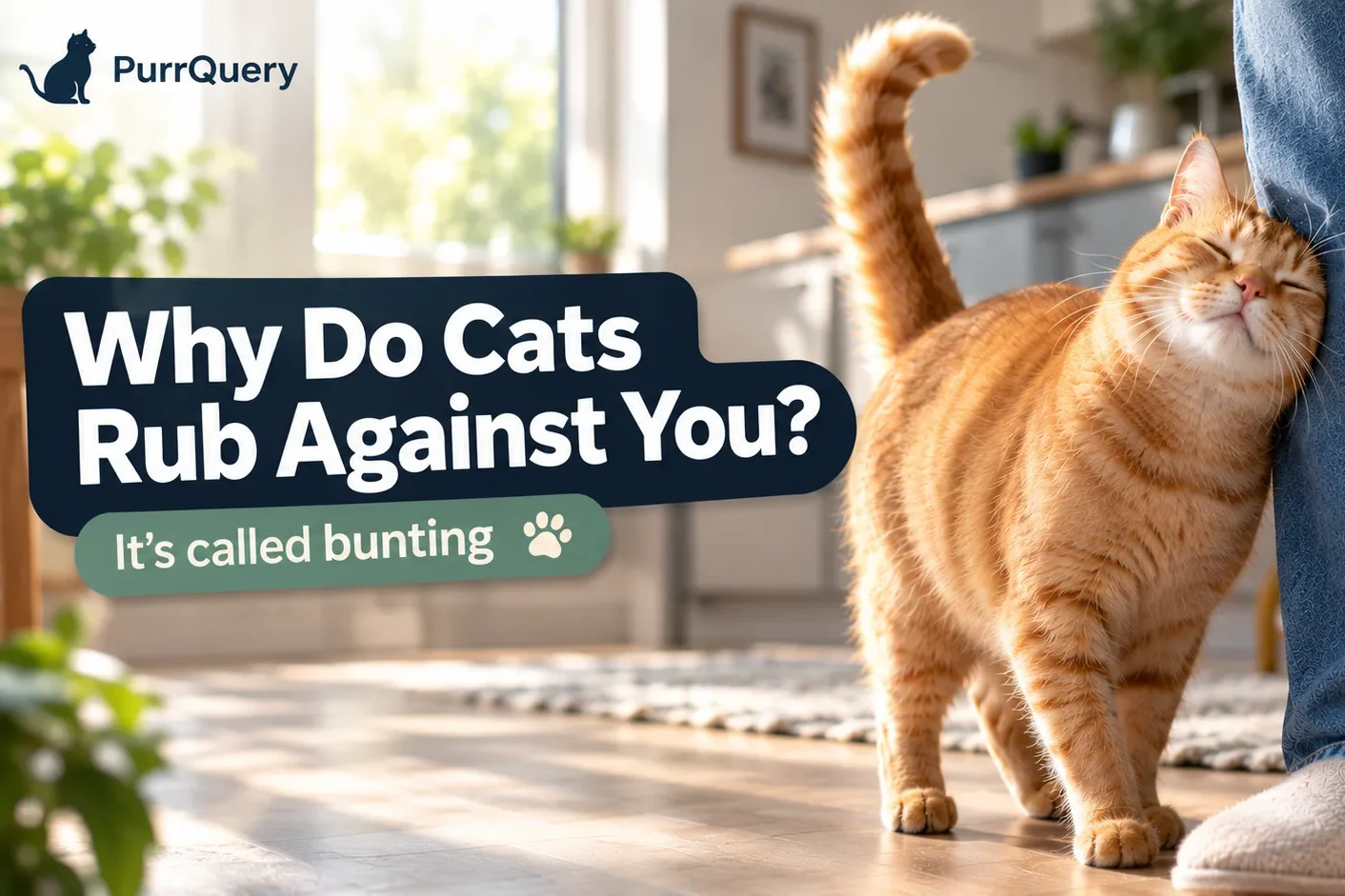
Cats rub against you mainly to leave their scent on you, from glands on their cheeks, chin, head and the base of the tail. It marks you as safe and part of their group. Cats also rub to say hello, to collect your scent, to ask for food or attention, and because it feels good. Rubbing the head against you has a name: bunting. [VCA Animal Hospitals; PetMD]
So if you have ever wondered "why does my cat rub against me?", the short answer is that it is a compliment. This guide explains what each kind of rub means, why cats target your legs, what to do when rubbing turns into biting, and when it is worth a call to your vet.
Key facts about cats rubbing against you:
- Cats have scent glands on their cheeks, around the mouth, under the chin, near the ears, on top of the head and at the base of the tail.
- Researchers have isolated five facial pheromones from cats' cheek secretions, named F1 to F5.
- People cannot smell these pheromones, but other cats can.
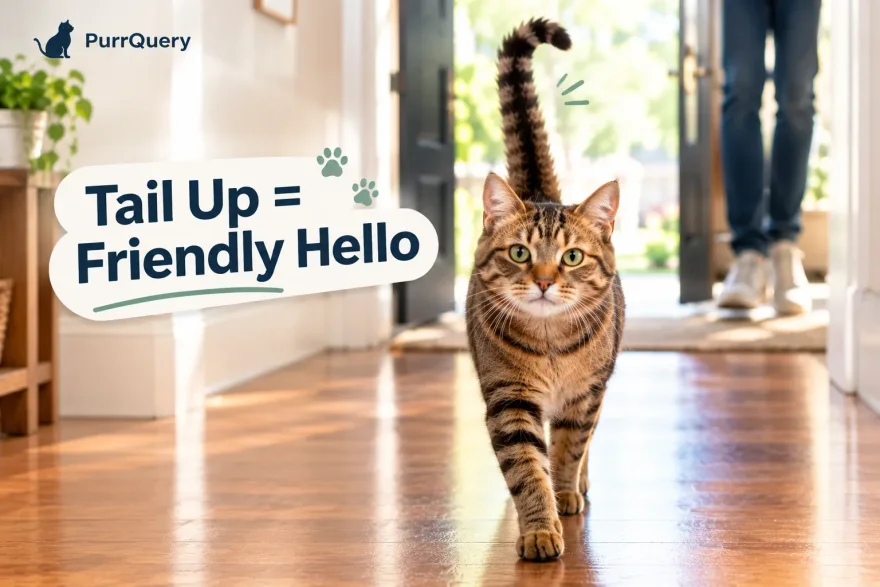
- A cat that walks up with its tail held straight up and then rubs your legs is giving a friendly greeting.
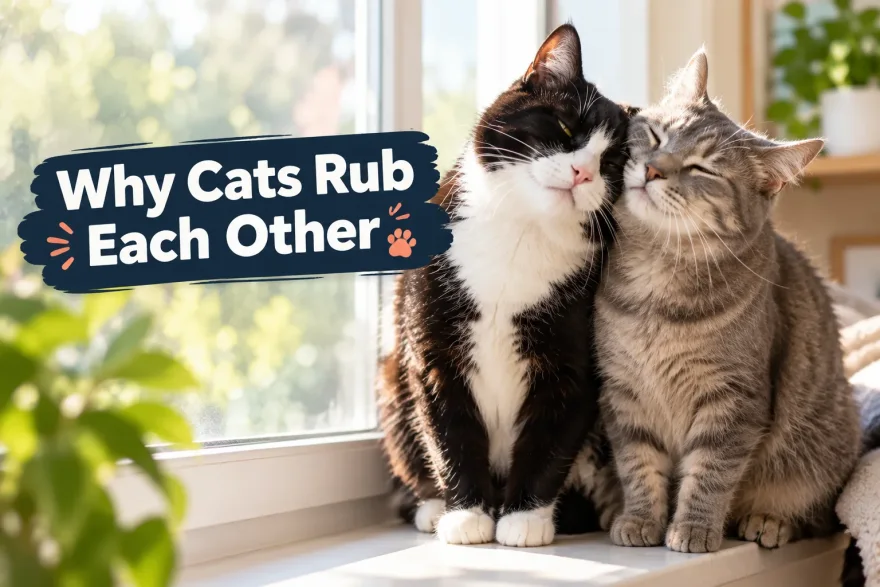
- Cats rub each other in the same way, a behavior researchers call allorubbing.
You walk through the door, and before you put your bag down your cat is weaving between your ankles, pressing its cheek against your shins and leaning its whole body into your legs. It feels like a warm welcome, and it is. But a cat rubbing against you is also talking in a language built mostly on smell.
What is it called when a cat rubs against you?
Rubbing the head or face against a person, another cat or an object is called bunting, sometimes head-butting or head-bunting. When a cat rubs another cat, researchers call it allorubbing (from the Greek allo, meaning "other"). Rubbing a chair leg, a door frame or the corner of a wall is simply object rubbing.
Cats use different parts of the body for each kind of rub. A head bunt leads with the forehead. A face rub uses the cheeks, lips and chin. A full body rub runs from the cheek along the side of the body and often ends with the tail wrapping around your leg. Whether a cat seems to rub, brush or bump against you, it is the same behavior.
Where are a cat's scent glands?
To understand why cats rub against you, it helps to know where their scent comes from. VCA Animal Hospitals lists scent glands on a cat's cheeks, around the mouth, under the chin and by the ears. [VCA Animal Hospitals] PetMD adds the top of the head and the base of the tail. [PetMD] Cats also have glands in their paw pads and between their toes, which they use to mark territory, one reason scratching is a form of marking too. [Pageat & Gaultier, 2003]
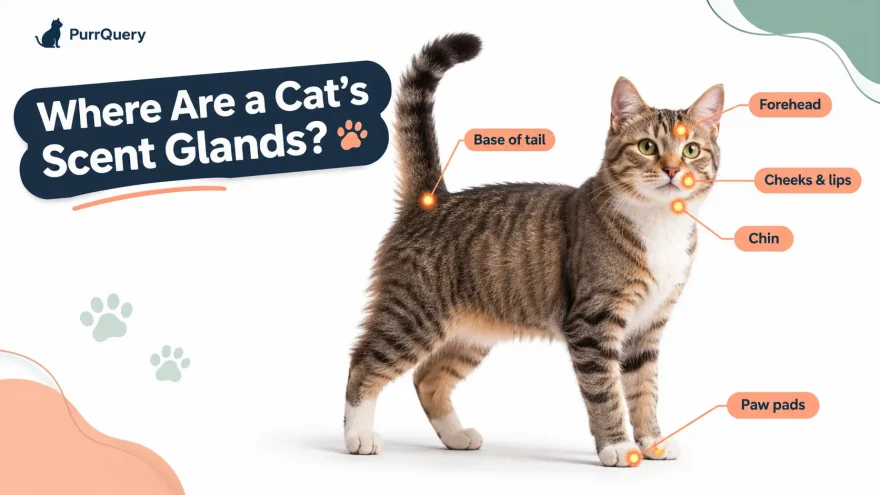
These glands release oily secretions that contain pheromones, chemical messages other cats read through smell. Researchers have isolated five facial pheromones, F1 to F5, from the secretions of cats' cheeks, and the job of three of them is known: [Pageat & Gaultier, 2003]
- F3 is left when a cat rubs its cheek on objects around its home. It is linked to marking familiar places as safe.
- F4 is used for allomarking, when a cat rubs other cats or people it is friendly with.
- F2 is linked to sexual marking by unneutered tomcats.
You will never smell these signals, but to other cats your legs, your sofa and your favorite sweater carry a clear message: this all belongs to one cat's family.
Why do cats rub against you? 7 reasons
Most of the time, a cat rubbing against you is a very good sign. Here are the seven main reasons.
1. To mark you as safe and part of the family
The main reason cats rub against you is to put their scent on you. The glands on a cat's face release pheromones it uses to mark its territory, and that includes the people it lives with. [VCA Animal Hospitals]
This is not ownership in a cold sense. A familiar scent helps a cat feel calm and in control, and when you smell like your cat, you smell like home. Cats tend to rub their scent onto people and places they feel comfortable with, so a cat that rubs you is paying you a real compliment.
2. To say hello
Watch your cat when you get home. It usually walks towards you with its tail held straight up, often with the tip slightly curled, and then rubs against your legs. That tail position matters.
In a 1997 University of Southampton study, Charlotte Cameron-Beaumont compared domestic cats with four species of small wild cats. The wild cats used almost all the same social signals, with one exception: the tail-up signal. She found that tail-up was closely linked in time with social rubbing, and concluded it probably evolved as a signal in the domestic cat, possibly during domestication. [Cameron-Beaumont, 1997]
A 2021 study in the journal Animals found the same pattern with people: cats most often approached a person with the tail up before rubbing against them. Tail-up showed up in about 94% of cat-to-human interactions, compared with about 22% between cats, and the authors compare it to the way kittens approach and greet their mother. [Deputte et al., Animals, 2021]
3. To build a shared group scent
Cats that live together rub against each other, and they treat you the same way. In a review in the Journal of Feline Medicine and Surgery, veterinary behaviorist Sharon Crowell-Davis and colleagues explain that allorubbing is usually preceded by at least one cat approaching with its tail up, and that cats often purr while they rub. [Crowell-Davis et al., 2004] Crowell-Davis has described allorubbing as "probably the feline equivalent of hugging and handshaking in people." [dvm360]
One likely purpose is to blend everyone's scent into a single group smell. VCA notes that cats who bunt other cats in their colony create a combined scent, then rub it on you too, so you smell like the group. [VCA Animal Hospitals]
4. To gather information about you
Rubbing works in both directions. As a cat leaves its scent, it also picks up yours, along with every new smell you bring home. When cats rub against new people or animals, they may be gathering information rather than asking for attention. [PetMD]
That is why your cat often rubs you more after you come back from work, a trip, the vet or a friend's house with a dog. You smell different, and your cat wants to check what has changed and put its own scent back on top.
5. To ask for food or attention
Cats learn quickly that rubbing gets results. A cat that rubs your legs in the kitchen, walks to its bowl and back again is not being subtle, and a cat rubbing the cabinet where its food is kept is most likely telling you it is hungry. [PetMD] The same goes for rubbing your laptop, your phone or your book: it is a polite but firm request to look at the cat instead.
6. Because it feels good
Rubbing is not only about messages. Veterinary behaviorist Nicholas Dodman, Professor Emeritus at Tufts University's Cummings School of Veterinary Medicine, has said of head rubbing: "This feels good and probably releases endorphins." [Tufts Catnip] So a cat may rub your hand, a table leg or a cardboard box simply because it is pleasant, the way you might stretch or rub a tired neck.
7. Because of hormones: heat
Female cats that are not spayed rub against people and objects much more when they come into heat. VCA describes cats in heat persistently rubbing against their owners or objects, rolling on the floor more often, raising their rear quarters when stroked along the back, and becoming very vocal. [VCA Animal Hospitals] If your young, unspayed female suddenly becomes very rubby and loud, heat is the most likely reason. Talk to your vet about spaying, and if she may already have mated, our guide to how long cats are pregnant explains what to expect.
What does it mean when a cat rubs against you?
What it means when cats rub against you depends on how and when your cat does it. Use this table as a quick guide.
| What your cat does | What it usually means | What to do |
|---|---|---|
| Tail up, then rubs your legs when you come home | A friendly hello and welcome back | Say hello, offer a hand to sniff, stroke its cheeks |
| Head-butts your face, hand or chin | Strong trust and affection | Lean in gently and let your cat lead |
| Rubs your legs, then walks to the food bowl | "Feed me" | Feed at set times so rubbing does not become a demand habit |
| Rubs your laptop, phone or book | It wants your attention | Take a short break for petting or play |
| Rubs you a lot after you visit a home with pets | Checking new smells and re-marking you | Let it sniff and rub; this is normal |
| Rubs, rolls and yowls (unspayed female) | Likely in heat | Talk to your vet about spaying |
| A stray cat rubs your legs | Friendly interest and gathering information | Let it sniff first; do not grab or pick it up |
So, when a cat rubs against you, what does it mean? In nearly every case, your cat trusts you, wants to stay connected to you, and wants you to smell like home.
Why do cats rub against your legs?
Cats rub against your legs for a simple reason: your legs are at cat height. To reach your face, a cat has to climb on you, so your shins and ankles are the easiest place to leave a scent mark and say hello at the same time.
A leg rub usually follows a set pattern. The cat approaches tail up, presses its cheek against your leg, runs the side of its body along you, and often finishes by wrapping its tail around your leg. Many cats then turn and do it again on the other leg, weaving a figure of eight between your feet. The tail-up approach before the rub is exactly what researchers recorded when cats greeted people. [Deputte et al., Animals, 2021]
So what does it mean when cats rub against your legs? It is a greeting, a scent mark and a touch all at once, the closest thing a cat has to a hug.
Why does my cat keep rubbing against me?
Some cats rub against their owners constantly, and usually that is just a very social cat. Common reasons a cat keeps rubbing against you include:
- Your scent keeps changing. Showers, perfume, laundry and time outside all fade your cat's mark, so it tops it up, especially when you come home smelling of new things.
- It has learned that rubbing works. If every rub earns food, treats or play, rubbing becomes more frequent.
- It needs reassurance. A move, a new pet, a new baby or building work can make a cat rub more to make its world smell familiar again.
- It is in heat. See reason 7 above.
If the rubbing is sudden, unusually intense, or comes with other changes, read the "When to worry" section below.
Why do cats rub against your legs, then bite you?
It can feel confusing when a cat rubs you lovingly, lets you stroke it, and then bites. This usually happens because the cat asked for a quick greeting and got more handling than it wanted. Vets call it petting-induced aggression, or overstimulation.
Research helps explain it. In a 2015 study in Applied Animal Behaviour Science, researchers led by Sarah Ellis stroked cats on different parts of the body and found that the caudal region, near the base of the tail, produced the most negative reactions. Surprisingly, cats reacted more negatively to their familiar handlers than to strangers. [Ellis et al., 2015] Other work suggests cats respond best to touch on the temporal region, the area between the eyes and ears, which is also where many facial glands sit. [Haywood et al., 2021]
In short, a cat that rubs you is asking for contact on its own terms, usually face first. Long strokes down the back to the tail, belly rubs or being picked up can push it past its limit.
Warning signs to stop petting: a twitching or thumping tail, rippling skin on the back, ears turning sideways or back, and the cat turning its head towards your hand.
How should you respond when your cat rubs against you?
A 2021 study in Frontiers in Veterinary Science tested simple handling rules built around the letters C-A-T with 100 shelter cats: give the cat Choice and control, pay Attention to its body language, and limit Touch mainly to the temporal region of the head. Cats handled this way rubbed against people more often, and the cats handled without the rules showed significantly more aggression towards people. [Haywood et al., 2021] Here is how to put that into practice:
- Let the cat come to you. Stay still and let it finish its rub.
- Offer a hand at nose height. Many cats will sniff your fingers and then rub their cheek along them.
- Stroke where the glands are. Gently stroke the cheeks, under the chin and the side of the head between the eyes and ears.
- Keep it short. Two or three strokes, then pause. If the cat pushes into your hand, it wants more.
- Let it leave. If the cat walks away, do not follow it or pick it up.
If your cat is anxious after a move or another change, a synthetic copy of the F3 facial pheromone, sold as Feliway Classic, is sometimes used to help it feel settled. A 2023 evidence review in Veterinary Evidence looked at five studies of its use at the vet: four found improvement in some signs of acute stress, and the overall evidence was rated moderate. [Veterinary Evidence, 2023] Think of it as a support, not a fix, and ask your vet before buying.
What if a stray cat rubs against you?
Feral and stray cats living in a colony often rub against each other to spread their pheromones across the group, and a friendly stray may treat you the same way. [PetMD] A stray that rubs your legs is usually curious and relaxed around people, and may be checking your scent or hoping for food.
A few sensible precautions: let the cat come to you, do not pick it up or hold it, and avoid touching a cat that looks ill or injured. You do not know an unknown cat's vaccination history, so wash your hands afterwards. If you are bitten or deeply scratched, wash the wound with soap and water for at least 15 minutes and seek medical advice. [World Health Organization] If a friendly stray keeps visiting, a local rescue group or vet can check it for a microchip.
Why is my cat rubbing against me so much? When to worry
Normal rubbing is calm, rhythmic and part of a greeting or a cuddle. Excessive rubbing can have medical causes, including allergies, fleas, ear infections and skin hypersensitivity. [PetMD] Call your vet if your cat's rubbing changes suddenly, especially with any of these signs:
- Rubbing its face hard against floors or furniture, or pawing at its face, mouth or ears. Pawing at the mouth is one sign of dental pain. [VCA Animal Hospitals]
- Rubbing combined with heavy scratching, hair loss or scabs, which can point to fleas or skin allergies.
- Rubbing much more than usual together with hiding, eating less, or changes in litter box use.
- Rubbing, rolling and yowling in an unspayed female (most likely heat, but worth discussing with your vet).
A change in a familiar habit is often the first clue that something is wrong, and our guide to the early signs a cat is unwell covers what else to watch for.
The bottom line
When a cat rubs against you, it is doing three things at once: saying hello, leaving its scent, and reading yours. Research suggests the tail-up rub is a greeting that developed in domestic cats, and cats use the same rubbing to bond with the other cats in their group. So the next time your cat winds around your ankles, take it as what it is: your cat telling you that you belong together. For the bigger picture, see our checklist of the signs your cat is happy.
Rubbing often comes with two other comfort behaviors. Read our guides on why cats purr and why cats knead to understand the rest of the conversation.
This article is general information and does not replace advice from a veterinarian. If your cat's behavior changes suddenly, contact your vet.
Frequently asked questions
Why do cats rub against you?
Cats rub against you to put their scent on you from glands on their face and the base of the tail. It marks you as safe and part of their group. They also rub to say hello, check your smell, ask for food or attention, and because it feels good.
When a cat rubs against you, what does it mean?
It usually means trust and affection. A tail-up rub when you come home is a greeting. A rub followed by a walk to the food bowl is a request. A sudden, intense change in rubbing can be a health sign worth a vet check.
Why does my cat rub against me?
Your cat is mixing its scent with yours so you smell familiar, greeting you, and checking any new smells you have picked up. Cats tend to rub on people they feel safe with, so it is a good sign.
Is it good when a cat rubs against you?
Yes. Cats tend to leave their scent on people and places they feel comfortable with. A cat that rubs against you treats you as part of its family.
Why does my cat head-butt me?
A head-butt, or bunt, is a strong sign of trust. Your cat is pressing the scent glands on its head and cheeks against you, and it is choosing to put its face close to yours.
Why does my cat rub its face on my phone or glasses?
These are objects you touch all day, so they smell strongly of you. Your cat is mixing its scent with yours, and it may also be asking you to put the phone down.
Should I rub my cat back?
Gently, yes. Stroke its cheeks, chin or the side of its head between the eyes and ears, the areas most cats prefer. Avoid long strokes down to the tail and belly rubs unless your cat clearly enjoys them.
Why do cats rub against your legs when you come home?
You come home smelling of the outside world. Your cat greets you, checks the new smells, and covers them with its own scent so you smell like home again.
Sources
- VCA Animal Hospitals: Why do cats rub their faces on you and objects? Facial scent glands, territory marking and the shared group scent.
- PetMD: Why do cats rub against you? Glands on the head and tail base, information gathering, food requests, colony cats and medical causes of excessive rubbing.
- Pageat & Gaultier (2003), Veterinary Clinics of North America: Current research in canine and feline pheromones The F1 to F5 facial pheromones and the paw pad glands.
- Cameron-Beaumont (1997), University of Southampton PhD thesis: Visual and tactile communication in the domestic cat and undomesticated small felids The tail-up signal in domestic and small wild cats.
- Deputte et al. (2021), Animals: Heads and tails, an analysis of visual signals in cats Cats approach people tail-up before rubbing against them.
- Crowell-Davis, Curtis & Knowles (2004), Journal of Feline Medicine and Surgery: Social organization in the cat Allorubbing, the tail-up approach, and purring while rubbing.
- dvm360: Dispelling the myth of the asocial cat (Sharon Crowell-Davis) Allorubbing as the feline equivalent of hugging and handshaking.
- Ellis et al. (2015), Applied Animal Behaviour Science: Cats' responses to being stroked The base of the tail produced the most negative reactions.
- Haywood et al. (2021), Frontiers in Veterinary Science: Best-practice handling guidelines for human-cat interactions The C-A-T guidelines and touch on the temporal region.
- Crump (2023), Veterinary Evidence: F3 feline facial pheromone analogue for acute stress Five studies of synthetic facial pheromone at the vet.
- Tufts Catnip: The art of bunting (Nicholas Dodman, archived) Head rubbing feels good and probably releases endorphins.
- VCA Animal Hospitals: Estrus cycles in cats Rubbing, rolling and vocalizing in cats in heat.
- VCA Animal Hospitals: Dental pain in cats Pawing at the mouth as a sign of dental pain.
- World Health Organization: Rabies fact sheet Wound care after an animal bite.
General information, not veterinary advice. If your cat's behavior has changed suddenly, speak to a vet rather than an article.
How this guide was researched and checked is set out in how our guides are written.

Want an answer in seconds?
The calculators handle age, due dates and portions without an account.