Can Cats Eat Tuna? A Safe Feeding Guide

On this page
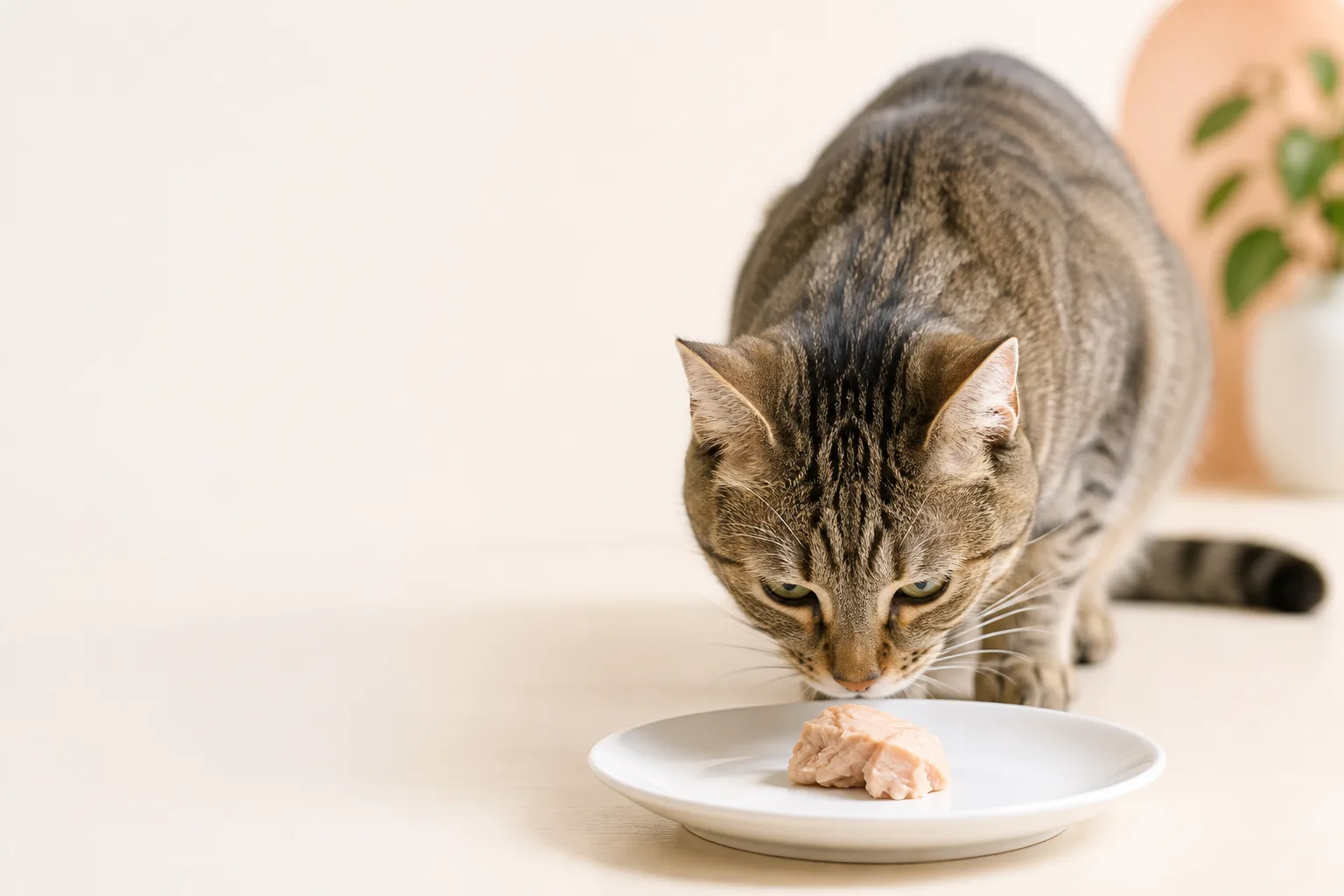
Tuna is not off the table for a cat, but it is not a food to build a habit around either. The short version: small amounts, plain, and only now and then, never a daily extra and never a stand-in for a real meal. Cats want tuna badly enough that it is worth understanding exactly why the caution exists, rather than either handing it over freely or cutting it out for no clear reason.
None of the concerns below turn tuna into a food to fear. They are reasons to keep it small and infrequent, which is a very different instruction than "never," and one that is easy to follow once the reasoning behind it is clear rather than just handed down as a rule.
This guide is written from published veterinary sources, named and linked as they come up and listed again at the bottom.
Is tuna safe for cats?
Yes, in small amounts and only occasionally. A bite of plain tuna, with nothing added, is unlikely to cause harm as a rare extra, and tuna is not toxic to cats the way onion or garlic is. That puts it in a different category from foods that need to be avoided outright.
What tuna is not is a food to offer regularly. It does not belong in a cat's diet as a staple, and whole tuna, however it is prepared, is not a substitute for a complete, balanced cat food. The reasons for that caution are specific rather than vague, and they are worth going through one at a time: mercury, a fixation cats can develop toward it, an enzyme in raw fish, and the fact that tuna made for people is not built to the same nutritional spec as tuna made for cats.
A useful way to think about it: a bite or two, offered every so often, sits in the same category as any other occasional extra. Tuna as a daily addition, a meal replacement, or the only thing a fussy cat will reliably eat is a different situation entirely, and each of the sections below explains a different piece of why that shift matters.
Why can't cats eat tuna often?
Mercury is the main reason tuna stays occasional rather than regular. Tuna accumulates mercury as it feeds over its lifetime, and larger, older fish carry more of it in their tissue than smaller, younger ones do. That accumulation does not reset between meals; it builds.
A cat is a small animal, and repeated tuna feedings, even modest ones, add up to real mercury exposure over time in a way a single occasional bite does not. The same amount of mercury means more, relative to body size, in an animal that weighs a few kilograms than it would in a much larger one, which is part of why a feeding pattern that might be a minor consideration elsewhere is worth taking seriously in a cat. A veterinary nutritionist at Tufts University makes the same point: a cat eating tuna as its main diet takes in far more mercury for its body weight than even a person who eats a lot of tuna.
The risk is not in any one piece of fish; it is in the pattern of feeding tuna often enough that the exposure keeps compounding, meal after meal, without ever being cleared out in between. That is exactly why tuna belongs in the "occasional treat" category and not the "regular food" one, and why a cat who gets tuna every day is being exposed to something a cat who gets it once in a while is not.
What is "tuna addiction"?
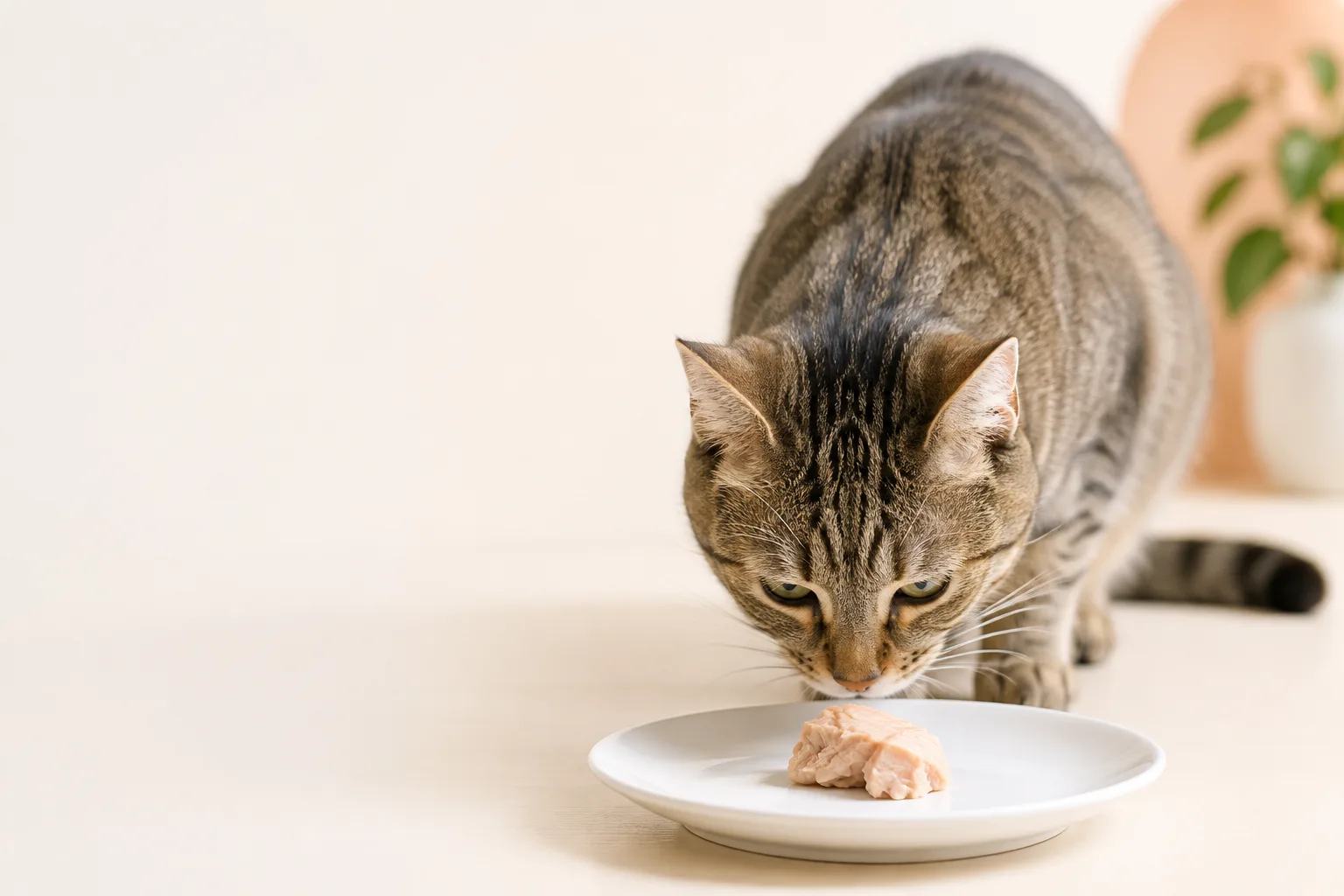
It is a real, commonly cited concern among vets, not an exaggeration invented to scare owners off a treat. Tuna's strong smell and taste can be so appealing to a cat that they start refusing their normal, balanced food in favor of it, holding out at the bowl until tuna is what turns up instead.
A cat who has decided tuna is the only acceptable meal is no longer eating a complete diet, and over time that pattern causes real nutritional deficiency, since tuna alone does not provide what a formulated cat food does. The fix is prevention rather than correction: keeping tuna a rare, small extra rather than a favorite regular food is what stops that fixation from forming in the first place. Once a cat has learned to hold out for tuna, getting them back onto a balanced diet is a much harder problem than simply never letting the habit start.
Is raw tuna different from cooked?
Cooking lowers one specific risk but does not remove the reason to keep tuna infrequent either way. Raw fish, tuna included, contains an enzyme called thiaminase that breaks down vitamin B1 (thiamine), which VCA Animal Hospitals notes is destroyed by cooking, a nutrient a cat's body needs and cannot simply do without over time. Cooking deactivates that enzyme, which is one real reason cooked tuna is the better option if tuna is being offered at all.
A diet too heavy in fish, raw or cooked, has also been linked to steatitis, a painful inflammation of body fat that develops when too much unsaturated fat in the diet is not balanced by enough vitamin E. That risk is not solved by cooking the fish; it comes down to how much and how often fish is fed, not simply whether it was raw or cooked beforehand. Cooked tuna, in other words, is the safer of the two, but "cooked" does not mean "no limit."
Canned tuna: water or oil?
Plain tuna packed in water, with no salt added, is the safer choice on the rare occasion tuna is given. Tuna canned for people is not formulated for cats in the first place: it is missing the calcium ratio a cat's diet needs and is not fortified with taurine, an essential nutrient cats cannot make enough of, the way an actual cat food is, so a can of human tuna, however it is packed, is never a substitute for a complete diet.
Beyond that baseline issue, the packing itself matters. Oil-packed tuna adds unnecessary fat on top of everything above, and tuna sold for people is often salted, neither of which does a cat any favors. A plain, no-salt-added, water-packed can is the better pick whenever there is a choice on the shelf, and draining it well before offering a small amount cuts down on how much of that liquid a cat ends up with too.
None of this applies to tuna-flavored cat food or cat treats, which are formulated to be nutritionally complete in a way a can of human tuna is not. A product made for cats has already had the calcium ratio and taurine level worked out; a can meant for a person's lunch has not, no matter how similar the two smell to a cat. The concerns above are specifically about feeding whole human canned tuna as a food or treat, not about products actually made for cats, and that distinction is worth keeping in mind while reading the label on anything tuna-flavored in the cat food aisle.
How much tuna is safe?
A small bite, offered occasionally, is the honest answer, not a fixed weekly amount, and not "safe" or "unsafe" as a flat yes-or-no. Weighed against mercury, the risk of a fixation forming, and the fact that whole tuna is not a complete food on its own, the sensible version of tuna in a cat's life is small, plain, water-packed, and rare enough that it stays a treat rather than becoming an expectation.
Treats and extras are generally kept under about 10 to 15 percent of a cat's daily calories, the Cornell Feline Health Center's rule of thumb. Our feeding guide covers how to work out a cat's daily calorie total so extras like this stay in proportion.
What does the mercury data actually say about tuna?
The FDA tracks mercury levels by tuna species, and the range is wide enough that "tuna" alone is not a specific enough word to judge risk by. Canned light tuna, made mostly from skipjack, averages 0.126 parts per million of mercury in FDA testing and sits in the FDA's "best choices" tier. Canned albacore, sold as white tuna, averages 0.350 ppm, a good choice rather than a best one. Bigeye tuna carries the most, 0.689 ppm, and sits in the FDA's "choices to avoid" category. A can labeled simply "tuna" without a species named is one more reason not to guess at how often it is safe to offer.
Methylmercury, the form that accumulates in fish tissue, is bound to protein at a molecular level, which means no amount of cooking, draining or rinsing removes it. It comes out of the can exactly as concentrated as it went in. That is part of why the caution here is about frequency rather than preparation: a plain, unseasoned piece of tuna carries the same mercury load as a seasoned one.
Can tuna cause a vitamin deficiency?
Two separate nutrients are worth knowing about, and they fail for two different reasons. Raw fish, tuna included, contains an enzyme called thiaminase that breaks down thiamine, also known as vitamin B1, before a cat's body can use it. A diet built around raw fish can produce a real thiamine deficiency over weeks, with signs ranging from reduced appetite and weakness to, in advanced cases, heart failure. Cooking destroys the enzyme, which is one more reason raw fish carries a different risk profile than cooked.
Taurine is a separate problem, and it applies to cooked and canned tuna too. Tuna packed for human consumption is not formulated to a cat's taurine requirement the way a complete cat food is, and a diet that leans on human-grade tuna instead of a balanced food risks a genuine taurine shortfall over time. Taurine deficiency in cats is linked to dilated cardiomyopathy, a serious heart condition, and to retinal degeneration that can cause blindness. Neither develops from an occasional bite; both are a real risk from tuna treated as a dietary staple rather than an extra.
This guide goes into more depth than Can Cats Eat Meat and Fish? and Can Cats Eat Treats & Snacks?, which compare the whole group side by side.
Frequently asked questions
Can cats eat tuna?
Yes, but only in small amounts and only now and then. A bite of plain tuna is unlikely to do any harm as an occasional extra, and tuna is not toxic to cats the way onion or garlic is. It is not, however, a food to offer regularly, and whole tuna is not a substitute for a complete cat food.
Why can't cats eat tuna often?
The main reason is mercury. Tuna accumulates mercury as it feeds, with larger, older fish carrying more of it, and repeated tuna feedings build up real mercury exposure over time in an animal as small as a cat. A single occasional bite is a very different thing from tuna offered as a regular food, which is why moderation matters more than an outright ban.
What is "tuna addiction" in cats?
It describes a cat becoming so fixated on tuna's strong smell and taste that they start refusing their normal, balanced food in favor of it. Vets cite this as a genuine concern, since a cat holding out for tuna is no longer eating a complete diet, and that pattern causes real nutritional deficiency over time. Keeping tuna a rare, small extra rather than a favorite regular food is what prevents the fixation from forming in the first place.
Is raw tuna worse for cats than cooked tuna?
Raw fish, tuna included, contains an enzyme called thiaminase that breaks down vitamin B1 (thiamine), and cooking deactivates that enzyme, which makes cooked tuna the better option if tuna is offered at all. A diet too heavy in fish, raw or cooked, has also been linked to steatitis, a painful inflammation of body fat, so cooking lowers one specific risk without removing the reason to keep tuna infrequent overall.
Should tuna be packed in water or oil?
Water, with no salt added, is the safer choice on the rare occasion tuna is given. Tuna canned for people is not formulated for cats regardless of packing, since it is missing the calcium ratio a cat needs and is not fortified with taurine, but oil-packed or heavily salted tuna adds unnecessary fat and sodium on top of that baseline issue. This is different from tuna-flavored cat food or treats, which are formulated to be nutritionally complete.
How much tuna can I give my cat?
A small bite, offered occasionally, not a set amount on any regular schedule. Treats and extras, tuna included, are generally kept under about ten percent of a cat's daily calories, and our feeding guide covers how to work out a cat's daily calorie total so extras like this stay in proportion.
Does canned tuna contain mercury?
Yes, and the amount varies by species. Skipjack, used in most canned light tuna, carries the least at around 0.12 ppm. Albacore runs higher, near 0.35 ppm. Cooking or draining the can does not reduce it, since methylmercury is bound to the fish's protein.
Sources
- FDA: Mercury Levels in Commercial Fish and Shellfish Measured mercury in canned light, albacore and bigeye tuna.
- FDA/EPA: Advice About Eating Fish Which tuna are best choices, good choices and choices to avoid.
- Tufts Now: Is it safe to give canned tuna to cats as a treat? A veterinary view on mercury and tuna for cats.
- VCA Animal Hospitals: Thiamine How thiaminase in raw fish destroys vitamin B1, and how cooking stops it.
- VCA Animal Hospitals: Taurine in Cats Why taurine is essential for cats.
- Cornell Feline Health Center: Feeding Your Cat Complete diets, and the rule of thumb for treats.
General information, not veterinary advice. If your cat's behavior has changed suddenly, speak to a vet rather than an article.
How this guide was researched and checked is set out in how our guides are written.

Want an answer in seconds?
The calculators handle age, due dates and portions without an account.