Northwest Naturals Cat Food Recall: What to Know Right Now
 By Ahsan Nawaz
Published:
By Ahsan Nawaz
Published:
On this page
On August 28, 2026, Northwest Naturals of Portland, Oregon issued a voluntary recall of two raw pet food products after testing turned up Salmonella and, in a separate product, Listeria monocytogenes. If you feed this brand, the fastest thing to do is check your bag against the exact details below before reading anything else. Everything on this page is drawn directly from the FDA's own recall notice and from CDC and veterinary sources on what these two specific bacteria actually do, not from a wire summary of a wire summary, and it is written specifically for cat owners rather than folded into a mixed cat-and-dog list, since the two recalled products carry different contaminants and different risks.
The recall covers Northwest Naturals Frozen Chicken Recipe cat food, 2 lb bag, UPC 087316384956, Lot B-5, Best By 01/26/2028. That lot tested positive for Salmonella. A separate product, Northwest Naturals Frozen Raw Diet for Dogs Chicken Recipe, 6 lb bag, UPC 087316380392, Lot B-19, Best By 01/25/2028, tested positive for both Salmonella and Listeria monocytogenes. Fifty three cases, 1,272 pounds, of the cat food were recalled, along with nineteen cases, 684 pounds, of the dog food. Both were distributed to retail stores nationwide, and as of this writing no illnesses in pets or people have been reported.
Is my cat food one of the recalled bags?
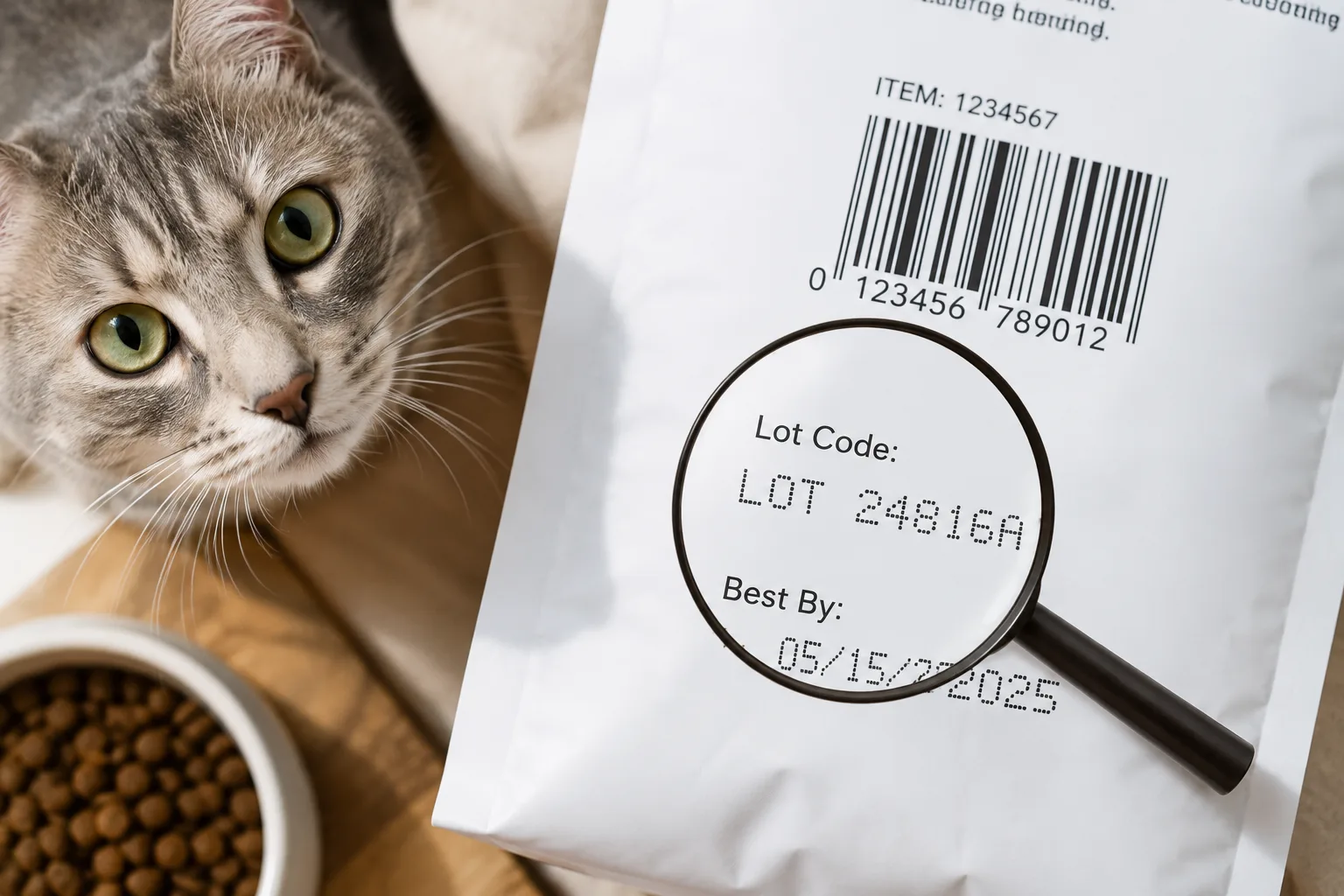
Check three things against your own bag, in this order: the product name, printed right on the front, has to read Frozen Chicken Recipe. The lot code has to read B-5. The Best By date has to read 01/26/2028. All three have to match for your bag to be part of this recall, not just the product name alone, since Northwest Naturals sells other lots and other recipes that are not affected.
The lot code and best-by date are typically printed on the back or bottom of the bag, near the UPC. If any of the three details is different, your bag is not part of this recall, though it is still worth a photo of the packaging before you use up or discard the bag, in case that changes.
What if I already threw away the bag or can't find the lot number?
Check your purchase history first: most grocery delivery apps, pharmacy or pet store loyalty accounts, and even a card statement search for the retailer's name can narrow down roughly when you bought it, which at least tells you whether it falls inside the window this lot would have been on shelves.
If you genuinely cannot find the lot code and the product name matches, Northwest Naturals' own contact line, 1-866-637-1872, or the email address below, can often look up whether a specific store and purchase window received the affected lot, since distributors typically ship a single lot to a defined set of retailers over a short window rather than spreading it everywhere at once. When in doubt and the bag is gone, treating the food as potentially affected and watching for the symptoms below is the more cautious call, especially if you bought Frozen Chicken Recipe from that retailer within the last month or so.
What should I do if I already fed this to my cat?
Stop feeding the product immediately. The FDA's own instruction for this recall is direct: consumers who purchased the affected lots should stop feeding them to their pets and return the unused portion to the place of purchase for a full refund. Photograph the packaging first, specifically the UPC, lot code and best-by date, before you return or discard it, since that is what the store or the company will ask for.
If your cat has already eaten some of it and is showing any of the symptoms below, that is a reason to call your vet now, not to wait and see. If your cat seems completely fine, there is no official day-by-day monitoring window published for this specific recall, but a reasonable, informed approach is to watch for the symptoms below for roughly the next one to two weeks, since that covers the incubation timelines documented for these two bacteria in other species.
This is a sensible precaution based on the available evidence, not a quoted official guideline, since no cat-specific incubation period for either bacterium has been published. Separately, a cat that is a kitten, pregnant or nursing, senior, or already managing an immune-compromising condition is worth a proactive vet call even without symptoms yet, since those are the groups most likely to actually get clinically sick rather than carry the bacteria without symptoms.
What are the symptoms of Salmonella in cats?
The most common sign is diarrhea, sometimes with blood or mucus, along with vomiting, fever, lethargy, reduced appetite, abdominal pain, weight loss and dehydration. A more severe, systemic form can follow, with lethargy, fever, loss of appetite, pale gums, a faster heart rate and breathing rate, and in some cases shock; conjunctivitis can also appear, and pregnant cats affected this severely may abort.
Diagnosis is by fecal culture or PCR testing, sometimes repeated, since carrier cats can shed the bacteria intermittently. Treatment is mostly supportive: fluids, anti-nausea medication and a bland, low-fat diet. Antibiotics are generally reserved for severe or systemic cases, or for cats that are already immunocompromised, since giving them for a milder intestinal case can actually prolong how long a cat sheds the bacteria and disrupt the gut bacteria that would otherwise help clear it.
What are the symptoms of Listeria in cats?
Listeria monocytogenes was found in the recalled dog product specifically, not the cat product, though cross-contamination in a household with both a dog and a cat sharing bowls or a food prep area is a real practical concern worth being careful about. In cats, Listeria most commonly causes gastrointestinal signs similar to Salmonella, vomiting and diarrhea that usually shows up within the first day or two of exposure.
A more serious, invasive form is possible but far less common, and follows the same pattern seen in other species: the bacteria moves beyond the gut into the bloodstream or nervous system, which can bring on fever, lethargy that goes beyond a simple upset stomach, disorientation, or in severe cases seizures, and pregnant or nursing cats face an added risk of pregnancy loss.
Vets diagnose it the same way as Salmonella, through a stool sample sent for culture or PCR testing, though a suspected invasive case may also call for bloodwork or imaging depending on which symptoms are present. Treatment for a straightforward intestinal case is supportive care, fluids and monitoring, while a confirmed invasive case needs antibiotics chosen specifically for Listeria, since not every antibiotic that works against Salmonella works as well against it. If a cat in your home has any exposure to the recalled dog food, the same watch-for-symptoms approach described above applies, with extra attention to the more serious signs given Listeria's ability to move beyond the gut.
What about my dog, or other pets in the household?
If your household feeds both the recalled cat food and the recalled dog food, treat both as affected on their own terms rather than assuming only one pet is at risk. The dog product is the one that tested positive for Listeria monocytogenes as well as Salmonella, so a dog that ate it carries both risks the cat food alone does not.
Beyond the two specifically recalled products, the practical household risk is cross-contamination: a shared food prep surface, a shared scoop, bowls washed in the same sink without being cleaned in between, or a cat and dog that eat out of each other's bowls, can move bacteria from one pet's food to another's even if only one recalled product was in the house. Wash bowls, scoops and prep surfaces for both pets separately until you are confident the recalled product is fully out of the house, and keep any other pets away from the area where the recalled food was stored or prepared in the meantime.
Can this make me sick too?
Yes, and this is a real risk worth taking seriously even if your cat never gets sick at all. The CDC does not recommend feeding raw pet food or treats to dogs or cats specifically because of this handling risk. People generally do not get sick from the pet actually eating the food, they get sick when the bacteria spreads around the kitchen and home during handling, from unwashed hands, contaminated bowls and utensils, counters the packaging touched, or a pet's mouth after eating. The CDC names four groups at highest risk: children under five, adults over sixty five, anyone with a weakened immune system, and pregnant women.
For Salmonella in people, symptoms typically start six hours to six days after exposure and include diarrhea, fever and stomach cramps, usually lasting four to seven days; most people recover without treatment, but severe cases can require hospitalization, and a small number of people go on to develop reactive arthritis.
Listeria works differently and can be more serious: a milder intestinal illness can start within 24 hours and last one to three days, but invasive Listeria infection has a much longer fuse, a median of about eleven days and as long as ten weeks in some documented cases, with fever and muscle aches in pregnant people, or headache, stiff neck, confusion, loss of balance and seizures in others.
Pregnant people usually experience only mild symptoms themselves but face a serious risk to the pregnancy: miscarriage, stillbirth, premature delivery or a severe newborn infection. Among non-pregnant people who develop invasive Listeria, roughly one in six die, and people with weakened immune systems make up about three quarters of all Listeria infections. If you handled either recalled product, wash your hands for at least twenty seconds, sanitize any surface it touched with a bleach solution of about one tablespoon per quart of water, and keep raw pet food handling completely separate from anything involving human food.
Has Northwest Naturals been recalled before?
Yes, twice before this, and it is worth being precise about what each one actually involved rather than treating them as one blurred pattern. In February 2018, Northwest Naturals recalled a single 94-case batch of 5 lb Frozen Chicken and Salmon pet food chubs for dogs, a different product from anything involved in this recall, after Michigan's state agriculture department bought one from a specialty pet store and it tested positive for Listeria monocytogenes. That recall was limited to specialty pet retailers in six states, California, Michigan, Pennsylvania, Rhode Island, Texas and Washington, and was updated once before being closed by the FDA, with no illnesses ever reported.
In December 2024, the company recalled its Feline Turkey Recipe, a raw frozen cat food and again a different product from this recall, after a domestic cat in Washington County, Oregon died and genetic testing by Oregon State University's veterinary diagnostic laboratory and the USDA's National Veterinary Services Laboratories matched the specific strain of bird flu, H5N1, found in the cat to the strain found in the food.
That recall reached distributors in twelve states, Arizona, California, Colorado, Florida, Georgia, Illinois, Maryland, Michigan, Minnesota, Pennsylvania, Rhode Island and Washington, plus British Columbia in Canada. The FDA subsequently audited the co-manufacturer's production facility over several weeks that December and into February 2025 and found no evidence of the virus there, and that recall was also later closed.
This current recall, for Salmonella and Listeria, is the third distinct incident in under nine years: three different causes, a bacterial contaminant, a viral contaminant and now bacterial contaminants again, and three different products across both the cat and dog lines. One meaningful difference sets this one apart from the other two: this is the first of the three where the contamination was caught by the FDA's own routine testing before it was tied to any confirmed illness, rather than a state agency's test or a pet's death prompting the discovery afterward. No illnesses in pets or people have been reported in connection with any of the three recalls to date, including this one.
Why do raw and frozen raw diets get recalled more often than dry or canned food?
The honest, structural answer is that raw diets skip the one step that kills bacteria in every other category of pet food: cooking. Dry kibble, canned food and semi-moist food are all heated during production to a temperature that kills Salmonella and Listeria; raw and frozen raw diets are not, since freezing slows bacterial growth but does not reliably kill these particular bacteria the way heat does.
The FDA's own testing makes the gap concrete: in a 2010 to 2012 study, the agency found Salmonella in 7.7 percent of raw pet food samples and Listeria monocytogenes in 16.3 percent, while zero of the dry, semi-moist and jerky treat samples tested positive for either, apart from a single dry cat food sample, 0.8 percent, that tested positive for Salmonella alone. Canned food was not included in that particular study. A more recent university study, out of Cornell, found culturable, potentially dangerous bacteria, specifically Salmonella enterica, E. coli and Klebsiella, in 42 percent of raw cat food samples tested, against zero percent of cooked cat food samples from the same set.
The raw samples in that study also carried more antibiotic-resistance genes than the cooked samples, and some raw samples contained detectable parasite DNA that the cooked samples did not. None of this means every bag of raw pet food is contaminated, most are not, and plenty of owners feed raw diets for years without incident. It does mean the category carries a real, structurally higher baseline risk than cooked food, which is part of what pet food recall data over time reflects: overall pet food recalls nearly doubled between 2024 and 2025, and raw and frozen raw products make up a disproportionate share of that total relative to how much of the pet food market they actually represent.
Raw diets can be fed safely by owners who understand and manage this risk deliberately, sourcing carefully, handling the way raw meat for human consumption would be handled, and watching for exactly this kind of recall notice, but it is a real, measured, structural risk built into the category, not a rare manufacturing accident, which is part of why recalls in this specific segment of pet food happen with some regularity.
Is it true that cats can't get sick from Salmonella because of their stomach acid?
This is a common claim in raw-feeding communities, and it does not hold up against the actual evidence. The claim usually goes that a cat's stomach acid is around pH 1 to 2, strong enough to reliably kill Salmonella before it causes harm. Measured feline gastric pH actually runs closer to 4.2 on average, well above the roughly pH 2.5 threshold generally considered strong enough to reliably inhibit Salmonella, which undercuts the mechanism the claim relies on.
Cats genuinely do appear to be somewhat less prone to clinical illness from Salmonella than dogs are; one peer-reviewed case report on two cats that developed confirmed salmonellosis after eating a commercial raw diet attributes that relative resistance to a cat's general immune status, not to stomach acidity or how fast food moves through the gut.
The same research documents real clinical illness in cats when it does happen, including bloody diarrhea and meaningful dehydration in the two cats it followed closely, and separate multilab survey data found Salmonella shedding in roughly 9 to 14 percent of cats tested, whether or not they had diarrhea at the time, which shows shedding without visible illness is genuinely common rather than rare.
For context on the scale of the difference between species, one estimate places dogs fed a raw diet at roughly 23 times greater odds of shedding Salmonella than dogs fed a conventional commercial diet, which is the kind of gap that makes raw feeding advocates reach for a protective explanation in the first place, it just is not the stomach-acid explanation that gets repeated. The safer way to think about it: most cats exposed to Salmonella become carriers that shed the bacteria without looking sick, rather than getting visibly ill, and that is a meaningfully different thing from being immune to it, especially for a kitten, a pregnant or nursing cat, or a cat with any condition that already affects its immune system.
How do I get a refund or report this?
Consumers with questions can contact Northwest Naturals directly at 1-866-637-1872, Monday through Thursday, 8am to 4pm Pacific time, or by email at recallinfo@nw-naturals.net. Returning the unused portion to the store where you bought it, with your receipt if you have it, is how the FDA's guidance describes getting a full refund.
A receipt makes it faster, but most retailers that carry a specialty frozen raw brand like this one can look up a purchase through a loyalty account or simply take the return once the lot code and best-by date match the recall, since the store itself is also working through its own recall process with the distributor. If a specific store is unwilling to process the return, contacting Northwest Naturals directly at the number above is the next step, since the company, not any individual retailer, is the one issuing the refund guarantee.
If your cat or a person in your household got sick after contact with either recalled product, it is worth reporting it directly to the FDA's recall notice page in addition to contacting your own vet or doctor, since consumer reports are part of how the FDA tracks whether a recall's scope needs to expand. Keeping a small unused sample of the product in a sealed bag in the freezer, separate from other food, is also worth doing if anyone in the household does get sick, since a vet or doctor may want it tested directly rather than relying on the lot information alone.
How worried should I actually be?
Genuinely worried enough to check your bag and act if it matches, and not more than that. A recall like this one exists specifically because the system is designed to act on a positive test result before anyone gets sick, not after, which is exactly what happened here: this lot was pulled because FDA testing found the bacteria, not because of a wave of sick cats. As of this writing, zero illnesses in pets or people have been reported in connection with it.
That does not make the underlying risk fake, Salmonella and Listeria are real pathogens and this article has covered what they can do, but it does mean the realistic range of outcomes for a cat that ate some of this food runs from no effect at all, which is the most likely outcome for a healthy adult cat, through to a real but treatable illness, with the more serious outcomes concentrated in kittens, pregnant or nursing cats, seniors, and cats with an existing condition that affects their immune system.
The right response to that picture is exactly what this article has walked through: check the lot, stop feeding it if it matches, watch for real symptoms, and get ahead of it with a vet call for the cats in the higher-risk groups, rather than either ignoring the recall or assuming the worst.
What should I watch for over the next two weeks?
Diarrhea, especially if it looks bloody or unusually mucus-heavy, vomiting, fever, a drop in appetite, lethargy that does not resolve with rest, and abdominal discomfort are the signs worth acting on, in either your cat or yourself. None of these symptoms are unique to this recall on their own, so the detail that actually matters is the timing: any of them showing up in the days after a known or suspected exposure to the recalled lot is worth a call to your vet, or your own doctor if it is a person in the household, and worth mentioning the recalled product by name when you call, since it changes what a vet or doctor will test for.
Write down the date your cat last ate the product, since that single detail turns a vague sense that something is off into a useful piece of information a vet can actually act on, and keep an eye on litter box habits specifically, since a change in stool consistency or frequency is often the earliest sign, showing up before a cat seems obviously unwell in any other way.
Most cases of both Salmonella and Listeria, in cats and in people, resolve with supportive care, but early treatment is consistently what the research on both bacteria points to as the biggest factor in a good outcome, which is the same reason acting on a positive lot match now, rather than waiting to see, is the right call even before any symptoms appear.
This guide goes into more depth than Can Cats Eat Meat and Fish?, which compares the whole group side by side.
Frequently asked questions
What exactly was recalled by Northwest Naturals?
Northwest Naturals Frozen Chicken Recipe cat food, 2 lb bag, UPC 087316384956, Lot B-5, Best By 01/26/2028, for Salmonella, and separately Northwest Naturals Frozen Raw Diet for Dogs Chicken Recipe, 6 lb bag, UPC 087316380392, Lot B-19, Best By 01/25/2028, for both Salmonella and Listeria monocytogenes. The recall was announced August 28, 2026.
How do I know if my cat food is part of the recall?
Check the product name, lot code and best-by date on your bag against the recalled lot exactly: Frozen Chicken Recipe, Lot B-5, Best By 01/26/2028. All three need to match. The lot code and best-by date are usually printed near the UPC on the back or bottom of the bag.
What should I do if I fed my cat the recalled food?
Stop feeding it immediately and photograph the packaging, including the UPC, lot code and best-by date, before returning the unused portion to the store for a refund. If your cat shows any symptoms, diarrhea, vomiting, fever, lethargy or reduced appetite, contact your vet. Cats that are kittens, pregnant, nursing, senior or immunocompromised are worth a proactive vet call even without symptoms.
What are the symptoms of Salmonella in cats?
Diarrhea, sometimes bloody or mucus-heavy, vomiting, fever, lethargy, reduced appetite, abdominal pain, weight loss and dehydration are the common signs. A more severe systemic form can cause pale gums, a fast heart rate and, in serious cases, shock. Most exposed cats become carriers without visible illness rather than getting clinically sick.
Can I get sick from recalled cat food even if I don't eat it?
Yes. People generally get sick from handling contaminated pet food, not from eating it, through unwashed hands, contaminated bowls and surfaces, or a pet's mouth after eating. The CDC specifically names children under five, adults over 65, pregnant women and people with weakened immune systems as the highest-risk groups.
Has Northwest Naturals had other recalls?
Yes, two prior recalls: a 2018 Listeria recall of a single batch of dog food chubs limited to six states, and a December 2024 recall of Feline Turkey Recipe cat food after bird flu was linked to one cat's death in Oregon. Both were later closed by the FDA. This is the third distinct incident, each with a different cause, in under nine years.
Why are raw pet food diets recalled more often than dry or canned food?
Raw diets skip cooking, the step that kills Salmonella and Listeria in dry, canned and semi-moist food. FDA testing found Salmonella in 7.7% of raw pet food samples and Listeria in 16.3%, compared to 0% of dry, semi-moist and jerky treat samples in the same study, aside from one dry cat food sample.
Is it true cats can't get Salmonella poisoning because of stomach acid?
No, this is a common but unsubstantiated claim. Measured feline stomach acidity averages around pH 4.2, well above the roughly pH 2.5 threshold usually needed to reliably kill Salmonella. Cats do appear somewhat more resistant to clinical illness than dogs, but veterinary research attributes that to general immune status, not stomach acid.
How do I get a refund for recalled Northwest Naturals cat food?
Return the unused portion to the store where you purchased it, ideally with your receipt, for a full refund. You can also contact Northwest Naturals directly at 1-866-637-1872, Monday through Thursday from 8am to 4pm Pacific, or by email at recallinfo@nw-naturals.net.
Sources
- FDA: Northwest Naturals Voluntarily Recalls Two Raw Pet Food Products The primary recall notice: exact products, lot numbers, UPCs, quantities, distribution, and the FDA's recommended consumer action.
- FDA: Updated Northwest Naturals 5lb Chub Recall (2018) The company's earlier, unrelated 2018 Listeria recall, confirmed as a separate closed incident.
- CDC: About Pet Food Safety CDC's guidance on raw pet food handling risk and the four highest-risk human groups.
- CDC: Listeria Signs and Symptoms Human Listeria incubation timelines, symptoms, and mortality data for invasive cases.
- Merck Veterinary Manual: Salmonellosis in Animals Feline Salmonella symptoms, carrier states, diagnosis and why antibiotic treatment is reserved for severe cases.
- Ferreira et al., peer-reviewed case report on feline salmonellosis Documented clinical Salmonella illness in two cats fed a raw diet, and the basis for the stomach-acid myth correction.
- FDA: Get the Facts, Raw Pet Food Diets Can Be Dangerous The FDA's 2010-2012 contamination testing comparing raw pet food to dry, semi-moist and jerky treats.
General information, not veterinary advice. If your cat's behavior has changed suddenly, speak to a vet rather than an article.
How this guide was researched and checked is set out in how our guides are written.

Want an answer in seconds?
The calculators handle age, due dates and portions without an account.