Can Cats Eat Chocolate? What To Do If Your Cat Ate Some
 By Ahsan Nawaz
Published:
By Ahsan Nawaz
Published:
On this page
Can cats eat chocolate? No, and this is one of the few food questions with no safe portion worth quoting. Chocolate contains two stimulant drugs, theobromine and caffeine, and a cat's small body turns a given piece into a far bigger dose than the same piece delivers to you. If your cat has already eaten some, stop reading and call now: your own vet, an emergency clinic, the ASPCA Animal Poison Control Center on (888) 426-4435, or Pet Poison Helpline on (855) 764-7661. Both hotlines charge a per-case consultation fee, so have a payment card in reach before you dial.
The rest of this page is for the person standing in a kitchen at 11pm holding a chewed wrapper. It gives the milligram math in units you can recognise on your counter, and it says plainly which numbers are solid and which are borrowed from dogs. Because they are borrowed. The Merck Veterinary Manual publishes chocolate thresholds for dogs and none for cats, so every calculator handing you a feline number has divided a canine threshold by a cat's weight, this page included. As Dr Joanna Woodnutt MRCVS puts it, in cats we do not know the exact quantity that causes toxicity.
My cat just ate chocolate. What should I do right now?
Call a vet or a poison hotline immediately, before symptoms appear. The most useful thing anyone can do happens in the first two hours, while the chocolate is still in the stomach. Merck advises that in patients who remain clinically normal, inducing vomiting should be considered within about two hours, and Cortinovis and Caloni's 2016 review in Frontiers in Veterinary Science states the prognosis is usually good if decontamination happens within two to four hours. An asymptomatic cat is not a cat that is fine. It is a cat inside the window where treatment works best.
Gather five things before you dial. Your cat's weight, a real recent figure rather than a guess, since every calculation is per kilogram. The product name and the cocoa percentage on the label. How much is gone, worked out by weighing what is left and subtracting from the net weight. The exact time, or the earliest it could have happened. And the wrapper in your hand, because there is no bedside test for theobromine and diagnosis is made from history and clinical signs alone.
Do not induce vomiting at home, do not give milk, salt or oil, and do not wait until morning. If the chocolate was homemade or from an assorted box, the ASPCA instructs clinicians to assume a worst case and calculate as though it were all the most concentrated chocolate present. If you cannot identify it, treat it as baking chocolate. For a weight figure you can defend on the phone, our cat weight checker takes a minute.
Why is chocolate toxic to cats, and is it worse for cats than for dogs?
The toxins are two methylxanthines: theobromine, chemically 3,7-dimethylxanthine, and caffeine, 1,3,7-trimethylxanthine. Merck states theobromine is present at three to ten times the concentration of caffeine and that both contribute to the poisoning, which is why doses are calculated on the two added together, as the ASPCA's toxicology brief instructs.
The mechanism is pharmacology, not vague upset. Merck describes methylxanthines competitively blocking adenosine receptors, which produces central nervous system stimulation, diuresis and tachycardia. They also raise intracellular calcium, so skeletal and cardiac muscle contract harder, inhibit phosphodiesterase, and increase circulating adrenaline. That is why a poisoned cat is vomiting, drinking, wired, trembling and tachycardic at once: one drug, several tissues.
Why it hurts a cat more than it hurts you is, first and most solidly, arithmetic. One ounce of dark chocolate carries roughly 150 mg of combined methylxanthine on the ASPCA's figures. In a 70 kg adult that is 2.1 mg per kilogram. In a 20 kg dog, 7.5 mg/kg. In a 4.5 kg cat, 33.3 mg/kg, above the dose where mild signs begin and near where cardiac effects start. That is a sixteen fold difference in dose intensity from the identical square, and it needs no claim about species metabolism.
The metabolic half deserves care. Merck gives theobromine a half life of 17.5 hours in dogs against 4.5 for caffeine, and 6 to 10 hours in humans, so dogs clear it two to three times slower than people. No feline theobromine half life has ever been published, so every "cats clear it very slowly" claim online is the dog figure wearing a cat costume. VCA Animal Hospitals sticks to what the profession will commit to: cats metabolise theobromine and caffeine differently from people, making them more sensitive to the effects.
On cats versus dogs, the one number favouring greater feline sensitivity is a species lethal dose of 200 mg/kg for cats against 300 for dogs in older toxicology registries. Treat it cautiously: sources disagree over whether it is a lethal dose or a lowest toxic dose, and it sits ten times above the dose that makes a cat ill. Dogs are simply poisoned more often, because they eat indiscriminately.
How much chocolate is toxic to a cat?
The working thresholds, as combined theobromine plus caffeine per kilogram of body weight, are 20 mg/kg for mild signs such as vomiting, diarrhoea and excessive thirst, 40 to 50 mg/kg for cardiac effects, and 60 mg/kg or more for seizures. The oral lethal dose is 100 to 200 mg/kg, with Merck's qualifier that severe signs and death can occur at much lower doses and that susceptibility varies. These figures appear in Merck, the ASPCA brief and Cortinovis and Caloni.
They are also, in all three sources, stated for dogs. Merck writes "in dogs" in the sentence itself, as do Cortinovis and Caloni. The ASPCA attributes them to poison centre casework, but that brief notes dogs are far more commonly affected, so the case pool is overwhelmingly canine. When this page says 8 grams of a 70 percent bar crosses the line for a 4.5 kg cat, it means 8 grams delivers the dose at which a dog would be expected to start vomiting, spread across a cat's body weight.
Treat 20 mg/kg as a conservative call-the-vet line, not a guarantee of safety underneath it. Cats with heart disease, kidney disease, epilepsy or advanced age have less reserve than the average animal in a case series. The ASPCA also notes methylxanthines cross the placenta and pass into milk, so a nursing queen can pass it to her litter.
Why does every website give a different toxic dose for cats?
Because anyone searching can cats eat chocolate meets at least four numbers for the same species, and almost nobody says where theirs came from. You will find 15, 20, 40, 55 and 200 mg/kg presented as the feline toxic dose. They are not four opinions about one measurement. They are four different measurements being mislabelled, and telling them apart tells you how far to trust a page.
The 20, 40 to 50 and 60 mg/kg tiers are the clinical thresholds above, borrowed from dogs. The 200 mg/kg figure quoted by some sites, including the American College of Veterinary Pharmacists, as a cat's toxic consumption level is a lethal dose estimate, an order of magnitude above the dose that makes a cat vomit. Handing that to an owner as a toxic dose is dangerous. The precise looking tiers in the widely copied Omnicalculator cat chocolate tool, with decimals such as 15.01 and 34.02 mg/kg, carry no citations at all. Even good pages slip: one veterinary written article puts the cocoa powder threshold for a 5 kg cat at 50 g, which implies 2 mg of theobromine per gram when cocoa powder runs 26 to 28.
Where this page lands: use 20 mg/kg of combined methylxanthine as the line at which you phone someone, 40 mg/kg as an emergency and 60 mg/kg as a drive to the clinic now, remember all three come from canine casework, and discard any source that will not say where its number came from.
How much chocolate is dangerous for a 4 to 5 kg cat, by chocolate type?
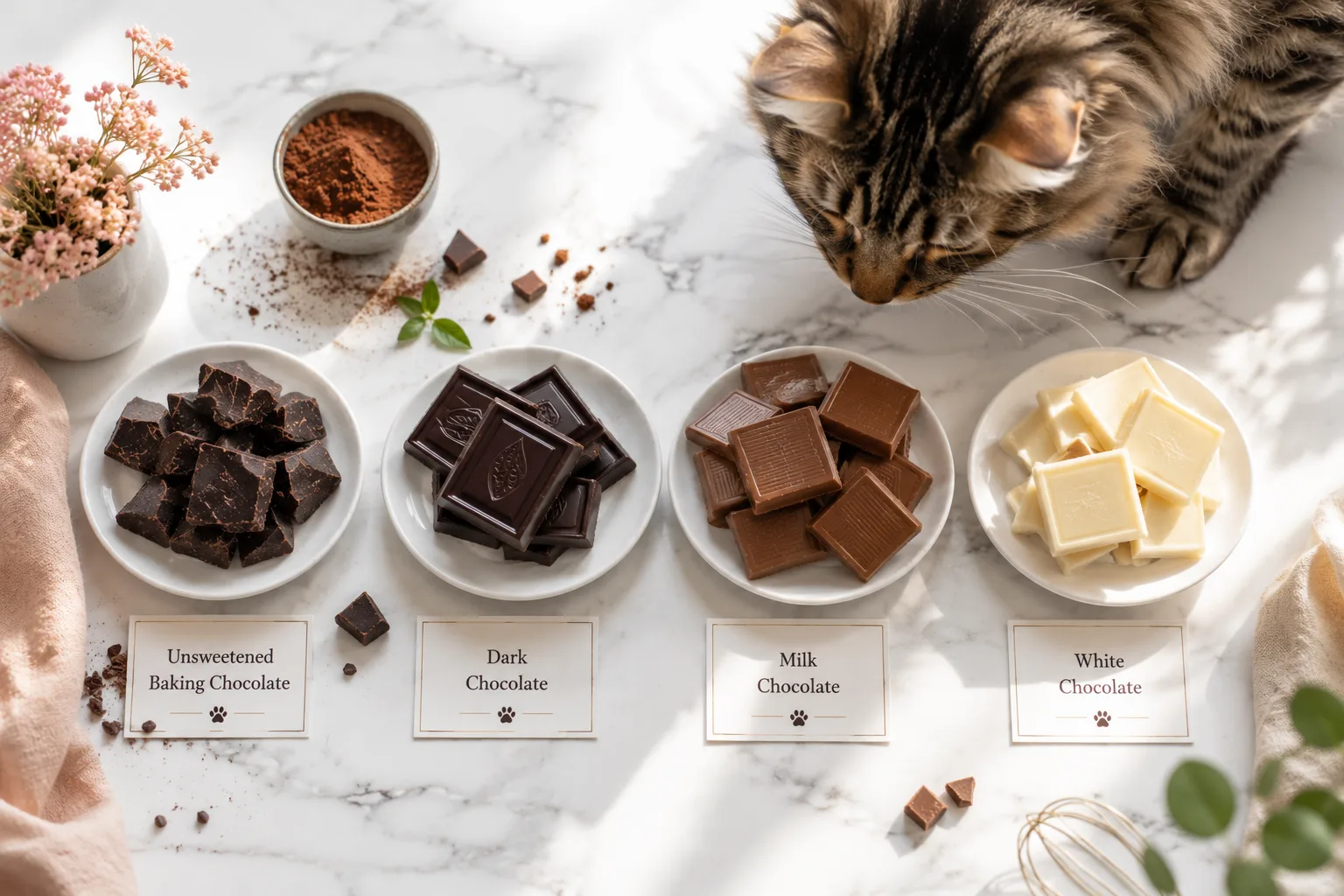
For an average 4.5 kg cat, 20 mg/kg works out to 90 mg of combined methylxanthine, cardiac effects at 180 mg and seizures at 270 mg. Content per ounce comes from the ASPCA Animal Poison Control Center table: white chocolate 1.1 mg per ounce, milk chocolate 64, dark sweet 150, semisweet chips 160, unsweetened baking chocolate 440, dry cocoa powder 807, instant cocoa mix 151, cocoa bean hulls 255. Everything below is my arithmetic from those figures.
Milk chocolate reaches the mild signs line at about 1.4 ounces, or 40 grams. Dark sweet chocolate at 0.6 ounces or 17 grams. Semisweet chips at 16 grams, roughly a small handful. Unsweetened baking chocolate at 5.8 grams, a fifth of one square. Dry cocoa powder at 3.2 grams, barely a heaped teaspoon. Instant cocoa mix at 17 grams. White chocolate needs 2.3 kilograms, as explained below.
There is a trap in the standard tables: the dark chocolate line. The ASPCA's dark sweet figure of 150 mg per ounce corresponds on USDA data to a bar of about 45 to 59 percent cacao, nothing like a modern premium bar. Merck supplies the correction: the cocoa percentage indicates the proportion of unsweetened chocolate, so a 65 percent bar holds about 15.5 mg per gram times 0.65, or 10.1 mg per gram. Run that out and a 70 percent bar carries 10.8 mg per gram, an 85 percent bar 13.2, a 90 percent bar 14.0.
So a 4.5 kg cat hits the mild signs line at 8.3 grams of a 70 percent bar or 6.8 grams of an 85 percent bar, against 17 grams of the generic dark chocolate the tables assume, meaning any page that does not ask the cocoa percentage understates a premium bar by roughly half. Scale by weight: a 4 kg cat crosses each line 11 percent sooner, a 5 kg cat 11 percent later, and a 1.5 kg kitten reaches mild signs at 30 mg, which is 13 grams of milk chocolate, 2.8 grams of a 70 percent bar, 1.9 grams of baking chocolate, or barely a gram of cocoa powder.
How much is that in real sweets, in things sitting on your counter?
This is the translation that settles whether you panic. All of these are my calculations for a 4.5 kg cat against that 90 mg threshold. One Hershey's Kiss, about 4.6 grams of milk chocolate, delivers roughly 10 mg, or 2.3 mg/kg, comfortably under the line and the reassuring number most owners are looking for. One fun size pouch of M&M's at 17 grams gives about 38 mg, or 8.5 mg/kg, still under. One chocolate chip cookie with 10 grams of chips comes to roughly 56 mg, or 12.5 mg/kg. A standard 43 gram milk chocolate bar eaten whole gives about 97 mg, or 21.6 mg/kg, just over the threshold.
Now the other end. One 12 gram square of a 70 percent dark bar delivers about 130 mg, which is 28.9 mg/kg, past mild signs and heading toward cardiac. A whole 100 gram bar of 70 percent dark is roughly 1,085 mg, or 241 mg/kg, inside and above the reported lethal range of 100 to 200 mg/kg. A single standard dark bar is a potentially fatal dose for an average cat, and that is arithmetic rather than rhetoric. One ounce of unsweetened baking chocolate gives 440 mg, or 97.8 mg/kg, past the seizure threshold on its own. As Hill's Pet puts it, one square of baking chocolate does a ten pound cat about as much harm as twenty three wrapped milk chocolate drops.
Cocoa powder is the item people underestimate, because it does not look like chocolate. One level tablespoon, about 5.4 grams, holds roughly 154 mg, which is 34.2 mg/kg, nearly cardiac range from one spilled spoonful. A heaped teaspoon in the bottom of a mug is around 85 mg, essentially the mild signs line exactly. Chocolate covered espresso beans are the worst thing per gram in a candy dish, stacking theobromine on a coffee bean's caffeine at roughly 12 to 17 mg per bean, so mild signs arrive at about five beans and seizures at sixteen. PetMD's veterinary reviewed figures for a ten pound cat, under half an ounce of semisweet or just under one and three quarter ounces of milk chocolate, land in the same place.
Can chocolate kill a cat, and are kittens at greater risk?
Yes, chocolate can kill a cat, although most treated animals recover fully. Merck gives the causes of death as cardiac arrhythmias, hyperthermia or respiratory failure. The lethal dose of 100 to 200 mg/kg means 450 to 900 mg for a 4.5 kg cat, reachable with one 100 gram dark bar, an ounce of baking chocolate at the low end, or roughly half a cup of dry cocoa powder. Against that, the ASPCA's conclusion is that with aggressive treatment most animals recover fully, and Merck notes early decontamination reduces severity.
Kittens are the highest risk readers here and usually get one sentence elsewhere. It is dose intensity again. A 1.5 kg kitten reaches mild signs at 30 mg, cardiac effects at 60 and seizures at 90, so one Hershey's Kiss puts it at 7 mg/kg, a fun size M&M's pouch at 25 mg/kg, and one 12 gram square of dark chocolate at 87 mg/kg, past the seizure threshold in a single square. Any chocolate at all in a cat under about 2 kg is a phone call.
How long after eating chocolate will a cat show symptoms?
Signs can begin as early as one to two hours and may not appear until six to twelve, and their absence at hour three tells you nothing. The sources genuinely disagree, and understanding why beats picking one. Merck and the ASPCA both say six to twelve hours. Cortinovis and Caloni, peer reviewed, and the American College of Veterinary Pharmacists say two to four. PetMD's Pet Poison Helpline team splits it: mild signs within a few hours, full severity possibly not until twelve.
The pharmacology reconciles them. Caffeine is absorbed rapidly while theobromine is absorbed about ten times more slowly, peaking in plasma at roughly ten hours. So early jitteriness, panting and a racing heart is the caffeine fraction, and the heavier theobromine effects arrive later and last longer. VCA notes caffeine signs can start within one to two hours and persist for twelve to thirty six. The ASPCA adds that a large quantity can form a stomach mass neither vomiting nor lavage easily removes.
Merck states signs may persist up to 72 hours in severe cases, and the ASPCA gives the reason as theobromine's long half life plus enterohepatic recirculation: the drug is absorbed, processed by the liver, secreted back into the intestine and absorbed again. That recycling is why a cat can look better at hour eight and worse at hour sixteen.
What are the symptoms of chocolate poisoning in cats, and what if my cat seems fine?
The earliest signs are gastrointestinal and behavioural: vomiting, diarrhoea, bloating, marked thirst and restlessness. As the dose climbs, Merck describes progression to hyperactivity, increased urination, wobbliness, rigidity, tremors and seizures, alongside a fast heart rate, premature ventricular contractions, rapid breathing, cyanosis, high blood pressure and raised temperature. Slow heart rate, low blood pressure and coma occur in severe cases, and low potassium appears late. Trembling, staggering, hard breathing or a pounding chest is not a wait and see situation.
A cat that seems fine three hours in is common and not reassuring, because the dominant toxin has not peaked. Watch for at least 24 hours, and 48 to 72 for a large or high cocoa dose. Check what shifts first: resting breathing rate while asleep, whether the cat can settle, water bowl level, litter tray output, and whether the heartbeat feels fast or irregular under your hand. Our guide to the signs your cat is sick covers what normal looks like, which is easier to learn before an emergency than during one.
Two cautions on self diagnosis. Straining in the tray with little produced is a urinary emergency in its own right, not a theobromine effect, as our page on cat UTI symptoms explains. And a cat vomiting two hours after chocolate ice cream may be reacting to lactose and fat rather than methylxanthine. You cannot tell those apart at home, so never let "it is probably just the dairy" delay the call.
Should I make my cat throw up at home?
No. Do not induce vomiting in a cat at home unless a vet or poison control specialist is on the phone telling you to. Cornell Feline Health Center states it flatly: do not try to induce vomiting unless specifically instructed to. PetMD's Pet Poison Helpline team is blunter, saying there is no safe way to do it in cats at home. This is the most preventable injury on the topic, because owners find dog advice, apply it to a cat, and create a second emergency.
The dog remedy is 3 percent hydrogen peroxide, and in cats it fails on both counts. ASPCApro states it is generally not advised in feline patients because it is not highly effective at making them vomit in a timely manner and cats are more prone to develop gastritis or even haemorrhagic gastritis. The harm is documented: Obr and colleagues published a case in the Journal of Veterinary Emergency and Critical Care in 2017 in which a cat given two owner doses of half to one tablespoon had histopathology showing severe confluent necroulcerative and haemorrhagic gastritis.
The reason is receptor biology. As the MSD Veterinary Manual explains, alpha adrenergic receptors in the chemoreceptor trigger zone are the important emetic pathway in cats, which makes alpha 2 agonists such as xylazine far more potent here than in dogs, and is why apomorphine, the standard dog emetic, usually fails. The clinic uses injectables you do not have: dexmedetomidine, xylazine at 0.44 mg/kg intramuscularly, or midazolam with hydromorphone. Salt, mustard and oil are all worse than doing nothing.
What will the vet do for a cat that has eaten chocolate?
There is no antidote, so treatment is decontamination first, then supportive care aimed at the heart, brain and kidneys. A cat arriving within roughly two hours and still clinically normal gets one of the injectable emetics above. Activated charcoal is no longer automatic, which is where older online advice is out of date. The 2001 ASPCA brief recommended 1 to 4 g/kg repeated. Merck now restricts it to a single 1 to 2 g/kg dose, only with lethal exposures and where benefits outweigh risks, because chocolate already dehydrates and charcoal has caused dangerous high sodium levels here.
Supportive care is where the work happens. Merck lists intravenous fluids to promote diuresis and speed urinary excretion, with the ASPCA specifying twice maintenance rate. Antiemetics such as maropitant at 1 mg/kg or ondansetron at 0.5 mg/kg control vomiting, and tremors and seizures are managed with methocarbamol or diazepam. Fast arrhythmias get beta blockers, with the ASPCA preferring metoprolol because propranolol reportedly delays renal excretion, while ECG monitoring runs throughout alongside electrolyte correction and temperature control.
The detail that best explains why hospitalisation is not optional is the urinary catheter. Because caffeine and theobromine are reabsorbed from urine sitting in the bladder, Merck advises catheter placement in non-ambulatory patients to stop that reabsorption. A cat can re-dose itself from its own bladder. Costs vary widely, and an exam with observation is a different order of expense from an overnight with fluids, ECG and bloods, so ask for an estimate range when you call.
Can cats eat white chocolate?
White chocolate will not poison a cat with methylxanthines, and any page lumping it in with dark chocolate is misinforming you, but it is still not something to give a cat. Merck footnotes its own table with the line that white chocolate is a negligible source of methylxanthines, at 0.04 mg per gram, which the ASPCA splits into 0.25 mg per ounce of theobromine plus 0.85 mg of caffeine.
The reason is regulatory and clean. Under the FDA standard of identity at 21 CFR 163.124, white chocolate must contain at least 20 percent cacao fat, 3.5 percent milkfat and 14 percent total milk solids, no more than 55 percent nutritive sweetener, and no nonfat cacao solids. Theobromine lives in those nonfat cacao solids, so the traces present are carry over in the cocoa butter. A whole 100 gram white bar delivers about 3.9 mg to a 4.5 kg cat, which is 0.9 mg/kg, and reaching the mild signs threshold would take roughly 2.3 kilograms, about half the cat's body weight.
What is realistic is everything else in the bar. That same regulation makes white chocolate roughly a third fat, on up to 55 percent sugar and at least 14 percent milk solids, meaning lactose, so vomiting or diarrhoea is the expected outcome. There is also a labelling trap: white chocolate may be compound coating made with vegetable fat, or filled or co-packed with dark chocolate, raisins, nuts or coffee. Pet Poison Helpline's position is worth adopting, that white chocolate should still be treated as a concern like any other chocolate exposure. Our sweets food guide and the wider toxic foods guide cover where sugary human foods sit.
Can cats have chocolate ice cream, chocolate milk, hot cocoa or Nutella?
No, and these are in practice the likeliest way a cat ever gets chocolate, which is the part most articles miss. Cats cannot taste sweetness at all. Li and colleagues showed in PLoS Genetics in 2005 that the cat Tas1r2 gene carries a 247 base pair microdeletion in exon 3 plus stop codons in exons 4 and 6, making it a pseudogene. The receptor works only as a T1R2 and T1R3 pair, so although cat Tas1r3 is intact, none can be assembled. Feline nerve recordings show responses to salty, sour and bitter stimuli but none to sucrose.
Everyone quotes that as reassurance and stops. The useful conclusion is the opposite: since sugar is invisible to a cat, the draw here is fat and dairy, which cats do detect and actively seek. Pet Poison Helpline notes cats are less drawn to chocolate than dogs, but that exposure still happens through baked goods, ice cream, candy and unattended treats, and that cats are often attracted to the dairy in milk chocolate. The risk is not a cat gnawing a plain 90 percent bar. It is a cat licking an ice cream bowl, an abandoned mug of cocoa, a beater covered in brownie batter, or Nutella from a spoon.
Dilute products carry less per gram but arrive in larger volumes. Instant cocoa mix runs 151 mg per ounce, so about 17 grams of powder reaches the threshold for a 4.5 kg cat, and USDA data puts a prepared cup of hot cocoa near 170 mg of theobromine. Ice cream and chocolate milk are more dilute again, so a lick is usually below the poisoning threshold, but the dairy is its own problem: adult cats lose most lactase after weaning, so undigested lactose draws water into the intestine and is fermented into volatile fatty acids, giving gas and osmotic diarrhoea. PetMD puts signs within twelve hours of a milk product down to lactose intolerance. Our pages on cats and cheese and the dairy and eggs guide go further.
One warning worth not copying from dog articles. Merck and the ASPCA both flag pancreatitis 24 to 72 hours after a fatty chocolate ingestion, which is recognised in dogs. In cats it differs: Merck's own pancreatitis chapter calls dietary indiscretion a common risk factor in dogs, gives no equivalent for cats, and notes dietary fat may not be as important. The realistic fat related outcome in a cat is vomiting and diarrhoea. Our junk food guide covers rich human foods more broadly.
What else in a chocolate product can hurt a cat, and how do I keep it out of reach?
Often the chocolate is not the most dangerous thing in the packet, and here the advice has to be cat specific rather than recycled from dog articles. Xylitol is the clearest case. In dogs it is a severe emergency, causing rapid insulin release and low blood sugar above roughly 100 mg/kg and liver failure above 500 mg/kg. In cats it is not. Merck states dogs are the only domestic species in which xylitol toxicosis has been reported and that cats are not at risk of hypoglycaemia or liver injury, and the ASPCA states people, cats and ferrets are not negatively affected. Cornell's hazards list still includes xylitol, so the profession is not unanimous, and sugar free chocolate is still worth a call.
Fruit and nut bars raise different questions. Grape and raisin toxicity is uncommon in cats but documented, with acute kidney injury reported and tartaric acid the leading candidate, though its concentration in grapes varies from about 0.35 to 2 percent, which makes toxicity hard to predict. There is no established feline dose, so PetMD's veterinary author advises calling if your cat has eaten any at all, with treatment in the first twelve hours giving the best chance of preventing kidney damage. Macadamia is the opposite: Merck states dogs are the only species in which clinical signs have been reported, so in a macadamia bar the hazard is the chocolate, the fat and a whole nut choking a small cat.
Coffee stacks with the chocolate. Coffee beans carry about 600 mg of caffeine per ounce and no theobromine, which is why chocolate covered espresso beans are so concentrated. VCA notes dogs and cats are more sensitive to caffeine than people and that one or two caffeine pills can be fatal for a small dog or cat. Feline caffeine figures of 80 to 150 mg/kg get quoted, but those are lethality estimates, not the 20 mg/kg mild signs threshold used for chocolate. Foil is not poisonous, but the ASPCA warns candy eaten in its wrapper can delay effects by hours or days, so tell the vet how much packaging went down.
Prevention is mostly about the three weeks a year when chocolate is loose in the house. At Easter, Halloween and Christmas the failure is never the locked cupboard. It is a bowl on a table, a stocking on a bed, an advent calendar at cat height, or gift bags on the floor. Cocoa mulch is the garden version: cocoa bean hulls carry 255 mg per ounce, so a 4.5 kg cat crosses the mild signs threshold at about 10 grams. If you want to give your cat something while you have dessert, use food made for cats, such as those in our treats and snacks guide, or a few shreds of plain cooked chicken, and keep treat calories in proportion with our cat calorie calculator and the feeding amount guide.
This guide goes into more depth than What Foods Are Toxic to Cats? and Can Cats Eat Sweets?, which compare the whole group side by side.
Frequently asked questions
What happens if a cat eats chocolate?
Theobromine and caffeine block adenosine receptors and raise intracellular calcium, so the cat vomits, drinks heavily, becomes restless and develops a fast heart rate. Higher doses bring tremors, raised body temperature, arrhythmias and seizures. Merck reports signs usually within 6 to 12 hours, persisting up to 72 hours in severe cases. Death, when it occurs, is from arrhythmias, hyperthermia or respiratory failure.
Is a small amount of chocolate OK for cats?
No amount is intended for cats, but calibration matters. Using the ASPCA content figures, one Hershey's Kiss gives a 4.5 kg cat about 2.3 mg/kg, well under the 20 mg/kg threshold, so it is a monitoring situation rather than an emergency. One 12 gram square of a 70 percent dark bar gives 28.9 mg/kg, which is not. Type and cocoa percentage decide it.
How long does chocolate stay in a cat's system?
Longer than most owners expect. Theobromine peaks in plasma around ten hours after ingestion and undergoes enterohepatic recirculation, being reabsorbed after the liver secretes it back into the gut. Merck gives a canine theobromine half life of 17.5 hours and states signs can persist up to 72 hours in severe cases. No feline half life has ever been published, so canine kinetics are the only guide.
Is there an antidote for chocolate poisoning in cats?
No. Treatment is decontamination inside roughly the first two hours, then supportive care: intravenous fluids at twice maintenance rate, antiemetics, methocarbamol or diazepam for tremors, beta blockers for fast arrhythmias, ECG monitoring, and a urinary catheter to stop methylxanthines being reabsorbed from the bladder. The ASPCA reports that most animals treated aggressively make a full recovery.
Should I induce vomiting if my cat ate chocolate?
Not at home. Cornell Feline Health Center says never induce vomiting unless specifically instructed to, and hydrogen peroxide, the standard dog remedy, is both unreliable in cats and injurious. A 2017 case in the Journal of Veterinary Emergency and Critical Care documented severe necroulcerative haemorrhagic gastritis in a cat after two owner given doses. Vets use injectable agents such as dexmedetomidine or xylazine instead.
Is chocolate more toxic to cats or to dogs?
Per kilogram they are treated with the same thresholds, because the feline numbers are borrowed from canine casework. Older toxicology registries list a theobromine lethal dose of 200 mg/kg for cats against 300 mg/kg for dogs, which hints at greater feline sensitivity, though sources dispute whether that figure is a lethal or a lowest toxic dose. Dogs are poisoned far more often simply because they eat indiscriminately.
Do cats even like chocolate?
Not for the sugar. The cat Tas1r2 sweet receptor gene is a pseudogene carrying a 247 base pair deletion plus premature stop codons, and recorded feline nerve responses show nothing for sucrose. What draws a cat in is fat and dairy, which is why the usual exposures are ice cream, frosting, hot cocoa and baked goods rather than a plain bar of chocolate.
Is cocoa mulch dangerous to cats?
Yes. Cocoa bean hulls carry about 255 mg of theobromine per ounce on the ASPCA table, so by my arithmetic a 4.5 kg cat reaches the 20 mg/kg mild signs threshold at roughly 10 grams of mulch. Merck notes deaths in animals that consumed cocoa bean hull mulch, though some products have had the methylxanthines removed before sale. Use a different mulch where cats roam.
Sources
- Merck Veterinary Manual, Chocolate Toxicosis in Animals Primary source for the mechanism, the methylxanthine content table, the 20, 40 to 50 and 60 mg/kg thresholds stated for dogs, the 100 to 200 mg/kg lethal dose, canine half lives, the cocoa percentage formula, onset and duration, and current treatment including the restricted activated charcoal guidance.
- ASPCA Animal Poison Control Center, Chocolate Intoxication, Gwaltney-Brant, Veterinary Medicine, 2001 Origin of the theobromine and caffeine milligrams per ounce table used for every calculation here, plus the instruction to add theobromine and caffeine, fluids at twice maintenance, the urinary catheter rationale and the worst case rule for assorted boxes.
- Cortinovis C, Caloni F. Household Food Items Toxic to Dogs and Cats. Frontiers in Veterinary Science, 2016 Peer reviewed. Source for caffeine being absorbed roughly ten times faster than theobromine, theobromine peaking near ten hours, the 2 to 4 hour onset figure, and the prognosis being good if decontamination happens within 2 to 4 hours.
- Li X et al. Pseudogenization of a Sweet-Receptor Gene Accounts for Cats' Indifference toward Sugar. PLoS Genetics, 2005 The 247 base pair microdeletion in Tas1r2 exon 3 with stop codons in exons 4 and 6, the intact Tas1r3, the absence of neural responses to sucrose, and the same defect in tiger and cheetah.
- VCA Animal Hospitals, Chocolate Poisoning in Cats Cat specific client page. Source for the careful phrasing that cats metabolise theobromine and caffeine differently from people, and for signs taking several hours to develop and lasting several days.
- PetMD, Can Cats Eat Chocolate? Pet Poison Helpline veterinary team, reviewed by Renee Schmid DVM DABT DABVT Independent check on the real world amounts: for a ten pound cat, under half an ounce of semisweet or just under one and three quarter ounces of milk chocolate. Also the statement that there is no safe way to induce vomiting in cats at home.
- ASPCApro, Proper Use of Emetics in Dogs and Cats Hydrogen peroxide is not advised in cats because it works poorly and causes gastritis or haemorrhagic gastritis, apomorphine is unreliable in cats, and the injectable feline options are xylazine, dexmedetomidine and midazolam with hydromorphone.
- Obr TD et al. Necroulcerative hemorrhagic gastritis in a cat secondary to administration of 3% hydrogen peroxide as an emetic agent. J Vet Emerg Crit Care, 2017 The documented harm behind the do not induce vomiting warning. An owner gave two doses of half to one tablespoon of 3 percent hydrogen peroxide and histopathology showed severe confluent necroulcerative and haemorrhagic gastritis. Abstract read, not full text.
- MSD Veterinary Manual, Principles of Toxicosis Treatment in Animals The alpha adrenergic chemoreceptor trigger zone pathway that explains why cats need different emetics from dogs, feline emetic doses, and general activated charcoal dosing for agents that undergo enterohepatic recirculation.
- Cornell Feline Health Center, Poisons and Common Cat Hazards The instruction not to induce vomiting unless specifically told to, the note that baker's chocolate is particularly dangerous, and the hazard list that still includes xylitol, which is where Cornell differs from Merck and the ASPCA.
- Merck Veterinary Manual, Xylitol Toxicosis in Dogs The correction most cat articles miss: dogs are the only domestic species in which xylitol toxicosis has been reported, and cats are not at risk of hypoglycaemia or liver injury from it. Corroborated by the ASPCA's own xylitol safety update.
- FDA final rule, White Chocolate: Establishment of a Standard of Identity, 21 CFR 163.124 The regulatory reason white chocolate carries almost no theobromine: at least 20 percent cacao fat, 3.5 percent milkfat and 14 percent total milk solids, no more than 55 percent nutritive sweetener, and no nonfat cacao solids, which is where theobromine lives.
- myfooddata, chocolate products highest in theobromine, from USDA FoodData Central Independent cross check on the ASPCA table. Confirms cocoa powder, semisweet chips, milk and baking chocolate, and shows that 70 to 85 percent dark at 802 mg per 100 g is far above the old dark sweet line of 493 mg for 45 to 59 percent.
- Hill's Pet, Can Cats Eat Chocolate? Source of the plain language equivalence used in the dose section: for a ten pound cat, one square of unsweetened baking chocolate does about as much harm as twenty three wrapped milk chocolate drops.
General information, not veterinary advice. If your cat's behavior has changed suddenly, speak to a vet rather than an article.
How this guide was researched and checked is set out in how our guides are written.

Want an answer in seconds?
The calculators handle age, due dates and portions without an account.