Can Cats Eat Chicken? A Complete Safety Guide

On this page
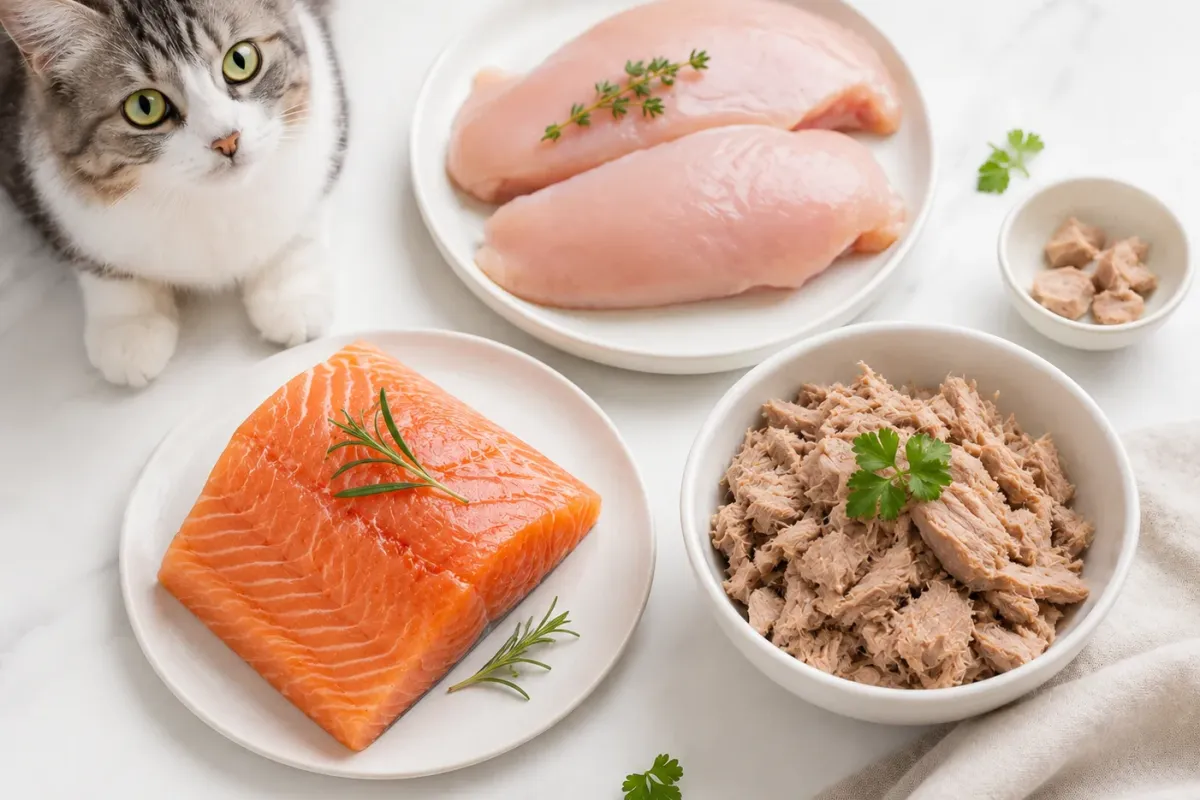
Chicken is the protein most complete cat foods are built around, so it makes sense that most of the time the answer to "can cats eat chicken" is yes. What actually causes harm is almost never the chicken itself. It is the bone left in a piece, the salmonella in an undercooked scrap, the garlic and onion in a seasoning blend, the sodium injected into a rotisserie bird, or a cat eating nothing but chicken for months on end.
This guide goes through chicken in every form a cat is realistically going to encounter it: plain and cooked, raw, bone-in, fried or seasoned, canned, sliced from the deli counter, and as liver, hearts or gizzards, and covers how any of it fits alongside a complete diet rather than replacing one. It is written from published veterinary sources, named and linked as they come up.
Is chicken good for cats?
Yes, in the sense that it is a lean, highly digestible source of animal protein, which is exactly what a cat's body is built to run on. Cats are obligate carnivores: unlike dogs, they cannot thrive on a mostly-plant diet, and several nutrients they need, including taurine and vitamin A in its usable form, come only from animal tissue. Chicken supplies complete protein and, cooked and unseasoned, is easy on the stomach, which is why it is one of the most common named proteins on a cat food ingredient list.
Where "good for cats" needs a caveat is that a home-cooked piece of chicken breast is not the same thing as chicken as it appears in a bag or can of complete food. Commercial cat food is formulated to hit AAFCO's minimum of 0.10 percent taurine on a dry-matter basis for extruded (dry) food and 0.20 percent for canned food, plus the calcium, phosphorus and B-vitamins a cat needs in balance with everything else in the bowl. A piece of plain chicken breast on its own does not carry that guarantee. It is a genuinely good addition to a complete diet. It is not, by itself, a diet.
How to prepare chicken safely for cats
The safest version of chicken for a cat is boiled, baked or poached until fully cooked through, with nothing added: no salt, no butter or oil, no garlic or onion powder, no seasoning blend of any kind. Bland is the point. Let it cool to room temperature before offering it, since a cat's mouth is sensitive to heat the same way a person's is, and cut or shred it into small, bite-sized pieces rather than leaving a whole chunk for a cat to tear at. Skin and bone should both come off before the chicken reaches the bowl, for reasons covered in the next two sections.
A cat that has never had chicken as a home-prepared extra before is worth introducing with a very small piece the first time, then watching for the following day rather than assuming a new food will sit fine just because chicken itself is a familiar ingredient in commercial food.
Can cats eat chicken bones? What happens if a cat swallows one?
No. Cooking changes chicken bone from something that mainly threatens teeth and the gut lining into something that also fragments into sharp shards. Veterinarians attribute this to cooking driving moisture out of the bone and breaking down its collagen, leaving it dehydrated and brittle, so it is more likely to splinter under bite force than a raw bone, which tends to crack or crush instead. Poultry bones are thin-walled to begin with, which makes them prone to sharp fragmentation even before cooking makes the problem worse.
Raw bone is not a safe substitute for a cooked one, though. WSAVA's Global Nutrition Committee lists bone ingestion, raw or otherwise, among the documented risks of feeding whole prey-style diets, including constipation, diarrhea, dental fractures and gastrointestinal obstructions, and states plainly that feeding bones does not even deliver the dental benefit it is often fed for. The ASPCA separately warns that dogs and cats "might sustain injury or obstruction to the gastrointestinal tract when ingesting bones, which could be serious and require surgery." Raw poultry carries its own separate risk of salmonella, campylobacter and other bacteria, covered in the next section.
Whether cooked or raw, a swallowed bone fragment can cut the mouth or throat on the way down, lodge in the esophagus, or perforate the stomach or intestine. VCA Animal Hospitals notes that when this happens, "the foreign body needs to be surgically removed and, in some cases, it penetrates the intestines, leading to more severe complications such as sepsis." When a lodged fragment cuts off blood supply to gut tissue for more than a few hours, that tissue can die, which is why exploratory surgery is generally recommended once an obstruction is diagnosed or even strongly suspected rather than waited out.
If your cat has just swallowed a chicken bone, call your vet or an animal poison control line rather than waiting to see how they seem. Do not try to induce vomiting yourself: bringing a sharp fragment back up can cause as much damage on the way out as it would on the way through. Watch for drooling, pawing at the mouth, vomiting, decreased appetite, straining to defecate, lethargy or pain when the abdomen is touched. Signs do not always show up the same day.
An embedded fragment does not follow a cat's normal gut transit schedule, and injury from a slow perforation can take a day or more to become obvious, so keep watching for at least 48 to 72 hours after a known bone swallow, not just the first few hours. No major veterinary body publishes a percentage of feline emergency visits caused specifically by bone, so treat this as a recognized but unquantified risk rather than a rare one: the right response is a phone call, not a wait-and-see.
Can cats eat raw chicken?
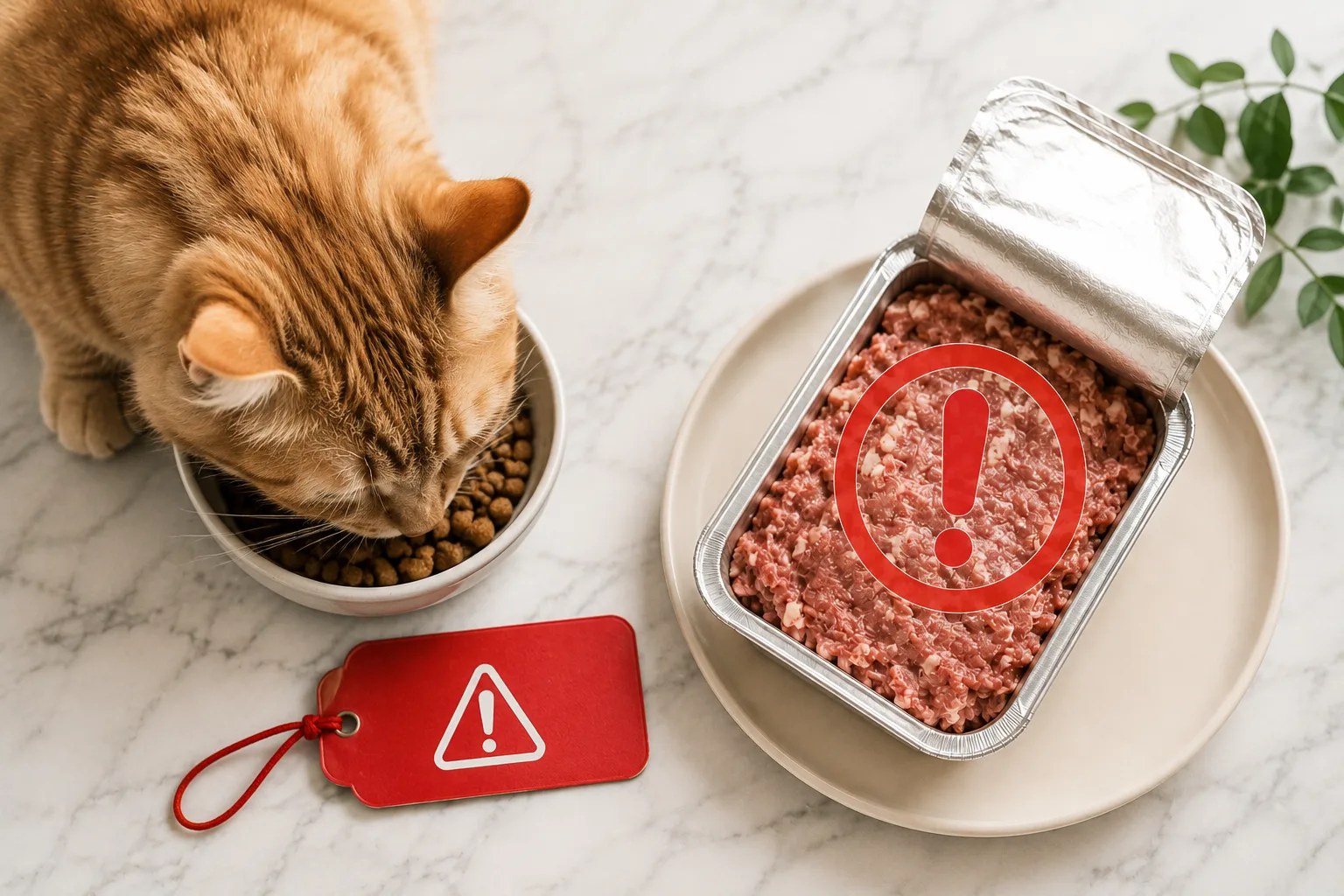
The concern with raw chicken is not the meat itself but what commonly lives on it. When the FDA tested 196 raw cat and dog food samples, 15 were positive for salmonella and 32 for listeria, close to a quarter of them, and the CDC attributes over 1.2 million salmonella infections and roughly 400 deaths a year in the United States to contaminated food generally. Campylobacter and E. coli are the other two organisms most consistently found on raw poultry. Cooking chicken through kills these pathogens; nothing about freezing or a quick rinse reliably does the same.
This is why every major body that has taken a public position on raw feeding, including the CDC, the FDA's Center for Veterinary Medicine and the Canadian Veterinary Medical Association, discourages it, and why the American Veterinary Medical Association separately "discourages the feeding to cats and dogs of any animal-source protein that has not first been subjected to a process to eliminate pathogens." Cornell Feline Health Center puts it plainly: raw diets "may contain viable bacteria, viruses, and parasites that can infect cats and their owners," and "do not impart a clear health benefit to cats that eat them," which is why Cornell does not recommend feeding them.
The bacteria risk is not only to the cat. A cat shedding salmonella or campylobacter in its stool can pass it on to the people cleaning the litter box, which matters more in a household with young children, an elderly person, or anyone with a weakened immune system. If raw feeding is something you are set on despite the above, that conversation belongs with a vet who can talk through sourcing, freezing protocols and supplementation, not with a blog post that is telling you plainly it is not the safer choice.
Can cats eat chicken necks or wings?
Raw chicken necks and wings are a different question from cooked bones, because raw bone tends to bend and crush rather than splinter, and these particular bones are soft and thin enough that some cats can gnaw through them safely. That is the argument raw-feeding advocates make for offering them, alongside a real, if theoretical, dental benefit from the chewing action itself.
It is still a real risk, not a safe workaround. The bacterial contamination covered above applies to a raw neck or wing exactly as it does to any other raw chicken part, and a cat that bites down wrong, or tries to swallow a piece too large, faces the same choking and obstruction risk described in the bones section. Cornell Feline Health Center does not recommend raw feeding in general, and no major veterinary organization has endorsed raw meaty bones specifically as a validated dental care method.
The Veterinary Oral Health Council, the body that actually certifies dental products, does not certify bones at all. Cornell's own numbers on feline dental disease are stark on their own: roughly 85 percent of cats over six have some degree of periodontal disease, and about half develop resorptive lesions, so there is a real problem worth solving, just not good evidence that raw bones are the way to solve it.
If you want to try raw necks or wings anyway, do it only with your vet's input, introduce them slowly, always under direct supervision, and never with a cat that gulps food rather than chewing it. A cooked neck or wing is worse, not better: cooking is exactly what turns a bone that bends into one that shatters.
Can cats eat chicken skin?
Best kept to a minimum rather than treated as toxic. Chicken skin is mostly fat, and here the picture for cats is genuinely different from the one for dogs. VCA Animal Hospitals states plainly that "unlike dogs, cats do not appear to develop pancreatitis as the result of eating a high-fat diet." Cornell lists "excessive dietary fat" only among several unconfirmed possible contributing factors to feline pancreatitis, not a proven cause, and notes the condition is uncommon overall, affecting under two percent of the general cat population.
The more realistic risks with chicken skin are indirect. Extra calories add up toward obesity, which is a real driver of feline diabetes. Rich or greasy food can trigger a bout of vomiting or diarrhea that puts a cat off its regular meals, and any cat that refuses food for more than a day needs attention: cats are poorly adapted to using body fat as an emergency energy source, and rapid weight loss from not eating can trigger hepatic lipidosis, a serious and sometimes fatal liver condition.
Cornell advises owners to "seek veterinary counsel if a cat with a typically healthy appetite suddenly refuses to eat, even for just a day." A little plain, unseasoned chicken skin now and then is unlikely to cause harm on its own. Seasoned or fried skin is a different story, covered below.
Can cats eat chicken liver or other organ meat?
In small amounts, yes, and it offers something plain breast meat does not: liver is a genuinely good source of taurine, iron, copper and B-vitamins. The problem is vitamin A, and the mechanism is specific enough to be worth understanding rather than just avoiding on instinct.
Vitamin A is fat-soluble, which means a cat's body stores the excess in the liver instead of flushing it out through urine the way it does with water-soluble vitamins. Cats also cannot convert plant-based beta-carotene into usable vitamin A the way many other animals can, so they depend entirely on preformed vitamin A from animal tissue, and liver is by far the most concentrated source of it.
Chicken liver runs somewhere around 3,300 to 4,000 micrograms of retinol per 100 grams, which is several times a cat's full day of vitamin A in a single small serving. VCA Animal Hospitals confirms cats are more susceptible to vitamin A poisoning than dogs, and that the excessive bone growth it causes, most visibly around the neck, chest and joints, is not reversible even once vitamin A levels come back down, though comfort and mobility can improve.
Documented cases of this in cats fed liver-heavy homemade diets, one involving raw pork liver and another raw beef liver, both describe progressive lameness caused by new bone growth compressing nerves, with serum vitamin A levels well above the normal range. Chicken liver is not the specific meat in either published case, but its retinol content is comparable, so the same mechanism applies.
The commonly cited moderation guideline in veterinary practice is to keep liver, of any kind, to somewhere around 5 to 10 percent of a cat's diet, offered occasionally rather than daily. A cat that gets a small piece of cooked chicken liver now and then is not at risk. A cat fed liver as a regular, sizeable part of its diet is exactly the pattern behind the documented poisoning cases.
Can cats have chicken broth or bouillon?
Plain broth in small amounts, yes, and it can genuinely help: a spoonful of unsalted, unseasoned chicken broth is a common trick for coaxing a sick or dehydrated cat to eat and drink more. Store-bought broth and bouillon are a different matter, and the two problems worth knowing are hidden onion or garlic and sodium.
Onion and garlic are genuinely dangerous to cats, not just an upset stomach risk. Both contain sulfur compounds that damage red blood cells, causing Heinz body formation and, eventually, hemolytic anemia. The Merck Veterinary Manual states that "cats are the most susceptible species, followed by dogs," with clinical signs reported after less than a teaspoon of cooked onion, or 5 grams per kilogram of body weight of raw onion, a far smaller amount than the 15 to 30 grams per kilogram that affects dogs.
Garlic is three to five times more concentrated than onion by weight, so it takes even less. Damage begins within 24 hours and peaks around 72 hours, with hemolysis typically showing up 3 to 5 days after exposure, well after the meal is forgotten. Broth or bouillon made with onion or garlic powder carries the same risk as the powder itself, just diluted in liquid, which is why the ingredient list matters as much as the sodium content. Our guide to toxic foods covers onion, garlic and the rest of the allium family in full.
On sodium: a regular bouillon cube commonly carries 800 to 1,200 milligrams of sodium, roughly a third to half of a human adult's entire daily recommended intake, and a cup of regular chicken broth commonly carries 700 to 900 milligrams. A cat's minimum daily sodium requirement is only around 10 milligrams per kilogram of body weight, so even a few tablespoons of ordinary broth can deliver several times what a cat needs in one serving.
"Reduced sodium" broth is only required to cut about 25 percent from a high starting point and can still land north of 500 milligrams per cup; only broth labeled "low sodium" or "no salt added" reliably drops to roughly 140 to 200 milligrams per cup, and even that still needs an ingredient check. If you want to offer broth, the safest version is one you make yourself: plain chicken simmered in water with nothing else added, strained, and offered in small amounts.
Can cats eat rotisserie, fried or seasoned chicken?
Not the way it usually comes. Rotisserie, fried and seasoned chicken are meaningfully riskier than plain cooked chicken, for reasons that have nothing to do with chicken as an ingredient. Grocery-store rotisserie chickens are commonly injected with a sodium-based brine before cooking, which can put a single three-ounce serving at 460 to 550 milligrams of sodium, close to half of what a full cup of regular broth carries. Many are also seasoned with garlic or onion powder as part of the rub, which brings the same red-blood-cell risk covered above, often without it being obvious from looking at the skin.
Fried and breaded chicken adds a separate problem: the frying oil and breading pack in extra fat and calories, and a cat that gets into fast-food-style chicken is eating something formulated for a human palate, not a cat's digestive system. While cats are not established to develop pancreatitis from dietary fat the way dogs are, a sudden dose of greasy, salty, heavily seasoned food is still a reliable way to trigger vomiting or diarrhea, and repeated exposure normalizes exactly the kind of eating that has nothing to do with a cat's nutritional needs.
Our guide to junk food and cats covers fried and fast-food items, including chicken nuggets and fast-food chicken, in more detail. A small taste of unseasoned chicken pulled from a rotisserie bird, meat only, no skin, no brine pockets, is a reasonable occasional exception. The seasoning and the skin are what to actually keep away.
Can cats eat canned or deli chicken?
In small amounts, occasionally, yes, with the same sodium caveat that runs through this whole guide. Plain cooked chicken breast carries roughly 45 milligrams of sodium per 100 grams raw, rising to about 65 to 75 milligrams once cooked. Canned chicken packed in broth commonly runs 270 to 500 milligrams per 100 grams depending on the brand and whether the liquid is drained off, and a two-slice, roughly 40-gram serving of deli-style chicken breast can carry around 455 to 460 milligrams on its own, several times what the same weight of home- cooked chicken would have.
Deli and lunch meat chicken adds a second issue on top of sodium: many brands use sodium nitrite as a preservative. In excess, nitrite oxidizes the iron in hemoglobin into a form that cannot carry oxygen, a condition called methemoglobinemia, and a documented case in New Zealand linked nitrite-preserved pet food to the deaths of three cats from exactly this mechanism, with the food's nitrite level measured at roughly 140 times the standard set for pet food.
That case involved commercial pet food specifically, not deli meat, but it illustrates why nitrite-preserved meat is not something to make a habit of. Deli chicken is also frequently cross-contaminated with or directly seasoned alongside other deli meats that carry onion or garlic flavoring. A plain canned chicken meant for cats, or a small amount of home-cooked chicken with the liquid drained, is the better default over either canned or deli chicken made for people.
Can cats eat chicken hearts or gizzards?
Yes, in moderation, and they are a genuinely useful addition. Chicken hearts are one of the richer taurine sources among poultry parts, and both hearts and gizzards run higher in protein than plain breast meat, which is part of why they show up as named ingredients in some commercial raw and canned diets. Cooked plain, with no seasoning, a small chopped piece now and then is a reasonable extra alongside a complete diet.
The same moderation logic that applies to liver applies here in a smaller way: organ meat generally should stay a minority of total intake rather than becoming the bulk of what a cat eats, and any store-bought version seasoned, brined or packed in sauce should be treated the same as rotisserie or deli chicken, not as plain meat.
How much chicken can I give my cat?
The Cornell Feline Health Center and VCA Animal Hospitals both frame treats and extras, chicken included, as best kept under roughly 10 to 15 percent of a cat's daily calories, since these additions are not formulated to be nutritionally complete the way the rest of the diet is. For a typical 8 to 10 pound adult cat eating somewhere around 200 to 260 calories a day, that ceiling works out to roughly 20 to 26 calories from chicken and other extras combined.
Cooked, skinless chicken breast runs about 45 to 50 calories per ounce, which means two tablespoons, a common "safe" portion cited elsewhere online, can already land at 18 to 23 percent of a smaller cat's entire daily calorie budget on its own. For most adult cats, a single tablespoon or less is a more realistic everyday portion, with two tablespoons better reserved for a larger or more active cat.
Kittens under six months generally do well with something closer to two teaspoons a day, given their smaller size and the fact that kitten food is already calorie-dense and formulated for growth, with chicken as an occasional extra rather than a meaningful part of the day's calories. Because "how much" really comes down to an individual cat's weight and activity level rather than a flat spoon measurement, our calorie calculator and feeding guide both work from a cat's actual weight to a real daily number, which is a more reliable starting point than any fixed portion size.
Can I feed my cat only chicken? What if my cat only eats chicken?
Not as a long-term diet, no. Plain chicken alone is missing taurine at a guaranteed, consistent level, along with calcium, phosphorus and several vitamins in the ratios a cat actually needs, and boiling in particular leaches out a meaningful share of the taurine chicken naturally contains. A study of homemade cat food recipes found that more than half were inadequate in taurine specifically, even when the person writing the recipe was deliberately trying to feed a balanced diet.
Commercial cat food listing chicken as its named protein is not the same thing as a bowl of home-cooked chicken: the commercial version is formulated, fortified and tested to a nutrient profile; the home-cooked version is not, unless a board-certified veterinary nutritionist specifically designed it that way.
A cat that has decided it will only eat chicken and refuses its usual food is a common, frustrating situation, and it is worth treating as two separate problems rather than one. First, rule out a medical reason: a cat that suddenly becomes selective, especially alongside any other change in appetite, energy or litter box habits, can be showing an early sign of illness rather than simple pickiness, and our guide to the early signs a cat is sick is worth a read if anything else seems off.
Once illness is ruled out, transition slowly rather than switching cold: mix a small, increasing amount of complete food into the chicken over one to two weeks, and avoid letting a cat go without eating for more than a day, since prolonged refusal to eat carries its own separate liver risk in cats, covered in the skin section above.
Can cats be allergic to chicken?
Yes, though true food allergy is uncommon overall. The Merck Veterinary Manual puts the rate at under 1 percent of cats seen for any kind of veterinary care, rising to 3 to 6 percent among cats specifically presenting with skin disease and 12 to 21 percent among cats with itching as a symptom. Cornell Feline Health Center ranks food allergy as the third most common type of feline allergy overall, behind flea-bite allergy and inhaled allergens.
Chicken is one of the more commonly identified triggers, alongside beef and fish, but no source shows it is inherently more likely to cause an allergy than those other proteins; it may simply show up more often because it is fed more often. A cat can develop a chicken allergy after months or years of eating chicken with no issue at all, since sensitization is not tied to how new or unusual a food is. Typical signs include itchy skin around the face, ears, belly and paws, recurring ear or skin infections, and in an estimated 10 to 15 percent of affected cats, vomiting or diarrhea as well.
There is no reliable blood or saliva test for a food allergy in cats. The only diagnostic method veterinary sources consider dependable is an elimination diet trial: feeding a novel protein, such as rabbit, venison or duck, or a hydrolyzed diet in which proteins are broken down too small for the immune system to recognize, for a strict 8 to 10 week period with zero exceptions, including flavored treats and medications.
Reintroducing chicken afterward and watching for signs to return, usually within one to three days but sometimes taking up to four weeks, confirms the diagnosis. Once identified, a chicken allergy is managed rather than cured: strict, ongoing avoidance is what keeps signs from coming back, which is also why comparing chicken to a cat's other realistic protein options, rather than assuming any one meat is automatically safer, matters more than the specific protein involved.
What to do if your cat eats something risky
A cat that swallowed a bone needs a phone call to your vet or an animal poison control line right away, not a wait-and-see approach, for the reasons covered above: watch for drooling, vomiting, decreased appetite, straining or lethargy over the following two to three days, and treat any of those as reason to go in, not just a bad day.
A cat that got into seasoned, rotisserie or fried chicken with real onion or garlic content is a genuine emergency call as well, even if nothing looks wrong yet: the red-blood-cell damage from allium compounds does not peak for up to 72 hours and hemolysis can take another few days on top of that, so waiting for symptoms means waiting for the problem to already be well underway. Watch for lethargy, pale or yellowish gums, rapid breathing, or dark, orange-tinged urine, and call sooner rather than later if any onion or garlic content is likely.
A cat that simply overate plain chicken, too much rich or fatty chicken, or a large piece of skin, is usually a milder situation: vomiting, diarrhea or a day of reduced appetite is the likely outcome, and most cats recover on their own within a day or two. The one exception worth taking seriously is a cat that stops eating entirely for more than 24 hours, since that crosses into hepatic lipidosis risk regardless of what caused the original upset. Our guide to the signs a cat is sick covers the broader symptom list worth knowing regardless of what your cat got into, and is worth bookmarking rather than reading only after something has already happened.
This guide goes into more depth than Can Cats Eat Meat and Fish? and Can Cats Eat Junk Food or Fast Food?, which compare the whole group side by side.
Frequently asked questions
Can cats eat chicken?
Yes. Plain, cooked, boneless chicken with no seasoning is one of the safer foods to offer a cat, and it is already a common named protein in complete cat food. The real risk is almost never the chicken itself, it is bones, skin, seasoning, raw handling, or letting chicken replace a balanced diet instead of adding to it.
Can cats eat chicken bones?
No. Cooking dries out and breaks down the collagen in bone, leaving it brittle enough to splinter into sharp fragments that can cut the throat or perforate the gut. Raw bone is not a safe substitute either, since it still carries contamination and obstruction risk. Every bone should come off before chicken reaches the bowl.
Can cats eat chicken skin?
Best kept minimal rather than treated as toxic. Chicken skin is mostly fat, and unlike dogs, cats are not established to develop pancreatitis from a high-fat diet. The real risks are extra calories and a greasy meal triggering an upset stomach. A small amount of plain skin now and then is unlikely to cause harm.
Can cats eat raw chicken?
The danger is not the chicken but what commonly lives on it: salmonella, campylobacter and E. coli. VCA Animal Hospitals found nearly a quarter of tested raw pet food samples carried harmful bacteria. Cooking chicken through kills these pathogens; freezing does not reliably. Cornell Feline Health Center does not recommend raw diets for this reason.
Can I feed my cat only chicken?
No. Plain chicken is missing taurine at a guaranteed level, along with calcium and other nutrients a formulated diet balances. Boiling also leaches out some of the taurine chicken naturally has. Chicken works well as a topper or occasional addition alongside a complete diet, not as a replacement for one long term.
Can cats be allergic to chicken?
Yes, though true food allergy is uncommon, affecting under 1 percent of cats overall. Chicken is one of the more commonly identified triggers, alongside beef and fish, causing itchy skin, recurring ear infections or digestive upset. An elimination diet trial run for 8 to 10 weeks is the only reliable way to confirm it.
How much chicken can I give my cat?
Generally under 10 to 15 percent of daily calories, which for an average adult cat commonly works out to about a tablespoon of cooked chicken or less, not the two tablespoons sometimes cited elsewhere. Our calorie calculator turns a cat's actual weight into a daily number rather than relying on a flat spoon measurement.
Can cats eat chicken liver?
In small amounts, yes. Liver is a strong source of taurine, iron and B-vitamins, but it is also extremely concentrated in vitamin A, which cats store rather than excrete. Fed regularly and in quantity, it can cause vitamin A poisoning with bone changes that do not reverse. Keep it occasional, not a daily addition.
Can cats have chicken broth?
Plain, homemade broth in small amounts can help a sick or dehydrated cat eat and drink. Store-bought versions often hide onion or garlic powder, which are genuinely toxic to cats, and can carry several times a cat's daily sodium needs in one cup. Choose a broth labeled low sodium or no salt added, or make your own.
Can cats eat rotisserie or fried chicken?
Not as it usually comes. Rotisserie chicken is commonly injected with a sodium brine and seasoned with garlic or onion powder, both real risks, while fried chicken adds oil, batter and extra salt. A small amount of plain meat pulled off, with no skin and no seasoning, is the only part worth offering a cat.
Can cats eat chicken necks or wings?
Raw necks and wings tend to bend rather than splinter, and some cats can gnaw them safely, which is the argument for offering them. They still carry the same bacterial contamination and choking risk as any raw chicken, and no major veterinary body endorses them as a proven dental method. Cooked versions are worse, not safer.
Sources
- Cornell Feline Health Center: Feeding Your Cat Obligate carnivores, raw diets, and the rule of thumb for treats.
- FDA: Raw Pet Food Diets Can Be Dangerous The FDA study that found salmonella and listeria in raw pet food.
- AVMA policy: Raw or Undercooked Animal-Source Protein Why the AVMA discourages raw feeding.
- WSAVA Global Nutrition Committee: Risks of Raw Meat-Based Diets Bone ingestion and other risks of raw diets.
- Merck Veterinary Manual: Garlic and Onion Toxicosis Why cats are the most susceptible species to allium poisoning.
- VCA Animal Hospitals: Nutrition and Pancreatic Disease in Cats Why high-fat foods affect cats differently from dogs.
General information, not veterinary advice. If your cat's behavior has changed suddenly, speak to a vet rather than an article.
How this guide was researched and checked is set out in how our guides are written.

Want an answer in seconds?
The calculators handle age, due dates and portions without an account.