Can Cats Eat Grapes or Raisins?

On this page
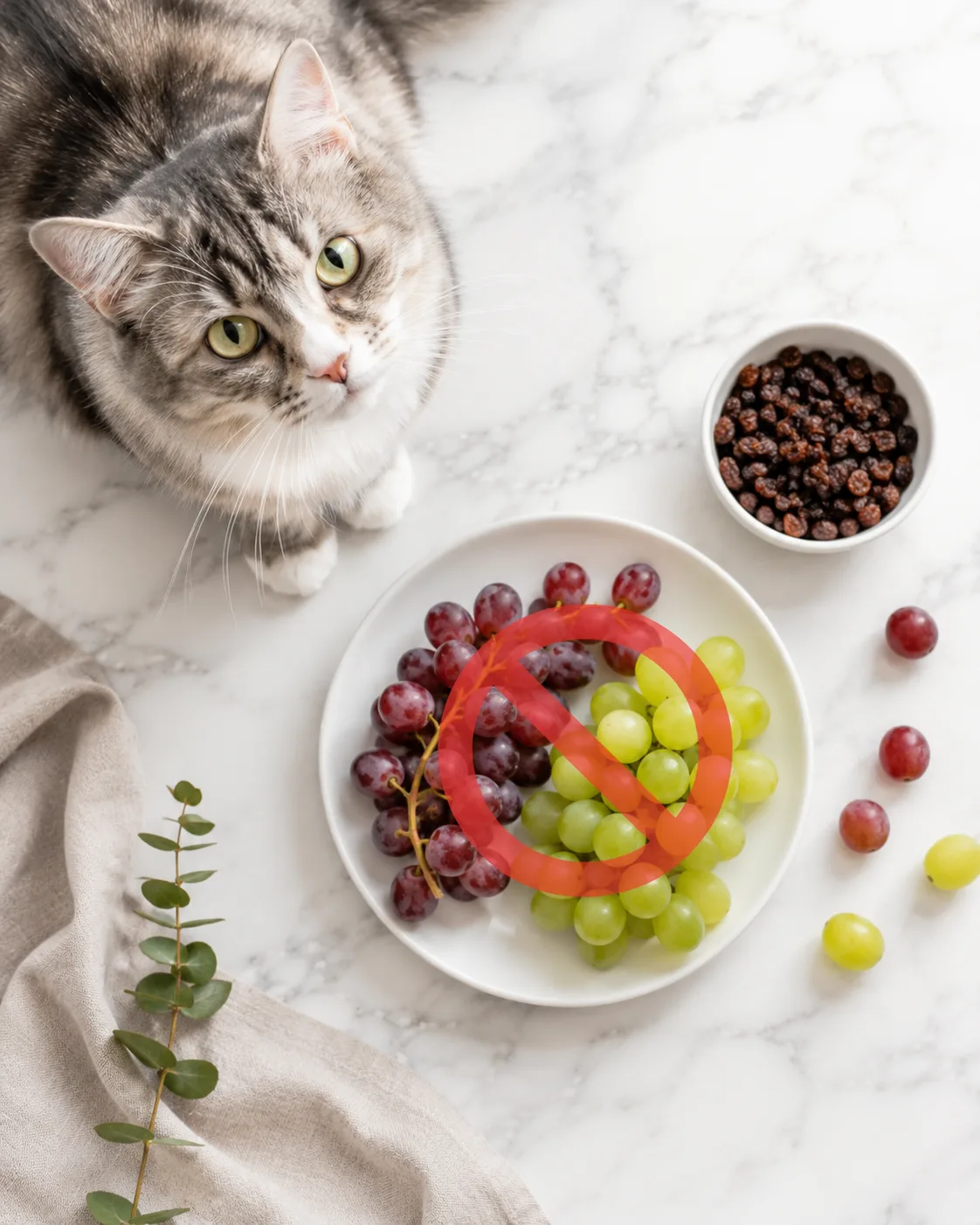
Grapes and raisins sit in an unusual place among the foods on this site. Most of what shows up in a cat's reach is either genuinely fine in small amounts, like a lick of plain chicken, or dangerous through a mechanism science actually understands, like the theobromine in chocolate. Grapes and raisins are neither.
They sit in our toxic foods guide as a flat no, and that flat no is correct, but the reasoning behind it is genuinely unusual: nobody has fully identified why grapes hurt some dogs and cats and not others, no dose has ever been shown to be safe, and cat-specific evidence has been thin for years. A large new study changes some of that thinness. This page covers what is actually established, what is still an educated guess, and exactly what to do if a cat has already eaten one.
Start with the practical answer, since that is what matters most if this is happening right now: treat any amount, of a fresh grape or a single raisin, as a reason to call a vet or an animal poison control line immediately. Not because every exposure ends badly, most do not, but because nobody, including the researchers who study this, can currently tell you in advance which cat will be fine and which will not.
Why are grapes and raisins toxic to cats?
The honest answer is that nobody fully knows, and that includes the veterinary toxicologists who study it. The Merck Veterinary Manual states plainly that the toxic principle in grapes and raisins is not known, which is a striking admission for a substance that has been causing documented poisonings in dogs since at least the early 2000s.
The leading theory, not a proven fact, points to tartaric acid, a compound naturally present in grape flesh at concentrations that vary widely, roughly 0.35 to 2 percent, depending on the grape variety, its ripeness, and how it was grown. That variability alone explains part of why toxicity looks so unpredictable from the outside: two grapes from two different vines are not delivering the same dose of the suspected toxin, even if they look identical on a plate.
The tartaric acid theory itself is fairly recent. It traces back to a 2021 case that had nothing to do with grapes at all: a dog developed the same kind of acute kidney injury seen in classic grape poisoning after eating homemade play dough made with cream of tartar, which is a tartaric acid salt.
That single case prompted a closer look, and a following study added cases involving tamarind, a fruit that runs far higher in tartaric acid than grapes do, with a similar pattern of kidney injury. Laboratory work since then has shown tartaric acid is toxic to canine kidney cells specifically, tied to dogs having comparatively little of a transporter protein, called OAT4, that most other species use to clear organic acids like this one out of the body efficiently.
That is a real, specific, mechanistic finding, and it is also specifically about dogs. Whether the same transporter shortfall applies to cats has not been tested, at least not in anything published that this article's research could find, so treat the tartaric acid explanation as the best current theory for dogs, not a confirmed answer for cats.
Is the danger different for cats than for dogs?
For years, the honest answer here was that almost nobody knew, because almost no published cat data existed. The Merck Veterinary Manual describes feline cases as unpublished anecdotal reports, and some other sources have gone further, listing grapes as non-toxic to cats specifically, which shows how thin the historical evidence base actually was. That changed in August 2026, when a multicenter study in Frontiers in Veterinary Science pulled real emergency room records from 64 UK veterinary hospitals covering 2018 through 2024, and it is the most directly relevant cat data available anywhere right now.
Across 1,030 probable feline cases, the study found 11.8 percent mortality, compared with 0.9 percent among more than 31,000 canine cases in the same dataset, a gap the authors describe as roughly a fourteen-fold difference in the odds of a fatal outcome. That is the opposite of the assumption baked into a lot of older advice, which treats dogs and cats as equally at risk and simply scales a dog's warning down to a smaller body.
The same study found fresh grapes carried meaningfully higher risk than processed grape products like raisins or currants in food, a relative risk of roughly three times, in both species, and that cats given activated charcoal after exposure survived at a notably higher rate than cats who were not, 100 percent versus 66 percent in this dataset.
One honest caveat matters here, and it is one the study's own authors raise: they measured whether a cat survived or died, not whether kidney injury was confirmed by bloodwork in every case, so this data proves cats are getting seriously and sometimes fatally sick after grape or raisin exposure in real emergency practice, without independently proving the kidney-injury mechanism in cats the way it has been shown in dogs through direct tissue examination.
Put plainly: the outcome data in cats is now real and current and worse than in dogs, while the underlying biological explanation for why is still borrowed from canine research. Both of those things can be true at once, and this page is not going to pretend otherwise.
Is there a safe amount of grapes or raisins for a cat?
No, and this is one of the clearer answers on this entire site, because multiple major sources agree on it independently. VCA Animal Hospitals states there is no well-established toxic dose for grapes, raisins, or currants in dogs, and no cat-specific dose exists at all. Cornell's veterinary researchers describe the exact toxic dose as not entirely known.
A 2024 review that pooled 24 separate studies covering more than 1,100 dogs found something specific and important: the amount of fruit a dog ate was not related to how sick that dog became. Nearly three quarters of the dogs in that pooled data ate a grape or raisin product and showed no symptoms at all, while a documented case elsewhere describes a fatal outcome in a dog after as few as four or five grapes.
That pattern is what toxicologists call idiosyncratic rather than dose dependent, and it is worth sitting with the difference, because it changes how this page's own advice compares to something like our chocolate guide or our ham guide. Chocolate poisoning genuinely does scale with dose: more theobromine per kilogram of body weight reliably produces worse symptoms, which is why that page can walk through real per-ounce, per-cat-weight math. Ham is a different kind of nuance again, where sodium content genuinely does add up in a fairly predictable way as the amount eaten goes up. Grapes and raisins do not behave like either.
The published numbers make this concrete rather than abstract. One clinical review cites a reported lowest toxic dose of roughly 19.6 grams per kilogram of body weight for fresh grapes and 2.8 grams per kilogram for raisins, figures precise enough to look like a real formula, and then the same body of case reports undercuts that precision directly: a dog weighing 8.2 kilograms reportedly died after as few as four or five grapes, well under what that math would predict, while separate documented cases describe other dogs eating up to a full kilogram of raisins with no symptoms at all.
Put those two facts side by side and the lesson is not that one number is right and the other is an outlier, it is that no formula reliably predicts this, in either direction. A cat's individual sensitivity, not the size of the exposure, seems to be doing most of the work in whether a given case turns serious, and nobody can currently predict that sensitivity in advance.
That is precisely why every major veterinary source lands on the same blunt rule: treat one grape the same way you would treat a handful, because the amount eaten does not reliably tell you how worried to be.
What happens if a cat eats a grape or raisin? Symptoms and timeline
Signs tend to arrive in two waves, and the gap between them is part of what makes this poisoning dangerous: the first wave can look mild and pass, while real damage is still developing underneath it. In the first six to twelve hours, expect gastrointestinal signs: vomiting, possibly diarrhea, reduced appetite, and general lethargy. Some cats also show abdominal discomfort or mild tremors in this window.
The second and more serious wave shows up between roughly twenty four and seventy two hours after exposure, as the kidneys, if they are going to be affected, start to fail. Watch specifically for reduced or absent urination, worsening or returning vomiting, lethargy that deepens rather than improves, and in more severe cases, breath that takes on an ammonia-like smell or neurological signs like tremors.
Reduced urination in this context is a genuine emergency sign, not the same thing as a urinary tract infection, which usually presents as frequent straining to urinate small amounts rather than an actual drop in output, a more routine pattern covered in our guide to cat UTI symptoms. If a cat is urinating less or not at all after a known or suspected grape exposure, that is a call now, not a wait and see, and it is also worth knowing the wider set of warning signs covered in our guide to signs a cat is sick.
One diagnostic detail worth knowing if you end up discussing bloodwork with a vet: in these cases, a specific kidney marker called creatinine tends to rise before the more commonly cited BUN value does, and it often rises higher than BUN would predict on its own, which is a pattern vets specifically look for when grape or raisin exposure is suspected but not confirmed.
My cat ate a grape or raisin, what do I do right now?
Call a veterinarian or an animal poison control line immediately, before symptoms appear, not after. This is not a wait-and-see food the way something in our fruits guide marked safe or caution would be. Have ready: roughly how many grapes or raisins were involved, whether they were fresh or dried, how long ago it happened, and your cat's approximate weight, since the vet will use that for fluid and medication dosing even though it cannot reliably predict toxicity itself. Knowing that number ahead of time, rather than guessing on the phone, is one small thing our weight checker can make one less thing to figure out in the moment.
Do not induce vomiting at home without being told to by a professional. The standard veterinary approach, when a cat is brought in soon enough and is not already showing symptoms, is professionally induced vomiting to clear the stomach, and some protocols consider this worth doing even several hours after ingestion, since the suspected toxin may slow stomach emptying. That timing judgment, and the method used, needs to come from a vet, not a guess made at home, because doing it wrong or at the wrong time can cause its own complications.
What does a vet actually do for grape or raisin poisoning?
For a cat brought in before symptoms start, treatment typically follows a fairly consistent pattern: induced vomiting to clear remaining stomach contents, then activated charcoal to bind whatever toxin is left in the gut. One honest detail most consumer-facing articles skip: the Merck Veterinary Manual itself notes that activated charcoal's actual effectiveness against this specific toxin is unknown, it is standard practice because it is a reasonable precaution with a good safety profile, not because it has been proven to work here specifically.
The real backbone of treatment is aggressive intravenous fluid therapy aimed at keeping the kidneys well perfused and urine flowing, typically maintained for a minimum of forty eight hours in a meaningful exposure, sometimes extended further based on how bloodwork looks. During that window, vets recheck kidney values, mainly BUN and creatinine, daily or twice daily, watching for the twenty four to seventy two hour window when kidney injury tends to declare itself if it is going to. In severe cases where a cat stops producing urine, treatment escalates to medications aimed at keeping urine flowing, and in the most serious cases, dialysis.
The single biggest lever on outcome, more than any specific drug, is how early treatment starts. One retrospective study found that dogs brought in and decontaminated early developed confirmed kidney injury at roughly half the rate of dogs who presented later, 4.5 percent versus 9 percent. A separate, older case series looking specifically at dogs who had already progressed to confirmed kidney injury found survival around 53 percent, noticeably worse than the outlook for animals treated before that point. The pattern is consistent across the research: caught early, most cats and dogs do well. Once kidney injury is already established, the outlook gets meaningfully more serious.
Can cats eat raisin bread, oatmeal raisin cookies, or raisin bran?
No, treat all of these the same as a loose raisin, because that is exactly what they contain. Raisin bread, oatmeal raisin cookies, granola bars with raisin paste mixed through them, trail mix, and raisin-containing cereals like raisin bran are all confirmed sources in the same research this page draws from, and they are easy to underestimate specifically because they do not look like the fruit itself.
A slice of raisin bread or a couple of cookies can deliver several raisins' worth of exposure without ever registering as grapes to the person handing it over. If a recipe or package lists raisins, currants, or sultanas anywhere in the ingredients, treat it exactly like whole fruit for a cat, not like a baked good that happens to contain some.
Fruitcake and other holiday baking deserve a specific mention: the same 2026 study that produced the mortality figures above found a real seasonal pattern, with cases clustering around December, which lines up with exactly the kind of dense, raisin-and-currant-packed baking that shows up on counters that time of year. If your household bakes seasonally, that is worth building into how food gets stored and cooled, not just something to remember once a year.
Can cats eat grape jelly, grape juice, or wine sauce?
This is one of the few places where genuinely reputable sources disagree, and it deserves a straight answer rather than a hedge dressed up as caution. Cornell's veterinary researchers state directly that grape juice, jelly, grape seed oil, and wine have not been associated with documented toxicosis, reasoning that the processing involved in juicing, fermenting, or extracting oil likely removes or breaks down whatever the responsible compound turns out to be. Other sources, including general ASPCA guidance and many clinic and consumer pages, list jelly and juice among things to avoid out of caution anyway, without pointing to specific case reports behind that caution.
The most defensible position, reading across both: the whole and dried fruit, fresh grapes and raisins, currants, and sultanas, are the confirmed-dangerous category, with real case reports and now real mortality data behind them. Jelly, juice, and wine sit in a lower-confidence, precautionary category, worth avoiding because there is no upside to testing it and one credible academic source's reassurance is not the same as proof of safety, but not something to treat with the same alarm as a cat that just ate a handful of raisins.
If a cat licks a smear of grape jelly off a plate, that is a different situation from a cat eating raisins out of a trail mix bag, and it is fine to weigh those two events differently while still keeping an eye on the cat either way.
Are currants and sultanas the same danger as raisins?
It depends entirely on which fruit is actually called a currant, and this is a genuinely useful distinction most articles skip. True currants, the small tart berries from Ribes plants used in jams and some baking, are a different plant family entirely and are not linked to this toxicity. What gets sold as dried currants in most grocery stores, sometimes called Zante currants, are something else altogether: a small dried grape variety, meaning they carry the exact same risk profile as a raisin, just in a smaller, easier-to-overlook form.
Sultanas are simply another name for a specific type of dried grape, again functionally identical to a raisin for this purpose. If a label says currants and the product is dried and shelf-stable rather than fresh and tart, assume it means dried grapes unless proven otherwise, and treat it accordingly.
Does a seedless grape or a peeled grape change the risk?
No, and this has been checked directly rather than assumed. Documented poisoning cases have involved seedless and seeded grapes, red and green varieties, organic and conventionally grown fruit alike, which rules out seeds, cultivar, and growing method as protective factors. The suspected toxin is believed to sit in the flesh of the grape rather than being concentrated in the skin or seed, which is consistent with seedless grapes still causing problems, though nobody appears to have run a direct test comparing peeled against unpeeled grapes specifically. Treat any part of the grape, any color, any variety, seeded or not, as carrying the same risk, since nothing in the research supports picking a safer grape.
Are kittens at higher risk from grapes and raisins?
No published research specifically addresses kittens and this toxin, which is worth stating plainly rather than guessing dressed up as fact. What can be said with confidence is narrower: because toxicity here does not appear to scale predictably with dose the way it does with something like chocolate, the usual smaller-body-means-more-danger logic does not map onto this the same clean way it does elsewhere.
That does not make a kitten safer, it just means there is no kitten-specific data to point to either direction. The practical guidance does not change: no amount is established as safe for a kitten any more than it is for an adult cat, and a kitten getting into anything unusual is worth an extra-prompt call regardless of what it was.
How much does treatment for grape or raisin poisoning cost?
It varies widely depending on how much treatment ends up being needed, but it is worth knowing roughly what the process involves before it happens, not after. A straightforward case caught early and requiring an exam, induced vomiting, and activated charcoal without an overnight stay sits at the lower end.
A cat that needs the standard forty eight hour minimum of hospitalization on intravenous fluids, with repeat bloodwork to track kidney values, moves into a meaningfully higher range, and a case that progresses to confirmed kidney injury requiring extended monitoring or more intensive intervention costs more again. If cost is a genuine concern, say so directly to the vet or an animal poison control line when you call, since decontamination performed early, which is also the cheapest step, is the single biggest factor in avoiding the more expensive stages entirely.
How do I keep my cat away from grapes and raisins?
Most of the exposures behind the real case data on this page did not start with a cat stealing fruit off a counter, they started with something dropped, forgotten, or left within easy reach. A fruit bowl on a low table, a snack-size box of raisins left open on a desk, a school lunch packed the night before with a small bag of raisins tucked in a side pocket, and a bag of trail mix left unzipped after a hike are all realistic, ordinary ways a cat ends up with access, none of which required the cat to go looking for grapes specifically.
Storing grapes and dried fruit in a closed cupboard or the refrigerator rather than a countertop bowl, treating a dropped grape the way you would treat a dropped pill, picked up immediately rather than left for later, and being deliberate about where school lunches, hiking snacks, and baking ingredients get set down all close off the most common paths.
The seasonal pattern in the 2026 study is worth building into a habit rather than just noting once. If your household does holiday baking involving raisins, currants, or sultanas, that means fruitcake batter, mixing bowls, and cooling racks all deserve the same out-of-reach treatment as the finished dish, not just the cake itself once it is done.
The same logic applies to a bag of trail mix in a backpack left on the floor, or a school lunch box within jumping distance of a counter. None of this requires treating a cat like it cannot be trusted in its own home, it just means putting the same category of food in the same category of storage every time, the way you already would for anything else on our toxic foods guide.
Why don't cats eat grapes as often as dogs do?
Part of why feline grape poisoning has historically been so under-documented is almost certainly behavioral, not just a reporting gap. Cats carry a broken copy of the gene, called Tas1r2, that in most mammals builds one half of the receptor pair needed to detect sweetness on the tongue. Without a working copy, a cat's mouth simply cannot register sugar the way a person's or a dog's can, a finding that has been replicated directly by researchers offering cats a genuine choice between plain water and sugar water and finding no preference either way.
So unlike a dog, which will readily seek out something sweet, a cat tasting a grape is not getting the flavor most people assume is the draw, and grapes and raisins have very little else to offer a cat's palate beyond that sweetness. That is not a safety feature, it is just a reason cats are statistically less likely to seek out or finish a grape on their own compared with a food that appeals to their actual sense of taste, savory and fatty rather than sweet.
Most feline exposures documented in practice involve a cat investigating something dropped or left within reach rather than a cat actively choosing to eat fruit, which is part of why prevention here is mostly about where fruit and dried fruit get stored, not about a cat developing a taste for them.
None of that changes the bottom line. A cat is less likely to seek grapes out than a dog is, but a cat that does eat one is not automatically safer for it, and the newest real-world data available says the opposite may be closer to true. Keep grapes, raisins, currants, and anything baked with them somewhere a cat genuinely cannot reach, the same way you would with anything else on our toxic foods guide, and treat any known or suspected exposure as an immediate call, not a wait and see.
This guide goes into more depth than Can Cats Eat Fruit? and What Foods Are Toxic to Cats?, which compare the whole group side by side.
Frequently asked questions
Can cats eat grapes?
No. No safe amount of grape has ever been established for a cat, and treating any exposure as a reason to call a vet immediately is the consistent advice across every major veterinary source, even though the exact toxic mechanism is still not fully understood.
Can cats eat raisins?
No, and raisins should be treated with the same urgency as fresh grapes, possibly more caution, since drying is believed to concentrate whatever compound is responsible. There is no established safe amount for raisins in cats any more than there is for whole grapes.
What happens if a cat eats a grape?
Vomiting, reduced appetite, and lethargy can appear within six to twelve hours. The more serious concern, reduced or absent urination and worsening lethargy from developing kidney injury, tends to show up twenty four to seventy two hours later, which is why watching only the first few hours is not enough.
How many grapes are toxic to a cat?
There is no known safe number. Research has found that how much a dog or cat ate does not reliably predict how sick they become, since individual sensitivity appears to matter more than dose. Treat one grape with the same urgency as a handful.
Is grape toxicity in cats actually confirmed, or just a dog problem?
Cat-specific evidence has historically been thin, and some older sources even listed grapes as non-toxic to cats. A large 2026 study of over 1,000 real feline emergency cases found mortality running several times higher in cats than in dogs, though the study's own authors note it measured survival outcomes rather than confirming kidney injury by bloodwork in every case. The safest reading is that cats appear to fare at least as badly as dogs, likely worse, even though the precise biological mechanism in cats has not been separately proven.
Can cats eat grape jelly or grape juice?
This is genuinely disputed. Cornell's veterinary researchers state grape juice, jelly, and wine have not been linked to documented poisoning, reasoning that processing likely breaks down the responsible compound. Other sources still advise caution. Treat whole and dried fruit as the confirmed danger, and jelly or juice as a lower-confidence precaution rather than an emergency on the same level.
Are currants and sultanas dangerous to cats?
It depends which currant. True currants from Ribes plants are a different fruit and not linked to this toxicity. What is usually sold as dried currants in stores is actually a small dried grape variety, carrying the same risk as raisins. Sultanas are also dried grapes. Treat any dried, shelf-stable product labeled currant or sultana the same as a raisin unless you know otherwise.
My cat ate a raisin bread or an oatmeal raisin cookie, is that dangerous?
Yes, treat it the same as loose raisins. Raisin bread, oatmeal raisin cookies, granola bars, trail mix, and raisin-containing cereal are all confirmed sources, and it is easy to underestimate how many raisins' worth of exposure a single slice or cookie actually contains.
Does peeling a grape or removing the seeds make it safe for a cat?
No. Documented poisoning cases involve seedless and seeded grapes, and every color and growing method, ruling out seeds and variety as protective. The suspected toxin sits in the grape's flesh, not just the skin or seed, so peeling is unlikely to help even though nobody appears to have tested it directly.
What should I do if my cat ate a grape or raisin?
Call a vet or an animal poison control line immediately, do not wait for symptoms. Have ready how much was eaten, whether it was fresh or dried, how long ago, and your cat's weight. Do not induce vomiting at home without professional guidance, since timing and method matter.
Sources
- Merck Veterinary Manual: Grape, Raisin, and Tamarind Toxicosis Primary clinical reference for mechanism, symptom timeline, treatment protocol, and the explicit statement that cat reports are unpublished and anecdotal.
- VCA Animal Hospitals: Grape, Raisin, and Currant Poisoning Confirms no established toxic dose exists, and that seedless, seeded, organic and non-organic varieties are all implicated.
- Cornell Riney Canine Health Center: Grape and Raisin Toxicity The source behind the jelly, juice and wine disagreement, stating these have not been associated with documented toxicosis.
- ASPCApro: Toxic Component in Grapes and Raisins Identified The ASPCA's own account of the tartaric acid theory, including the concentration variability that makes dosing unpredictable.
- Pet Poison Helpline: Grapes Confirms toxic mechanism is unconfirmed and toxicity depends on individual sensitivity, not just amount eaten.
- Altman, Kamat, Leicester, Fraser, Singleton and Elias Santo-Domingo, Frontiers in Veterinary Science, 2026 The 2026 multicenter study of 1,030 feline and over 31,000 canine emergency cases behind the mortality and charcoal-survival figures on this page.
- Downs et al., Veterinary Record, 2024 A pooled review of 24 studies and over 1,100 dogs finding no relationship between amount eaten and severity of illness.
General information, not veterinary advice. If your cat's behavior has changed suddenly, speak to a vet rather than an article.
How this guide was researched and checked is set out in how our guides are written.

Want an answer in seconds?
The calculators handle age, due dates and portions without an account.