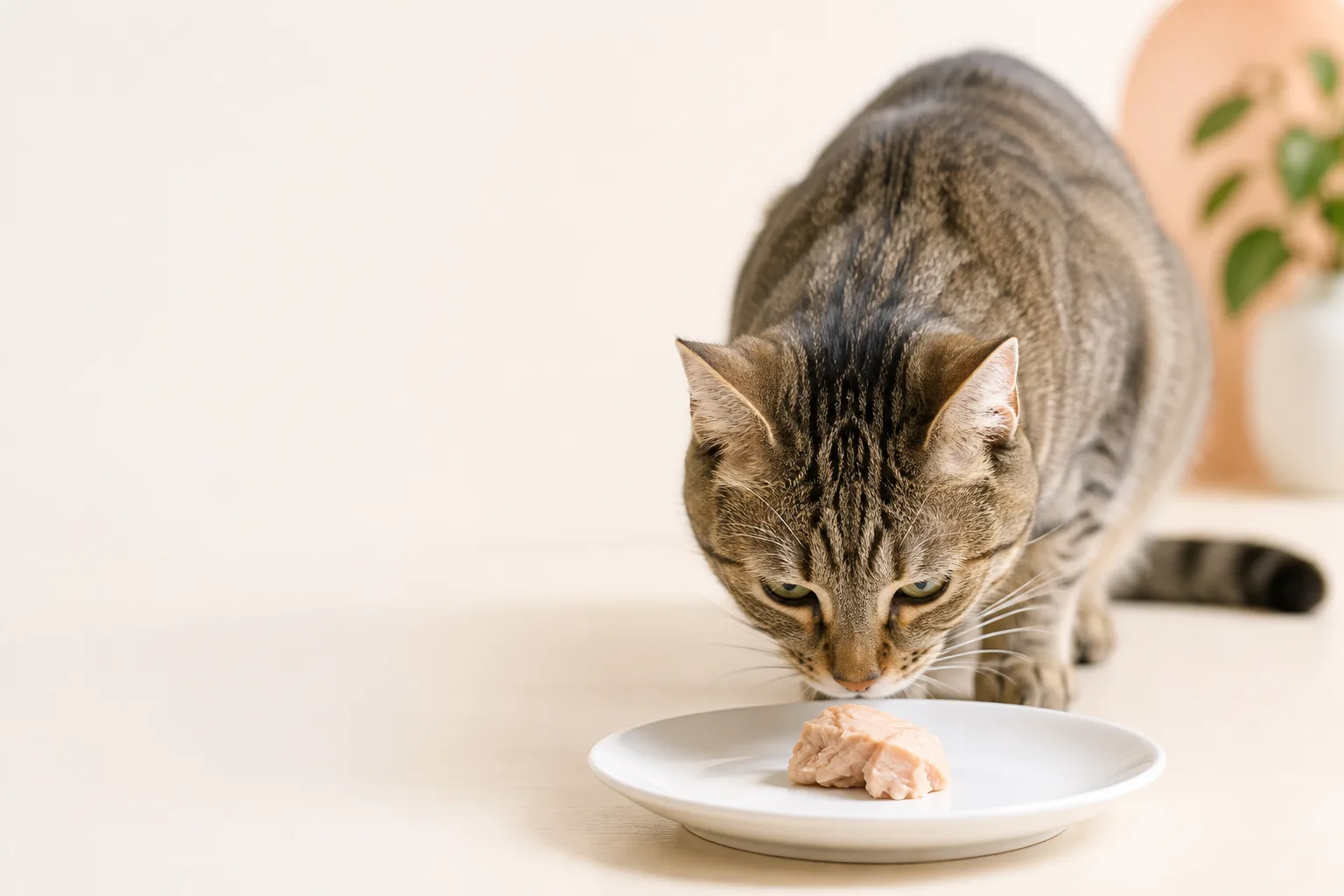
Can Cats Eat Eggs? A Safe Feeding Guide

On this page
Eggs are one of the more nutritious human foods a cat can safely eat, and that is not a coincidence: egg is already used as a protein source in some complete cat foods. Whole, cooked egg supplies protein a cat's body can use well, which is part of why a spoonful now and then shows up as an easy, low-effort treat in a lot of feeding routines. It is also cheap, quick to prepare, and already sitting in most kitchens, which is why the question comes up so often.
The question that actually matters is not whether eggs are safe in general, but how the egg in front of you was cooked. Raw and cooked eggs carry very different risks, and that one detail is what separates a genuinely useful treat from something worth skipping entirely. The rest of this guide works through that distinction, along with the smaller questions that tend to follow it: whether egg can replace a meal, what to do with the shell, and how much is actually reasonable to give.
This guide is written from published veterinary sources, named and linked as they come up and listed again at the bottom.
Are eggs safe for cats?
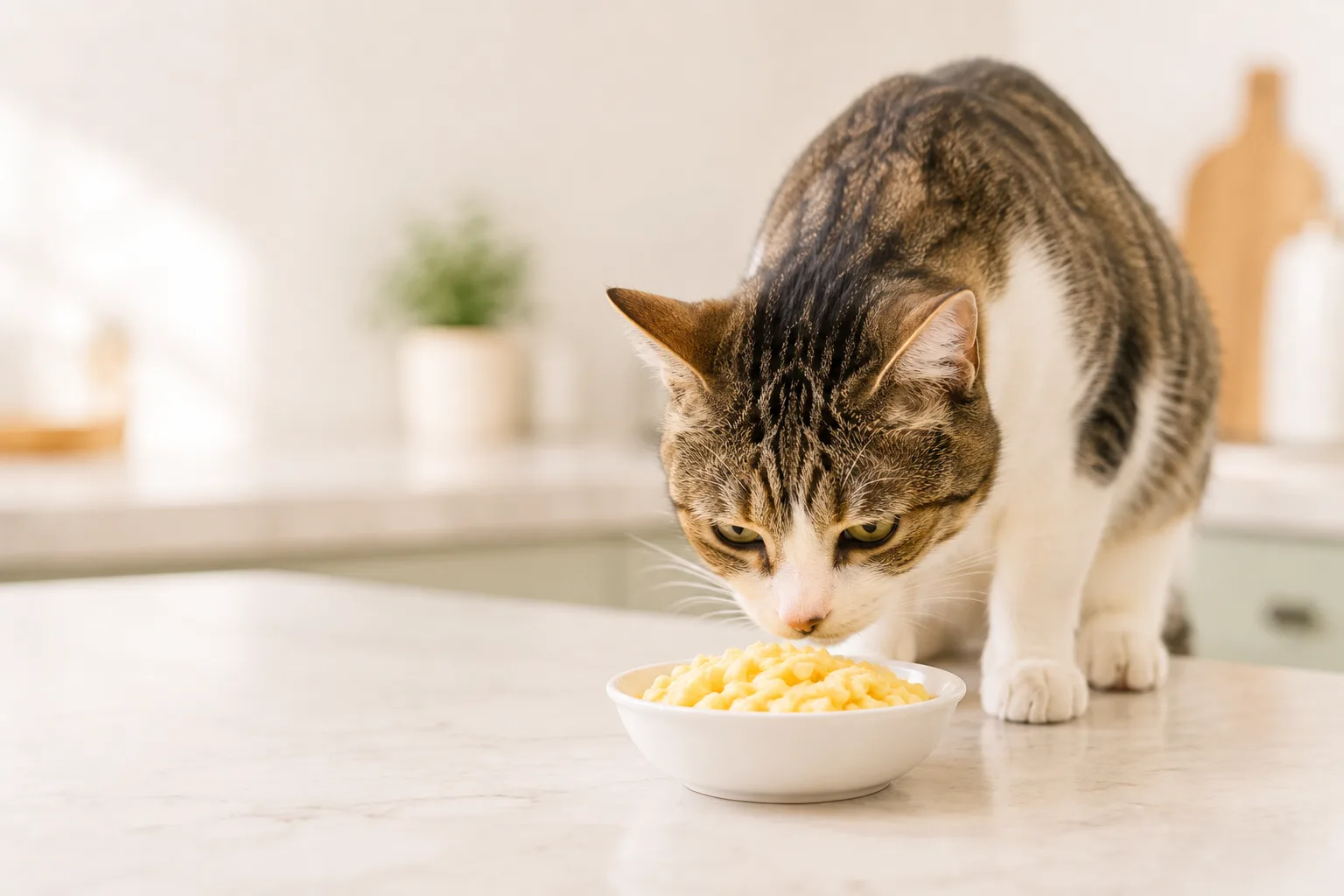
Yes, when the egg is cooked. Scrambled or hard-boiled, plain, and with nothing added, a cooked egg is a lean, easily digested protein that suits a cat's diet well and is genuinely nutritious in small amounts. Either method works; what matters is that the egg is cooked all the way through and served on its own.
Plain means exactly that. Leave out the butter, oil, salt, milk, and any onion or garlic seasoning that a scrambled egg might normally get for a person. A cat's portion should have nothing in it but the egg itself, cooked through and cooled to room temperature before it is offered. Almost the entire safety question with eggs comes down to preparation, not the egg as an ingredient, which is why the same food can be a fine treat or an unnecessary risk depending only on how it reaches the bowl.
There is no meaningful safety difference between scrambling an egg and hard-boiling it, as long as both are cooked plain and served without anything else mixed in. Pick whichever is easier: a small piece of hard-boiled egg white and yolk, or a spoonful of plain scrambled egg once it has cooled, both work the same way in a cat's bowl.
Can cats eat raw eggs?
No. Raw eggs are not worth the risk, even though a single raw egg is unlikely to cause immediate harm on its own.
The first concern is bacterial. Raw eggs carry a real risk of salmonella and other bacteria; the FDA warns that even clean, uncracked eggs can contain it, the same concern that applies to feeding raw meat of any kind. An infection can make a cat unwell, and because it is a foodborne bacteria and not something specific to how a cat's body handles food, it can also spread to the people who handle the food or clean the litter box afterward. That second part is easy to overlook: the risk is not just to the cat eating the egg.
The second concern is nutritional rather than infectious. As the Merck Veterinary Manual explains, raw egg white contains avidin, a protein that binds biotin, one of the B vitamins, and interferes with how much of it a cat's body can actually absorb from food. An occasional raw egg is not going to cause a deficiency on its own, since the effect depends on how often it happens rather than a single serving. Feeding raw eggs repeatedly over time is where the biotin risk actually builds, as less and less of the vitamin gets absorbed with each raw serving. Cooking denatures avidin and removes this problem entirely, which is the main reason cooked eggs are always the better choice over raw ones, for the biotin question as much as for the bacteria.
This is also the one part of feeding eggs where trends around raw diets for pets do not carry over cleanly. Whatever the reasoning behind feeding a cat raw meat, egg is a separate case with its own two-part risk, bacteria and biotin, and both of those are resolved simply by cooking the egg first. There is no upside to raw egg that cooking takes away.
Are eggs a complete meal on their own?
No. Egg is a good source of protein, but it is not a complete diet, and it should stay an occasional addition rather than a meal replacement.
It is missing taurine at the level and balance that a complete cat food is formulated to provide, the same gap that applies to plain chicken or any other single-ingredient food fed on its own. A cat that eats mostly egg, even cooked and prepared correctly, is still missing nutrients that a balanced commercial diet is built around and tested for. Eggs work well as a topper stirred into a complete diet, or as an occasional side, not as a stand-in for one, no matter how good the protein in an egg actually is.
This is worth spelling out because egg looks, on paper, like it should be enough: it is high in protein and easy for a cat to digest. What it cannot do is replicate the specific balance of nutrients a commercial cat food is formulated to hit, which is the actual bar for a complete diet rather than protein content alone. Keeping egg in the "extra" column rather than the "meal" column is the simplest way to avoid that gap.
Can cats eat eggshells?
There is no need to feed eggshell, though it is not toxic if a cat happens to eat a small piece by accident while investigating the kitchen counter.
Eggshell is sometimes suggested as a calcium source for pets, but there is no established benefit to feeding it to a cat, and it is not part of standard veterinary advice. Since it adds no real value and is not something a cat needs, the simpler approach is to stick to the egg white and yolk, cooked, and leave the shell out of the bowl altogether.
There is a difference between "not toxic" and "worth adding." A cat that licks a bit of shell residue off a plate is not in any danger, but that is not the same as a reason to crush shell into food on purpose. When the goal is a safe, simple treat, egg white and yolk already cover it without the shell being part of the plan.
Can cats be allergic to eggs?
It is possible, though a genuine egg allergy is less common in cats than allergies to chicken, fish, or beef, which are the food allergies seen more often in practice.
Signs of a real egg allergy or sensitivity include itchy skin, digestive upset, or ear infections that show up consistently after a cat eats egg, rather than a one-off reaction. If those signs appear every single time egg is on the menu, that pattern is worth taking seriously: stop feeding it and mention what you have noticed at the next vet visit, since a consistent pattern is what actually points to egg as the cause.
None of this means most cats need to avoid egg out of caution. Egg allergy is uncommon enough that it should not be the default assumption; it is simply worth knowing the signs so a real reaction is not mistaken for something else, or a coincidence mistaken for a pattern.
How much egg is safe?
A whole egg is a meaningful portion for an animal as small as a cat, and it is calorie-dense and moderately fatty enough that it should stay an occasional addition rather than a daily habit, even though the protein itself is a good one. A small piece of hard-boiled egg or a spoonful of plain scrambled egg, offered every so often rather than every day, is enough to count as a treat without turning into a habit that adds up. Treats and extras are generally kept under about ten percent of a cat's daily calories. Our feeding guide covers how to work out a cat's daily calorie total so extras like this stay in proportion.
What does raw egg white actually do to biotin levels?
Raw egg white contains a protein called avidin, which binds tightly to biotin, also known as vitamin B7, in the digestive tract and prevents it from being absorbed. A single raw egg is not the issue; the effect is cumulative, from repeated raw egg white over weeks or months. A controlled feeding study in cats given diets built around raw egg white produced a measurable biotin deficiency, with the classic signs being a dull, thinning coat and skin irritation rather than anything dramatic or fast-moving.
Cooking denatures avidin, which is a chemical way of saying heat changes its shape enough that it can no longer bind biotin the way it did raw. A cooked egg white delivers the same protein without the same absorption problem, which is the whole reason "cooked, not raw" is the actual rule here rather than a vague preference.
Is Salmonella from raw eggs a real household risk?
Raw eggs can carry Salmonella on the shell and occasionally inside it, even when the shell is clean and uncracked, according to the FDA, and a cat that eats one is not always the one who gets visibly sick. The Cornell Feline Health Center warns that bacteria in raw foods can infect both cats and their owners. Cats can become asymptomatic carriers, meaning they show no signs of illness themselves while shedding the bacteria in their stool, which turns a litter box into a real transmission risk for anyone in the house who is young, elderly, pregnant or immunocompromised. That household risk exists whether or not the cat itself ever looks unwell, which is what makes it worth taking seriously rather than judging purely by how the cat seems.
Cooking the egg fully addresses both problems at once: heat kills Salmonella and denatures avidin in the same step, which is why a cooked egg is treated as a genuinely different food here from a raw one rather than the same food with a milder version of the same risk.
This guide goes into more depth than Can Cats Eat Dairy and Eggs?, which compares the whole group side by side.
Frequently asked questions
Are eggs safe for cats?
Yes, cooked eggs are safe for cats and a genuinely good source of protein in small amounts. Scrambled or hard-boiled, plain, with nothing added, is the right way to serve one. The safety question comes down almost entirely to preparation rather than the egg itself as an ingredient.
Can cats eat raw eggs?
No, raw eggs are not worth feeding. They carry a real risk of salmonella and other bacteria, the same concern as raw meat, which can make a cat unwell and can spread to people handling the food or litter box afterward. Raw egg white also contains avidin, a protein that binds biotin and can interfere with its absorption if raw eggs are fed repeatedly over time. Cooking denatures avidin and removes both risks, which is why cooked is always the better choice.
Can eggs replace a meal for a cat?
No, eggs are not a complete diet on their own. They are missing taurine at the level and balance a complete cat food provides, the same gap that applies to chicken or any other single-ingredient food fed alone. Eggs work well as an occasional topper or treat, not as a stand-in for a full meal.
Can cats eat eggshells?
There is no need to feed eggshell to a cat, though it is not toxic if a small piece is eaten by accident. It is sometimes suggested as a calcium source, but there is no established benefit and it is not part of standard veterinary advice, so cooked egg white and yolk are enough on their own.
Can cats be allergic to eggs?
It is possible, though a genuine egg allergy is less common in cats than allergies to chicken, fish, or beef. Signs include itchy skin, digestive upset, or ear infections that show up consistently after a cat eats egg. If that pattern appears every time, it is worth mentioning to a vet.
Can raw egg white cause a biotin deficiency in cats?
Yes, with regular feeding over time. Raw egg white contains avidin, which binds biotin and blocks its absorption. A feeding study in kittens produced a measurable deficiency, showing up as a dull coat and skin irritation. Cooking denatures avidin and removes the problem.
Sources
- Merck Veterinary Manual: Nutritional Requirements of Small Animals How avidin in raw egg white blocks biotin, and what deficiency looks like.
- Pastoor et al. (1991), Journal of Nutrition: Biotin deficiency in cats fed egg white The feeding study that produced biotin deficiency in cats.
- FDA: What You Need to Know About Egg Safety Salmonella in eggs, even with clean, uncracked shells.
- Cornell Feline Health Center: Feeding Your Cat Why raw animal foods can infect cats and their owners.
- VCA Animal Hospitals: Adverse Reactions to Food in Cats Food reactions in cats, including raw eggs.
General information, not veterinary advice. If your cat's behavior has changed suddenly, speak to a vet rather than an article.
How this guide was researched and checked is set out in how our guides are written.

Want an answer in seconds?
The calculators handle age, due dates and portions without an account.