Can Cats Eat Raw Chicken? What the Real Data Says
 By Ahsan Nawaz
Published:
By Ahsan Nawaz
Published:
On this page
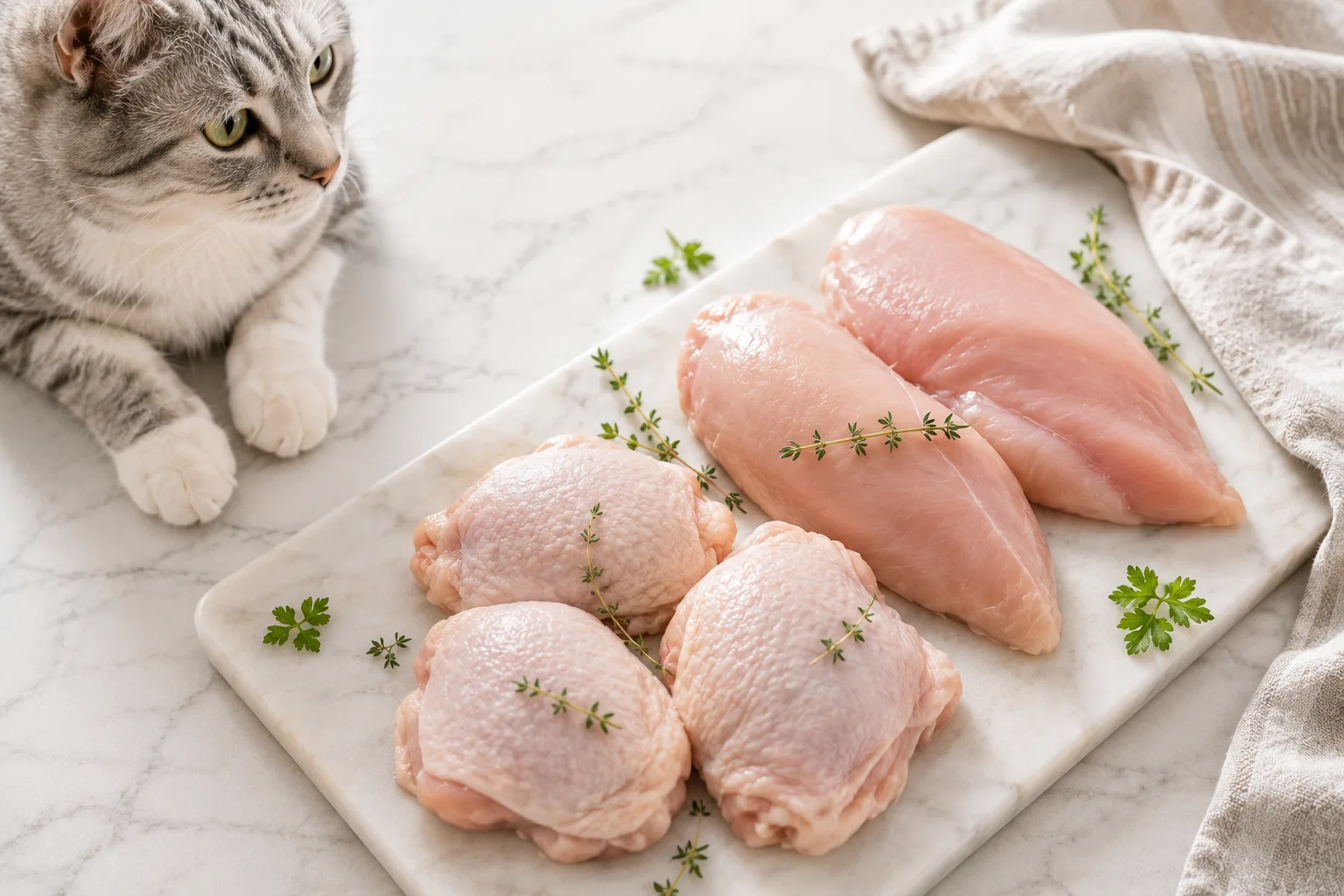
Can cats eat raw chicken? A healthy adult cat's digestive system can process it without necessarily getting sick, so the literal answer is yes. That is a different question from whether you should feed it, and this is one of the few food questions on this site where those two answers genuinely pull apart. Raw chicken is not a toxin. It carries no compound like the theobromine in chocolate or the mystery kidney toxin in grapes. The risk here is contamination, and contamination is measurable: how often raw poultry actually carries something that can make a cat, or a person in the house, sick.
That measurement has changed in the last two years in a way most articles on this topic have not caught up with. Since December 2024, three separate brands of raw poultry pet food have tested positive for H5N1 bird flu, and cats have died. This page covers the older, well established bacterial risk first, then the new one, with the actual testing numbers behind both rather than a blanket "ask your vet."
What actually happens if a cat eats raw chicken?
Nothing dramatic, most of the time, and it helps to say that plainly before the rest of this page gets into the numbers. A cat's digestive tract is short relative to its body length and its stomach is markedly more acidic than a human's, both features of an obligate carnivore built to process raw prey. A cat that steals a piece of raw chicken breast off a cutting board is not swallowing poison, and most cats that do this once show nothing at all.
The question this page actually answers is a different one: not "can a cat's body handle raw meat" (yes, mechanically, it can), but "how often does real raw chicken carry something that makes that irrelevant." The meat and seafood guide already lists raw meat as unsafe for exactly this reason. This page is the full explanation of why, specific to chicken, with the actual prevalence data, the current H5N1 situation, and an honest look at whether raw chicken is nutritionally better than the cooked chicken already covered on this site.
Is discouraging raw chicken outdated advice, or the current professional position?
It is current, and if anything it has gotten more specific recently rather than softer. The American Veterinary Medical Association's policy on raw or undercooked animal-source protein states plainly that the AVMA discourages feeding any raw or undercooked animal-sourced proteins, meat, poultry, fish, egg or milk, to dogs and cats because of their risk to human and animal health. The policy names the pathogens directly: Salmonella, Campylobacter, Clostridium, E. coli, Listeria monocytogenes, highly pathogenic avian influenza virus, Mycobacterium bovis and enterotoxigenic Staphylococcus aureus. That avian influenza line did not exist in older versions of this kind of guidance. It is there because of events covered further down this page.
The World Small Animal Veterinary Association's Global Nutrition Committee, an international panel rather than a single national body, reaches the same conclusion from its own review: there is currently no properly documented evidence of health benefits for raw meat-based diets, but there are well documented risks.
It lists those risks specifically, contamination with bacteria and parasites, nutritional inadequacy, injuries from bones including constipation, diarrhea, dental fractures and gastrointestinal obstruction, diet-induced hyperthyroidism from excessive ingestion of thyroid tissue, and public health risk to vulnerable people in the household. The committee's own recommendation is that raw meat-based diets not be fed to dogs and cats. That is not one vet's opinion. It is the considered position of the bodies that actually convene panels to weigh this evidence.
How likely is raw chicken to actually be contaminated?
More likely than most owners assume, and this is the part with real numbers behind it rather than a general warning. The clearest evidence comes from a two-year FDA Center for Veterinary Medicine survey run through its Veterinary Laboratory Investigation and Response Network, published by Nemser and colleagues in Foodborne Pathogens and Disease in 2014. Researchers tested more than a thousand pet food samples in two phases.
Phase one, dry and semi-moist dog and cat food bought from ordinary stores, came back almost entirely clean: 2 positive results out of 480 samples, one for Salmonella and one for a harmless Listeria species. Phase two, raw pet food and jerky treats bought online, told a different story: of 576 samples, roughly 8 percent tested positive for Salmonella, roughly 16 percent for Listeria monocytogenes, and roughly 4 percent for Shiga toxin-producing E. coli.
The FDA's own consumer-facing summary of this same body of work gives the raw-specific figures as 15 Salmonella positives and 32 Listeria monocytogenes positives out of 196 raw samples, and its conclusion is direct: raw pet food was more likely to be contaminated with disease-causing bacteria than any other category tested.
Chicken itself is not exempt from this even before it reaches a pet food product. USDA's Food Safety and Inspection Service runs continuous Salmonella verification testing on raw chicken carcasses and parts at the plant, the same testing regime behind the "cook chicken to 165°F" instruction on every package sold for human kitchens. That testing shows real progress: FSIS reports Salmonella prevalence on raw chicken parts, legs, breasts and wings, fell by roughly three-quarters between 2012 and 2020.
Progress is not zero. The entire reason chicken carries a cooking instruction at all is that raw chicken meant for human tables still carries a measurable Salmonella rate, and raw chicken sold as pet food skips the one step, cooking, that the USDA's own guidance depends on to bring that number down to something safe to eat.
Can a cat actually get sick from this, or is it only a risk to people?
Cats can get sick from it directly, not just carry it to someone else. The Merck Veterinary Manual's chapter on enteric campylobacteriosis describes the clinical picture: mucus-laden, watery or bile-streaked diarrhea, sometimes with blood, typically lasting 5 to 15 days, along with reduced appetite, abdominal pain, occasional vomiting and sometimes fever. Signs are worse in young animals, and diarrhea appears most severe in cats under six months old specifically, with intermittent diarrhea persisting more than two weeks in some. Salmonella infection in cats follows a broadly similar pattern of gastrointestinal illness, and both organisms are picked up the same way cats have always picked up gut infections: eating raw or undercooked poultry, or contact with an infected animal's feces.
The detail most owners miss is the AVMA's point about apparently healthy carriers. Cats infected with these organisms do not always show any signs at all, and a cat that looks completely fine can still be shedding Salmonella or Campylobacter in its stool, posing a real risk to other animals and to people in the household, especially anyone young, elderly, pregnant or immunocompromised. A cat eating raw chicken without visible illness is not the same as a cat eating raw chicken safely.
The risk almost no other article on this topic mentions: H5N1 in raw poultry
This is the part of the raw chicken question that has changed the fastest, and it is specific to poultry in a way the older bacterial risk is not. Since the current U.S. outbreak of highly pathogenic avian influenza in dairy cattle began spreading in early 2024, the same H5N1 virus has repeatedly turned up in raw pet food made from poultry, duck and turkey included alongside chicken, and cats have died from it. Cornell's Feline Health Center states the conclusion directly: feeding cats raw foods is not worth the risk of exposure to potential contaminants that might be present in these products, including disease-causing bacteria, parasites, and the recently demonstrated H5N1.
The documented cases are specific and recent, not a hypothetical. On December 31, 2024, the Los Angeles County Department of Public Health warned that an indoor house cat with a laboratory-confirmed H5N1 infection had eaten Monarch Raw Pet Food, sold at several Southern California farmers markets, and that four other cats in the same household were presumed infected after eating the same product.
Separately, two indoor cats from different residences in New York City died of confirmed H5 avian influenza after eating raw poultry pet food from another brand, Savage Cat Food. A third incident, covered by public health officials in Washington and Oregon, followed the deaths of two more indoor cats linked to a different raw pet food brand entirely. These are three separate brands, three separate states, in roughly a two-month window. It is not a single bad batch from one manufacturer.
This site's own coverage of the Northwest Naturals Salmonella recall shows that contamination in raw pet food is not a rare or hypothetical failure even for an established brand. H5N1 is a genuinely separate risk from that recall, a virus rather than bacteria, but the pattern underneath both is the same: raw poultry entering a cat's bowl without the one processing step, heat, that reliably destroys both.
What about the people in the house, not just the cat?
The AVMA's policy is explicit that this is not only a cat-health question: raw or undercooked animal-sourced protein poses a risk to other animals and people, especially young children, the elderly, pregnant people and anyone immunocompromised, through subclinical infection in an apparently healthy pet. The FDA's and CDC's practical guidance follows from that. The CDC states plainly that it does not recommend feeding raw pet food or treats to dogs and cats at all, for exactly this reason: contamination in the bowl becomes contamination in the kitchen.
If raw chicken is going to be in the house regardless, the FDA's own consumer guidance sets out the minimum handling standard: wash your hands thoroughly with soap and water for at least 20 seconds after handling it, keep it separate from other food, do not rinse raw meat in the sink, and disinfect anything it touched with a bleach solution of 1 tablespoon of bleach to 1 quart of water.
The same guidance adds a detail people rarely think of on their own: do not let a pet that has eaten raw food lick your face, and do not kiss it around the mouth. A litter box in a household feeding raw chicken deserves the same daily-cleaning discipline as the kitchen counter, since Salmonella and Campylobacter both leave the body the same way they came in.
Does freezing raw chicken make it safe?
No, and this is one of the more common and more wrong beliefs about raw feeding. The CDC states it without qualification: freeze-drying, dehydrating or freezing raw protein from animals only reduces the amount of germs present, it does not kill all of them. Freezing is genuinely effective against certain parasites under specific time and temperature conditions, which is part of why sushi-grade fish is frozen before serving, but Salmonella, Listeria and Campylobacter are bacteria, not parasites, and a home freezer's job here is slowing them down, not eliminating them. A raw chicken breast that goes into the freezer contaminated comes out of it contaminated.
Is raw chicken actually more nutritious for a cat than cooked chicken?
Less than raw-feeding advocates usually claim, and the actual measured data corrects a popular oversimplification rather than confirming it. The nutrient genuinely at stake is taurine, an amino acid cats cannot synthesize themselves and must get from animal tissue, and the standard reference work here is Spitze and colleagues' 2003 measurement of taurine across raw and cooked meats. Their numbers do show real cooking losses in some cases: a chicken leg measured 337 mg of taurine per kilogram raw, fell to 229 mg baked, and fell further to just 82 mg boiled. That is a genuine, well documented loss, and it happens because taurine is water soluble and leaches out into whatever liquid the meat cooks in.
What the same study does not support is "raw is always higher than cooked." Chicken dark meat measured 1690 mg of taurine per kilogram raw and 1990 mg per kilogram broiled, higher after cooking, not lower, most likely because broiling drives off moisture and concentrates what remains. The pattern across this dataset is not raw versus cooked. It is boiling versus everything else: boiling is what destroys taurine, while roasting or broiling largely preserves it.
A plain chicken thigh, cooked properly rather than boiled to death, is not a nutritionally compromised food next to raw chicken. The plain cooked chicken guide on this site covers exactly that preparation, and it delivers close to the same taurine as raw chicken without the Salmonella, Listeria, Campylobacter or H5N1 exposure that comes with skipping the cooking step entirely.
What about a complete, properly balanced homemade raw diet?
This is the strongest version of the raw-feeding argument, and it still runs into a real problem: getting the balance right is harder than most homemade recipes manage, on paper and in practice. Wilson and colleagues evaluated 114 published home-prepared maintenance diet recipes for cats against the National Research Council's recommended nutrient allowances in a 2019 study in the Journal of the American Veterinary Medical Association.
Not one recipe met every recommended allowance. Taurine specifically was one of the amino acids recipes most often failed to meet, alongside choline, iron, thiamine, zinc, manganese, vitamin E and copper falling short across many of the recipes tested. These were not fringe recipes; they were recipes published as complete diets, written by people who believed they had gotten the balance right.
The standard a genuinely complete cat food is actually built to hit is AAFCO's Cat Food Nutrient Profiles, which set a taurine minimum of 0.10 percent of dry matter for extruded food and 0.20 percent for canned, alongside dozens of other minimums most home cooks have no practical way to verify without lab testing. A commercially produced raw diet that carries an AAFCO complete-and-balanced statement has at least been formulated against that standard, even though it still carries the same bacterial and viral contamination risk covered above.
A homemade raw diet assembled from a blog recipe or a book has usually solved neither problem. Anyone committed to feeding raw chicken as a full diet rather than an occasional scrap is better served working directly with a board-certified veterinary nutritionist than with a downloaded recipe, which is exactly what the authors of that 2019 study recommend.
Can cats eat raw chicken bones or chicken necks?
Cautiously, and only some of them, never as a free-feeding habit. Raw bone genuinely behaves differently from cooked bone: cooking dries bone out and makes it brittle, which is why the meat and seafood guide lists cooked bones, poultry included, as an outright unsafe item, while it places raw bone in a more cautious middle category, less likely to splinter into sharp shards, but still a real choking, tooth-fracture and bacterial risk, and one it recommends only under a vet's guidance rather than as routine feeding.
The WSAVA Global Nutrition Committee's list of documented raw-diet risks names bones specifically: constipation, diarrhea, dental fractures and gastrointestinal obstruction all appear on its list of harms linked to bone ingestion, not benefits. A study of 30 cats presenting with esophageal foreign bodies found bones responsible in 5 of those cases, with roughly one cat in five across the whole study developing a complication such as perforation or abscess before recovering.
Chicken necks specifically carry one more risk that is easy to overlook: the thyroid gland sits in the neck, and the WSAVA committee separately names diet-induced hyperthyroidism from excessive ingestion of thyroid tissue as a documented consequence of feeding neck and throat cuts regularly. None of this makes an occasional, appropriately sized raw bone an emergency. It does mean "raw bones are basically safe because they don't splinter" oversells what the evidence actually supports, and it is worth a conversation with your own vet before making chicken necks a regular feature rather than an occasional, supervised one.
Kittens, and other cats at higher risk
The case against raw chicken is strongest for kittens specifically, for the same reason it is strongest for young children in a household: no prior exposure means no existing immunity. Merck's data on feline campylobacteriosis shows diarrhea is most severe in cats under six months old, and the same lack of previous exposure that makes a first-time infection worse in a kitten applies to Salmonella too. AAFCO's taurine minimum for growth is identical to the adult maintenance minimum, so a growing kitten has no extra margin built into that number, on top of a smaller, less resilient body facing the same contamination risk described throughout this page.
The WSAVA's public-health point about vulnerable household members works the same way for vulnerable cats. A senior cat, a cat on immunosuppressive medication for a condition like inflammatory bowel disease, a cat recovering from illness or surgery, or a pregnant queen all have less physiological reserve to absorb a Salmonella or Campylobacter infection than an otherwise healthy adult cat, in the same way an elderly or immunocompromised person in the house has less reserve than everyone else at the table. None of these are reasons raw chicken is instantly dangerous. They are reasons the calculation shifts further away from worth it.
So, should you feed your cat raw chicken?
Biologically, a healthy adult cat can eat raw chicken and very often will show nothing at all. That much is true, and no vet body disputes it. What the evidence above adds up to is a different, more specific answer: the organizations that have actually reviewed the data, the AVMA, the WSAVA, the FDA and the CDC, currently and consistently discourage it, not on instinct but because peer-reviewed testing puts real contamination rates on raw pet food, roughly 8 percent Salmonella and 16 percent Listeria monocytogenes in the Nemser data, and because since December 2024 that same category of product has repeatedly tested positive for H5N1 with confirmed cat deaths attached.
If your cat has already stolen a piece of raw chicken off a counter, that alone is unlikely to be an emergency for a healthy adult cat, and this page is not written to induce panic over a single stray bite. Watch for diarrhea, vomiting or loss of appetite over the following one to two weeks, the window Merck's own data covers, and our guide to signs your cat is sick covers what else is worth watching for generally.
Building raw chicken into a regular diet is a separate decision, and if you choose to make it, buy human-grade chicken from a source you trust, handle it with the same hygiene the FDA recommends for your own kitchen, never for a kitten or a household with a pregnant, elderly or immunocompromised person, never assume freezing has made it safe, and if you want it as a complete diet rather than an occasional item, work with a board-certified veterinary nutritionist rather than a recipe found online.
If the appeal is simply feeding something closer to what a cat would eat in the wild, a plain cooked chicken thigh gets you close to the same taurine this page found in raw chicken, without the Salmonella, Listeria, Campylobacter or H5N1 risk that comes with skipping the one step that reliably removes all four.
This guide goes into more depth than Can Cats Eat Meat and Fish?, which compares the whole group side by side.
Frequently asked questions
Can cats eat raw chicken?
A healthy adult cat's digestive system can process raw chicken without necessarily getting sick, so mechanically the answer is yes. The AVMA's own policy states it discourages feeding any raw or undercooked animal-sourced protein to cats and dogs because of the risk to human and animal health, and WSAVA's Global Nutrition Committee found no documented health benefit to raw feeding, only well documented risks.
Is raw chicken safe for cats?
Not reliably. A two-year FDA-linked survey published by Nemser and colleagues in 2014 found roughly 8 percent of raw pet food samples positive for Salmonella and roughly 16 percent positive for Listeria monocytogenes, against just 2 positives out of 480 dry and semi-moist samples. Raw chicken carries a measurable, testable contamination rate that cooking removes.
Can cats get salmonella from raw chicken?
Yes, and a cat can carry it without looking sick. The AVMA notes that apparently healthy cats can develop subclinical infections from raw or undercooked protein and still pose a risk to other animals and people in the household, especially anyone young, elderly, pregnant or immunocompromised.
Can cats get bird flu from raw chicken?
Yes. Since December 2024, at least three separate brands of raw poultry pet food, in California, New York and the Pacific Northwest, have tested positive for H5N1 avian influenza, and cats in those households died. Cornell's Feline Health Center now states plainly that feeding cats raw food is not worth the risk given bacteria, parasites and the recently demonstrated H5N1.
Can cats eat raw chicken bones or necks?
Cautiously at most, not as routine feeding. Raw bone is less likely to splinter than cooked bone, but WSAVA's Global Nutrition Committee lists bone ingestion risks, constipation, diarrhea, dental fractures and gastrointestinal obstruction, among the documented harms of raw diets, and chicken necks specifically carry a hyperthyroidism risk from thyroid tissue if fed regularly. Only worth doing under a vet's guidance.
Is raw chicken more nutritious than cooked chicken for a cat?
Not meaningfully. Measured taurine data shows boiling destroys taurine, a chicken leg fell from 337 mg per kg raw to just 82 mg boiled, but roasting or broiling largely preserves it, and broiled dark meat actually measured higher than raw in the same study. A properly cooked chicken thigh is not a nutritionally compromised alternative to raw.
Can kittens eat raw chicken?
No. Merck's data on feline campylobacteriosis shows diarrhea is most severe in cats under six months old, kittens have no prior exposure to build immunity against, and AAFCO's taurine minimum for growth leaves no extra safety margin built in on top of that added contamination risk.
Does freezing raw chicken make it safe for cats?
No. The CDC states directly that freeze-drying, dehydrating or freezing raw animal protein only reduces the amount of germs present, it does not kill all of them. Salmonella, Listeria and Campylobacter are bacteria, not parasites, and a home freezer slows them down rather than eliminating them.
What should I do if my cat ate raw chicken?
A single stolen piece is unlikely to be an emergency for a healthy adult cat. Watch for vomiting, diarrhea or reduced appetite over the following one to two weeks, the window Merck's data covers, and call your vet if your cat is a kitten, is already unwell, or develops persistent symptoms.
Sources
- AVMA, Raw or Undercooked Animal-Source Protein in Cat and Dog Diets (policy) The AVMA discourages feeding any raw or undercooked animal-sourced protein to dogs and cats, naming Salmonella, Campylobacter, Clostridium, E. coli, Listeria monocytogenes, highly pathogenic avian influenza virus, Mycobacterium bovis and Staphylococcus aureus, and notes apparently healthy pets can carry subclinical infection that risks other animals and vulnerable people.
- WSAVA Global Nutrition Committee, Statement on Risks of Raw Meat-Based Diets No properly documented health benefit to raw meat-based diets, but well documented risks: bacterial and parasitic contamination, nutritional inadequacy, bone-related injury (constipation, diarrhea, dental fractures, GI obstruction), diet-induced hyperthyroidism from thyroid tissue, and public health risk to vulnerable household members. Recommends against feeding raw meat-based diets.
- FDA, Get the Facts! Raw Pet Food Diets can be Dangerous to You and Your Pet FDA's two-year Vet-LIRN survey found 15 of 196 raw pet food samples positive for Salmonella and 32 positive for Listeria monocytogenes, against near-zero positives in dry and semi-moist food. Handling guidance: wash hands 20 seconds, use a 1 tablespoon bleach to 1 quart water disinfectant, don't rinse raw meat, don't let a pet lick your face after eating raw food.
- CDC, About Pet Food Safety (Healthy Pets, Healthy People) CDC does not recommend feeding raw pet food or treats to dogs and cats. States that freeze-drying, dehydrating or freezing raw animal protein only reduces the amount of germs, it does not kill all of them. Storage and hygiene guidance for households that do feed raw.
- Nemser SM et al., Investigation of Listeria, Salmonella, and Toxigenic Escherichia coli in Various Pet Foods, Foodborne Pathogens and Disease 2014;11(9):706 Phase 1 (480 dry/semi-moist samples): 2 positive. Phase 2 (576 raw/exotic/jerky samples): approximately 8% Salmonella, 16% Listeria monocytogenes, 4% Shiga toxin-producing E. coli positive. The peer-reviewed source behind the FDA consumer summary above.
- Merck Veterinary Manual, Enteric Campylobacteriosis in Animals Clinical signs: mucus-laden, watery or bile-streaked diarrhea lasting 5 to 15 days, reduced appetite, abdominal pain, occasional vomiting, fever. Diarrhea most severe in cats under six months old; intermittent diarrhea can persist more than two weeks. Infection route includes eating raw or undercooked poultry.
- USDA, USDA Proposes New Policy to Reduce Salmonella in Raw Poultry Products FSIS's continuous retail Salmonella verification testing on raw chicken parts (legs, breasts, wings) found prevalence fell by roughly three-quarters between 2012 and 2020, the surveillance program behind the safe-cooking-temperature guidance for raw chicken sold for human kitchens.
- Spitze AR et al., Taurine concentrations in animal feed ingredients, J Anim Physiol Anim Nutr 2003;87:251 Chicken leg taurine: 337 mg/kg raw, 229 mg/kg baked, 82 mg/kg boiled. Chicken dark meat: 1690 mg/kg raw, 1990 mg/kg broiled (higher after cooking). Shows boiling, not cooking generally, is what depletes taurine.
- AAFCO Dog and Cat Food Nutrient Profiles (2014 revised, Appendix A) Taurine minimum 0.10 percent dry matter (extruded) and 0.20 percent (canned), identical for growth and adult maintenance, the complete-and-balanced standard a commercial raw or cooked diet is formulated against.
- Wilson SA, Villaverde C, Fascetti AJ, Larsen JA. Evaluation of the nutritional adequacy of recipes for home-prepared maintenance diets for cats. JAVMA 2019;254(10):1172 Evaluated 114 published home-prepared cat diet recipes against NRC recommended allowances. No recipe met every allowance; taurine was among the amino acids most frequently under-met, alongside choline, iron, thiamine, zinc, manganese, vitamin E and copper.
- Los Angeles County Department of Public Health, Monarch Raw Pet Food advisory December 31, 2024 advisory: a house cat with laboratory-confirmed H5N1 infection had eaten Monarch Raw Pet Food; four other cats in the same household presumed infected after eating the same product.
- AVMA News, Cat deaths linked to bird flu-contaminated raw pet food, sparking voluntary recall Reports two indoor cats from separate New York City residences died of confirmed H5 avian influenza linked to raw poultry pet food from Savage Cat Food, and a separate Washington/Oregon incident involving another brand and two more cat deaths.
- Cornell Feline Health Center, H5N1 Avian Influenza and Its Impact on Feline Health States that feeding cats raw foods is not worth the risk of exposure to potential contaminants, including disease-causing bacteria, parasites, and the recently demonstrated H5N1, discussing indoor cats that died after eating commercial raw cat foods later confirmed to contain the same H5N1 strain.
- Abd Elkader NA et al., Oesophageal foreign bodies in cats, PLoS ONE 2020;15(6):e0233983 Thirty cats with oesophageal foreign bodies: bones responsible in 5 cases, roughly 20 percent of cases overall developed a complication such as perforation or abscess, all recovered after removal.
General information, not veterinary advice. If your cat's behavior has changed suddenly, speak to a vet rather than an article.
How this guide was researched and checked is set out in how our guides are written.

Want an answer in seconds?
The calculators handle age, due dates and portions without an account.