How Long Are Cats Pregnant? Cat Gestation Period Explained

On this page
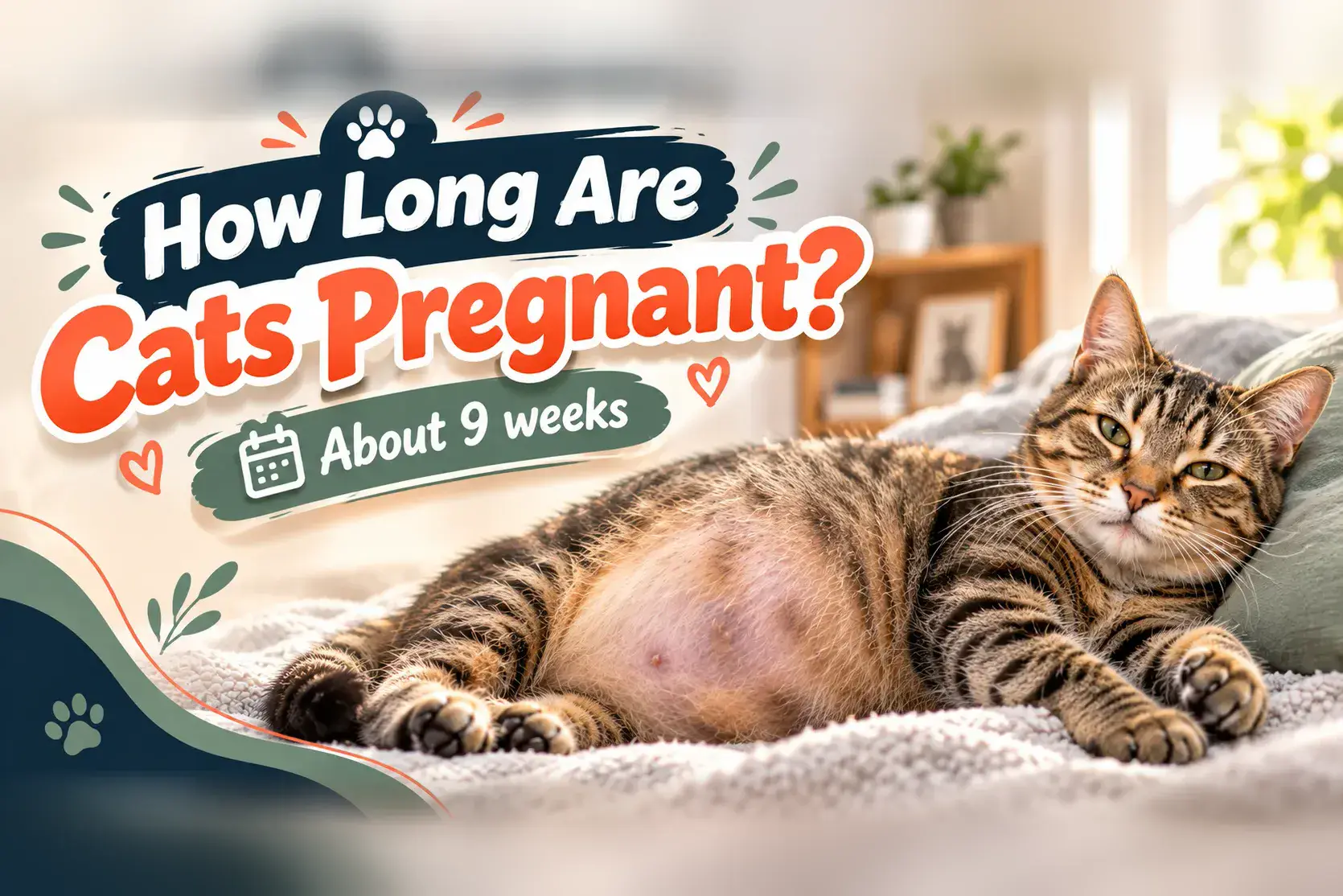
Cats are pregnant for about 63 to 67 days, which is roughly 9 weeks or just over 2 months. In the largest study, of 1,056 litters, the average was 65.1 days, and healthy pregnancies in other studies ran from about 60 to 72 days. Cats carrying bigger litters tend to give birth slightly earlier. [Sparkes et al., 2006]
Work out your cat's due date: enter the mating date in our free cat pregnancy calculator to see her due date and a week-by-week plan.
Cat pregnancy at a glance
| Question | Answer |
|---|---|
| How many days are cats pregnant? | About 63 to 67 days, average about 65 |
| How many weeks are cats pregnant? | About 9 weeks |
| How many months are cats pregnant? | Just over 2 months |
| Usual range | About 60 to 72 days in studies of healthy pregnancies |
| Earliest age a cat can get pregnant | From around 4 months old |
| Average litter size | About 4 to 5 kittens |
| When a vet can confirm pregnancy | Ultrasound from about day 21 (best from day 25); X-ray from about day 42 to 45 |
| When to call the vet | Past day 70 with no labor, or any labor warning sign below |
Whether you have just found out your cat is expecting or you are worried she might be, the first question is always the same: how long do cats stay pregnant? The short answer is about nine weeks. The useful answer also covers why the exact date is hard to pin down, what happens each week, how early cats can get pregnant, and when labor needs a vet. This guide brings together large studies of cat births and the references vets use, with a source for every number.
Cat gestation period in days, weeks and months
How many days are cats pregnant?
The gestation period for cats is usually quoted as 63 to 65 days, and the research agrees closely. Here is what the studies of real litters found:
- A UK study of 1,056 pedigree litters from 14 breeds found an average gestation of 65.1 days. Length differed between breeds, from about 63 days in Korats to more than 66 days in Siamese and Oriental Shorthairs, and larger litters were linked to slightly shorter pregnancies. [Sparkes et al., 2006]
- A study of 52 Maine Coon litters found an average of 65.5 days, and 95% of births fell between day 62 and day 68. [Socha et al., 2019]
- A study of a small research colony found an average of 66.9 days, with a range of 62 to 71 days. [Root et al., 1995]
- A study of pedigree cats in the Netherlands found an average of 65.3 days, with healthy pregnancies recorded from 57 to 72 days. [Musters et al., 2011]
International Cat Care gives the practical figure most owners need: kittens arrive about 63 to 65 days after mating. [International Cat Care] Because the date can only be counted from mating, not from the moment eggs are fertilized, a window of 63 to 67 days is the most useful way to plan.
How many weeks are cats pregnant?
Cats are pregnant for about 9 weeks. Most cats give birth in their ninth or early tenth week after mating.
How many months are cats pregnant?
Cats are pregnant for just over 2 months. The MSD Veterinary Manual gives pregnancy as lasting about 60 to 65 days, with delivery typically 64 to 66 days after breeding. [MSD Veterinary Manual]
Why the due date is hard to pin down
Cats are induced ovulators: a female cat, or queen, releases eggs in response to mating, so breeders often allow several matings over 2 to 3 days. [MSD Veterinary Manual] A queen in heat may also mate with more than one male, and one litter can have several different fathers. [International Cat Care; VCA Animal Hospitals] So unless you know the exact date, count from the first possible mating day and expect birth within a window rather than on one day.
Does pregnancy length vary by breed?
Yes, a little. The differences are a few days, not weeks, but they help explain why one cat delivers on day 63 and another on day 67.
| Group | Average gestation | Source |
|---|---|---|
| Pedigree cats overall (14 breeds) | 65.1 days | UK study of 1,056 litters [Sparkes et al., 2006] |
| Korat | About 63 days, the shortest of the breeds studied | UK study [Sparkes et al., 2006] |
| Siamese and Oriental Shorthair | More than 66 days, the longest of the breeds studied | UK study [Sparkes et al., 2006] |
| Maine Coon | 65.5 days | Polish study of 52 litters [Socha et al., 2019] |
Litter size matters as well: in the UK study, each extra kitten shortened the pregnancy slightly, so a queen carrying a big litter is more likely to deliver at the early end of her window. [Sparkes et al., 2006]
How early can cats get pregnant?
Much earlier than most owners expect. Cats reach sexual maturity from around 4 months of age, and a young queen can get pregnant during her very first heat. [International Cat Care]
The typical age is a little older. A veterinary reproduction textbook puts the first heat usually between 5 and 9 months, though it can be anywhere from 3.5 to 18 months. [Little, The Cat, 2012] It depends on:
- Breed: shorthaired breeds usually reach puberty earlier than longhaired ones, and Persians and related breeds may not have a first heat until about 18 months. [Little, The Cat, 2012]
- Season: cats need at least 12 hours of light a day to cycle, so heats are most common in spring and summer, and an indoor cat under artificial light can cycle all year. [MSD Veterinary Manual]
- Body condition: a kitten needs to reach a certain size and maturity before puberty.
A cat in heat becomes very affectionate, rolls on the floor, rubs against people and objects and calls loudly. Heat lasts about seven days on average, from 1 to 21 days, and if she is not mated it usually comes back after about a week out of heat. [VCA Animal Hospitals] This is why vets recommend spaying before the first heat if you don't plan to breed.
Can a cat get pregnant while nursing?
Yes. Nursing does not reliably stop the heat cycle, and a queen can return to heat while she is still feeding her kittens. [Little, The Cat, 2012] Cats Protection warns that a mother can get pregnant again as early as one or two weeks after giving birth, and suggests spaying her when the kittens are around eight weeks old. [Cats Protection] Until then, keep her away from unneutered males.
Cat pregnancy week by week
Vets don't divide cat pregnancy into neat trimesters as they do for people. This timeline counts from the mating date, so actual timings can shift by a few days.
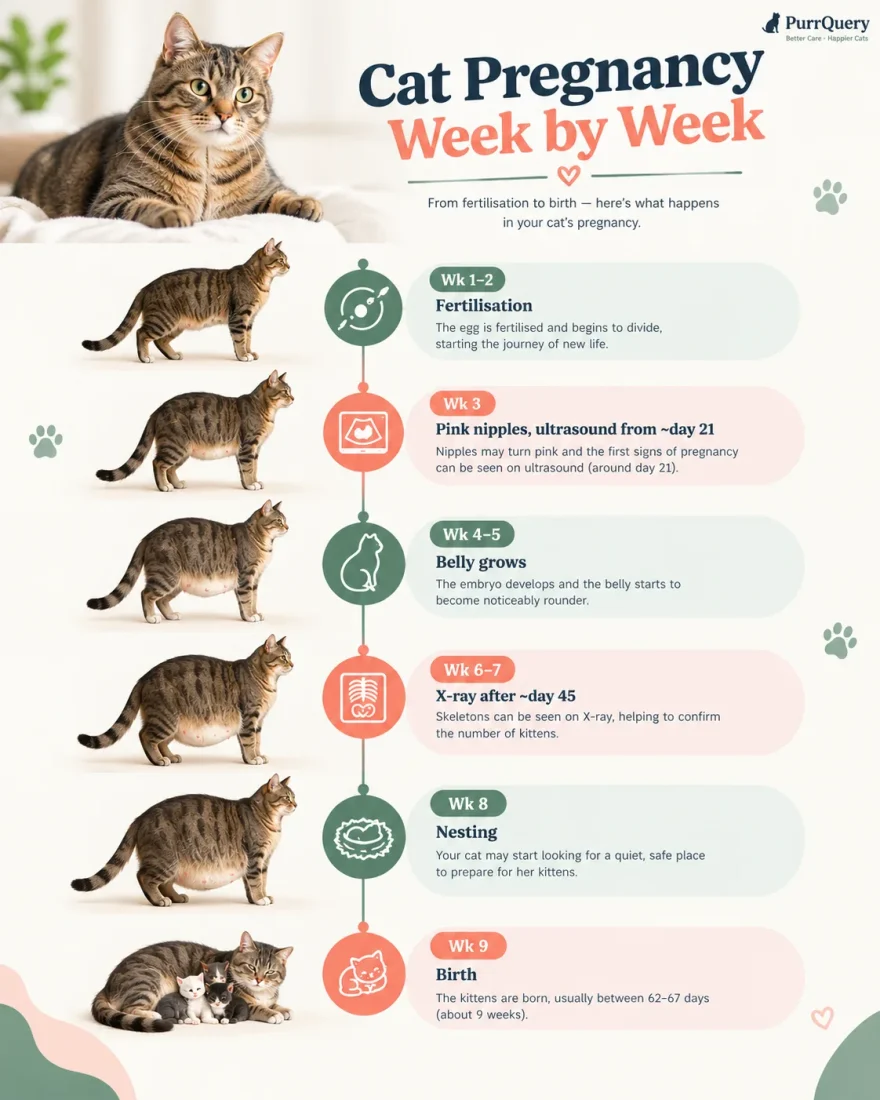
| Week | What is happening | What you might notice | What the vet can check |
|---|---|---|---|
| 1 to 2 (days 1 to 14) | Ovulation and fertilization; embryos travel to the uterus and settle in | Heat behavior stops; usually no visible change | Nothing reliable yet |
| 3 (days 15 to 21) | Embryos grow quickly | Nipples turn pinker and more prominent ("pinking up"), around day 15 to 18 | Gentle palpation is possible, though easiest from about day 21 to 25 |
| 4 to 5 (days 22 to 35) | Kittens develop claws, eyes and ears by about week 5 | Weight gain, a rounder belly and a bigger appetite; some cats become more affectionate | Ultrasound, best from about day 25 to 35; relaxin blood test from about day 20 to 25 |
| 6 to 7 (days 36 to 49) | Kittens grow fast and their skeletons harden | Belly clearly enlarged; she slows down and rests more | X-ray from about day 42 to 45 |
| 8 (days 50 to 56) | Kittens are nearly fully formed | Looks for a quiet nesting spot; mammary glands enlarge | X-ray after about day 55 gives the most accurate kitten count |
| 9 (days 57 to 67) | Birth | Restless, nesting, may refuse food; temperature may drop below 100°F (37.8°C) in the last 24 hours | Call the vet if labor problems appear (see below) |
These timings come from veterinary references. Nipples typically "pink up" by the third week, and kittens have claws, eyes and ears by about the fifth week. [Vetstreet] Pinking can be seen around day 15 to 18, palpation is easiest at about day 21 to 25, and a relaxin blood test can detect pregnancy from about day 20 to 25. [Little, The Cat, 2012] Ultrasound is best performed at 25 to 35 days, because scans before day 21 can miss a pregnancy, and kittens' skeletons show on X-ray from about day 42 to 45, with the most reliable count after day 55. [MSD Veterinary Manual] There is no home urine pregnancy test for cats.
Many owners say their cat becomes extra affectionate in the middle weeks. If you are curious what a contented cat looks like, our guide to the signs your cat is happy covers the body language to watch for.
Early signs your cat is pregnant
If you are not sure whether your cat is pregnant at all, these are the signs to look for, roughly in the order they appear:
- Her heat stops. The calling, rolling and restlessness end and do not come back a week or two later as they normally would. [VCA Animal Hospitals]
- Pinking up. Her nipples turn pinker and more prominent, usually around the third week. [Vetstreet]
- Weight gain and a rounder belly from about weeks 4 to 5, with a bigger appetite.
- Behavior changes. Some cats become more affectionate, others quieter and sleepier.
- Nesting in the final week or two, when she starts exploring cupboards and quiet corners.
None of these is proof on its own, and an early pregnancy can be hard to spot. A vet visit three to four weeks after a possible mating is the reliable way to know. [VCA Animal Hospitals] Once you have a likely date, the pregnancy calculator turns it into a week-by-week plan.
How far along is my pregnant cat?
If you know the mating date, the quickest answer is to work out your cat's due date with our calculator, which also shows which week she is in. If you don't, these clues give a rough idea:
- No visible change, but heat behavior has stopped: possibly weeks 1 to 2.
- Pink, more prominent nipples but a normal-looking belly: about week 3.
- Belly starting to round out and appetite up: about weeks 4 to 5.
- Clearly round belly, kittens may move when she rests: about weeks 6 to 7.
- Nesting, restless, big belly, enlarged mammary glands: weeks 8 to 9, so birth is close.
Only a vet can say for sure. A scan can estimate how far along she is, and an X-ray late in pregnancy shows how many kittens to expect, which matters on the day so you know when she has finished.
When is my cat due? Due-date examples
Add 63 to 67 days to the first mating date to get the most likely birth window. The wider window of 60 to 70 days covers the normal range seen in studies of healthy pregnancies.
| First mating date | Most likely birth window (days 63 to 67) | Wider normal window (days 60 to 70) |
|---|---|---|
| January 1 | March 5 to 9 | March 2 to 12 |
| March 1 | May 3 to 7 | April 30 to May 10 |
| May 1 | July 3 to 7 | June 30 to July 10 |
| July 1 | September 2 to 6 | August 30 to September 9 |
| September 1 | November 3 to 7 | October 31 to November 10 |
| November 1 | January 3 to 7 | December 31 to January 10 |
Dates assume a non-leap year. For any other date, the cat pregnancy due date calculator does the counting for you. If your cat passes day 70 with no sign of labor, vets treat the pregnancy as prolonged, so book a vet check. [MSD Veterinary Manual]
How many kittens do cats have?
Average litter size ranges from about 3.7 to 4.6 kittens, according to a veterinary reproduction textbook. [Little, The Cat, 2012] In the UK study of 1,056 litters the average was 4.6, with litters from 1 to 13 kittens. [Sparkes et al., 2006] A study of 151 Flemish pedigree litters found an average of 4.5, and queens over four years old had smaller litters, 3.6 kittens on average, than younger queens, at 4.8. [De Moor et al., 2019] Breed matters too: Maine Coons in one study averaged 5.3 kittens per litter. [Socha et al., 2019]
Caring for a pregnant cat
- See your vet early. An examination three to four weeks after mating will usually confirm the pregnancy, and it is the right time to plan for the birth. [VCA Animal Hospitals] Ask before giving any medicine, flea or worming treatment or vaccine, because not all are safe in pregnancy.
- Feed for growing kittens. Vets usually recommend switching her to a high-quality kitten food during pregnancy and nursing, because it carries the extra calories and nutrients she needs. [VCA Animal Hospitals] Her appetite will rise through pregnancy and may dip in the final days, when her belly is full. Our guide to how much to feed a cat explains how calorie needs change.
- Keep her indoors and away from unneutered males and sick cats.
- Let her rest. Avoid lifting her by the belly, and keep her surroundings calm and predictable.
Getting ready for birth
In the last weeks, your cat will look for a safe, quiet place to give birth. [VCA Animal Hospitals] Have a nesting box ready by about week 8 so she has time to choose it:
- a sturdy cardboard box or low-sided crate, big enough for her to lie stretched out
- clean towels or puppy pads you can swap out easily
- a quiet, warm, draft-free spot away from busy rooms
- food, water and a litter box close by, but not inside the box
- your vet's phone number and the nearest emergency clinic's after-hours number

Signs your cat is in labor
Cat labor, called queening, has three stages:
- Stage 1, preparation: restlessness, pacing, nesting, panting, licking her rear and often refusing food. This stage commonly lasts 12 to 24 hours, and her rectal temperature may drop below about 100°F (37.8°C) in the last 24 hours, though temperature is not a reliable sign on its own. [MSD Veterinary Manual; Little, The Cat, 2012]
- Stage 2, delivery: visible straining and contractions, then the birth of a kitten, usually head or tail first.
- Stage 3, afterbirth: the placenta passes, usually shortly after each kitten. She will lick the kitten clean and often eat the placenta, which is normal.
Stages 2 and 3 repeat for each kitten. The MSD Veterinary Manual describes normal intervals of 30 to 60 minutes between kittens, with delivery ideally completed in about 7 to 9 hours. [MSD Veterinary Manual] Many queens rest, nurse and groom between kittens, and many purr through labor, which seems to help them stay calm.
When to call the vet during labor
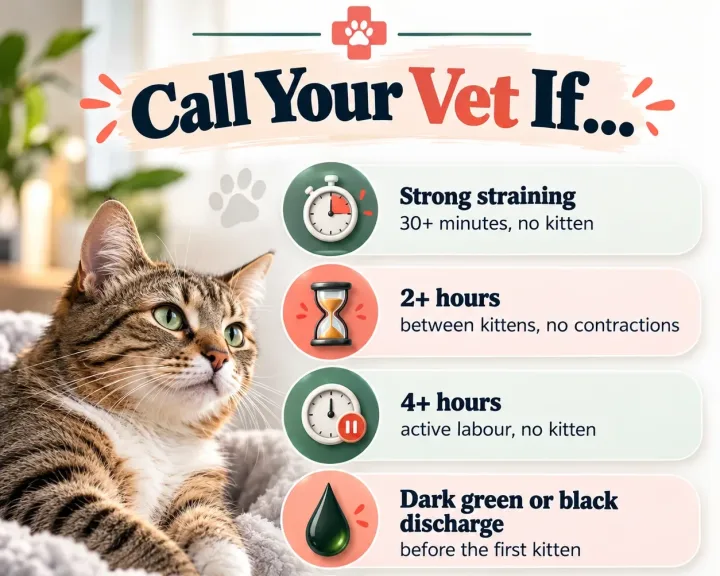
A difficult birth, or dystocia, affects about 5% of cat and dog pregnancies. [MSD Veterinary Manual] In the UK pedigree study, 8% of litters needed a caesarean. [Sparkes et al., 2006] Based on the MSD Veterinary Manual, call your vet or an emergency clinic straight away if: [MSD Veterinary Manual]
- she has strong contractions for more than 30 minutes without producing a kitten
- more than 2 hours pass between kittens with no contractions, when you know more kittens are inside
- she has been in active labor for more than 4 hours with no kitten born
- the whole birth has gone on for more than 24 hours
- you see dark green or foul-smelling discharge before the first kitten, or heavy fresh bleeding
- she is pregnant past day 70 with no sign of labor
- she seems in severe pain, very weak, or is crying and licking or biting at her rear
If you are unsure, call. Vets would far rather take an early call than see a kitten or mother in trouble hours later.
After the kittens are born
In the first days, check that each kitten is nursing and gaining weight, keep the nest warm and quiet, and watch the mother for fever, a foul-smelling discharge, or loss of interest in her kittens, all of which need a vet. Newborn kittens cannot control their own body temperature, so warmth matters. The first days are the riskiest: most kitten losses happen at birth or within the first few days of life. [Veronesi & Fusi, 2022] In the UK study, 9.1% of kittens died between birth and 8 weeks, most of them in the first week. [Sparkes et al., 2006]
Kittens knead their mother as they nurse, a habit many keep for life. Our guide to why cats knead explains where it comes from.
Found a pregnant stray cat?
Every spring, many people find a heavily pregnant stray in the garden or under a shed. A few practical steps help her and the kittens:
- Don't grab her. A frightened stray may run and give birth somewhere unsafe. Put out food, water and a sheltered box with towels nearby instead.
- Call a local rescue or vet. Many rescues run foster programs for pregnant cats and can scan her for a microchip, in case she has an owner looking for her.
- Plan for the kittens. Kittens are best left with their mother while they nurse, so if she gives birth outdoors, a rescue can advise on whether and when to move the family.
- Think about spaying. As a mother can get pregnant again within a week or two of giving birth, ask the rescue or vet about spaying her once the kittens are weaned. [Cats Protection]
Common myths about cat pregnancy
- "A cat can't get pregnant in her first heat." False. Cats can conceive from their first heat, which can come from around 4 months of age. [International Cat Care]
- "She can't get pregnant while she is nursing." False. Queens can return to heat while still feeding their kittens. [Little, The Cat, 2012]
- "All the kittens in a litter have the same father." Not necessarily. One litter can have several fathers. [International Cat Care]
- "A cat should have one litter before she is spayed." There is no health reason for this. Vets recommend spaying before the first heat if you don't plan to breed.
- "Cats are always pregnant for exactly 63 days." Day 63 is a useful marker, but the largest study put the average at 65.1 days, and healthy pregnancies vary by several days either way. [Sparkes et al., 2006]
The bottom line
Cats are pregnant for about 63 to 67 days, around 9 weeks, with an average of about 65 days. Because cats ovulate in response to mating and often mate several times, count from the first possible mating date and plan for a window. Know the week-by-week signs, have a nesting box ready by week 8, and keep your vet's emergency number at hand for labor. To get her due date in seconds, use our cat pregnancy calculator.
This article is general information and does not replace advice from a veterinarian. If your cat is pregnant or in labor and you have any concerns, contact your vet straight away.
Frequently asked questions
How long are cats pregnant?
About 63 to 67 days, or roughly 9 weeks. In the largest study the average was 65.1 days, and healthy pregnancies in other studies ran from about 60 to 72 days.
How long is a cat pregnant in months?
Just over 2 months. Most cats give birth about 2 months and a few days after mating.
How many weeks are cats pregnant?
About 9 weeks. Most cats give birth in the ninth or early tenth week after mating.
How long does a cat stay pregnant before giving birth?
Usually 63 to 67 days from the first mating. Larger litters often arrive slightly earlier, and the exact day is hard to predict because cats often mate several times over a few days.
How old can a cat get pregnant?
A female cat can get pregnant from her first heat, which can come from around 4 months of age. Most cats have their first heat between 5 and 9 months.
How soon can a cat get pregnant after having kittens?
Very soon. Nursing does not reliably stop heat cycles, and a mother can get pregnant again within one or two weeks of giving birth, so keep her away from unneutered males and talk to your vet about spaying.
How can I tell if my cat is pregnant?
Look for heat behavior stopping, pink and more prominent nipples around week 3, weight gain and a rounder belly from weeks 4 to 5, and nesting late in pregnancy. A vet can confirm it with an ultrasound, best from about day 25.
Can a cat be pregnant for 70 days?
Healthy births up to about 72 days have been recorded, but vets treat a pregnancy past day 70 as prolonged. If your cat passes day 70 with no labor, or the dates are uncertain, see your vet.
Do cats get morning sickness?
Not in the way people do. A pregnant cat may eat a little less at times, but if she vomits more than once, refuses food for more than a day or seems lethargic, call your vet.
Sources
- Sparkes et al. (2006), Journal of Feline Medicine and Surgery: Gestation, parturition and neonatal mortality in UK pedigree cats 1,056 litters: average gestation 65.1 days, litter size, caesarean and kitten mortality rates.
- Root, Johnston & Olson (1995), Journal of the American Animal Hospital Association Gestation of 62 to 71 days in a research colony.
- Socha et al. (2019), Polish Journal of Veterinary Sciences: Obstetric parameters in the Maine Coon Gestation and litter size in Maine Coons.
- Musters et al. (2011), Journal of Small Animal Practice: Pedigree cat reproduction in the Netherlands Average gestation 65.3 days, range 57 to 72.
- De Moor, Van Soom & Wydooghe (2019), Vlaams Diergeneeskundig Tijdschrift Litter size by queen age in 151 Flemish pedigree litters.
- Veronesi & Fusi (2022), Journal of Feline Medicine and Surgery: Feline neonatology When kitten losses happen.
- Little (2012), The Cat: Clinical Medicine and Management, chapter on female reproduction Age at first heat, pregnancy diagnosis, heat while nursing, litter size and labor.
- MSD Veterinary Manual: Management of reproduction of cats Induced ovulation, length of pregnancy and timing of delivery.
- MSD Veterinary Manual: The gonads and genital tract of cats Daylight and the heat cycle.
- MSD Veterinary Manual: Pregnancy determination in bitches and queens Ultrasound and X-ray timing.
- MSD Veterinary Manual: Labor, delivery and postpartum care in bitches and queens Stages of labor and normal intervals between kittens.
- MSD Veterinary Manual: Dystocia in small animals How often dystocia happens and when labor needs a vet.
- International Cat Care: Cat pregnancy Age of sexual maturity, multiple fathers and the 63 to 65 day guide.
- VCA Animal Hospitals: Estrus cycles in cats Heat length and behavior.
- VCA Animal Hospitals: Breeding and queening cats Vet checks, kitten food in pregnancy, nesting and temperature before labor.
- Cats Protection: Kitten care Pregnancy soon after giving birth, and when to spay.
- Vetstreet: Pregnancy in cats Pinking up and fetal development by week.
General information, not veterinary advice. If your cat's behavior has changed suddenly, speak to a vet rather than an article.
How this guide was researched and checked is set out in how our guides are written.

Want an answer in seconds?
The calculators handle age, due dates and portions without an account.