Cat Dental Care: Why It Matters and How to Start

On this page
Dental disease is one of the most common health problems in cats, and one of the most consistently missed. Most owners never look inside their cat's mouth, and cats are experts at eating around pain, so a mouth that has been quietly hurting for months can look completely normal from the outside.
Why dental care matters more than it looks like it should
Studies cited by the Cornell Feline Health Center find some degree of dental disease in between 50 and 90% of cats older than four, most commonly periodontal disease: inflammation and infection of the tissue supporting the teeth, caused by plaque and tartar buildup along the gumline. Left alone, it progresses from mild gingivitis to bone loss and eventual tooth loss.
Cats also develop a condition largely specific to them called tooth resorption, where the tooth's own structure breaks down starting at the root, often below the gumline where it is not visible at all. It is common, with Cornell reporting signs of it in 30 to 70% of cats, it is painful, and in most cases the only fix once it has progressed is extraction.
A cat in dental pain rarely stops eating. It just learns to eat around the part that hurts, which is exactly why owners miss it for so long.
The stages of periodontal disease
Periodontal disease is generally described in stages, and the distinction between them matters because it marks the line between reversible and permanent damage:
- Gingivitis, the earliest stage, is inflammation of the gums alone, without bone loss. It is fully reversible with a professional cleaning and improved home care.
- Early periodontitis involves the start of bone loss around the tooth root. Some of the damage can be managed and slowed, but the lost bone itself does not regenerate.
- Moderate to advanced periodontitis means significant bone and attachment loss, loose teeth, and often visible pain or infection. Extraction of the affected teeth is usually the outcome at this stage, not a last resort but the standard, most humane treatment.
The practical point is that catching dental disease at the gingivitis stage is genuinely different from catching it later: one is fully reversible, the other is not.
Signs of dental problems in cats
- Bad breath that is noticeably worse than usual, not just "cat breath"
- Drooling, especially if it is new or one-sided
- Pawing at the mouth or face, or reluctance to be touched near the mouth
- Dropping food while eating, or chewing visibly on one side
- Reduced interest in dry food or hard treats, while still wanting wet food
- Red, swollen or bleeding gums, and visible yellow-brown tartar along the gumline
None of these need to be severe to matter. A cat that has quietly switched to swallowing kibble whole, or that has gone from an enthusiastic eater to a slower, more careful one, is often already dealing with some degree of discomfort.
How to start brushing your cat's teeth
Daily brushing is the single most effective thing an owner can do at home, and Cornell names regular tooth brushing as the best way to prevent gingivitis, but it works best introduced slowly, over days rather than forced in one sitting.
- Start with your finger. Let your cat lick a small amount of cat-specific toothpaste off your finger for a few days, so the taste and the process both become familiar before a brush is involved at all.
- Move to gentle rubbing. Once they are comfortable, rub the finger, or a soft finger brush, gently along the outside of the teeth and gumline for a few seconds at a time.
- Introduce a proper brush. A small, soft cat toothbrush replaces the finger once your cat tolerates the motion, focusing on the outside surfaces where plaque builds up fastest.
- Keep sessions short and positive. A few seconds done daily beats a long session done occasionally. End on a good note, with praise or a treat, every time.
Never use human toothpaste. It often contains fluoride and sometimes xylitol, both of which are unsafe for cats. Cornell warns that human products can be toxic to cats, so only use toothpaste made specifically for pets.
Beyond brushing
- Dental-specific diets and treats carrying the Veterinary Oral Health Council (VOHC) seal have been tested to show a real reduction in plaque or tartar, unlike most general "dental" marketing claims.
- Professional cleanings, done under anesthesia by a vet, are the only way to remove tartar below the gumline and to properly assess and X-ray each tooth, including the resorption that brushing alone cannot catch or prevent.
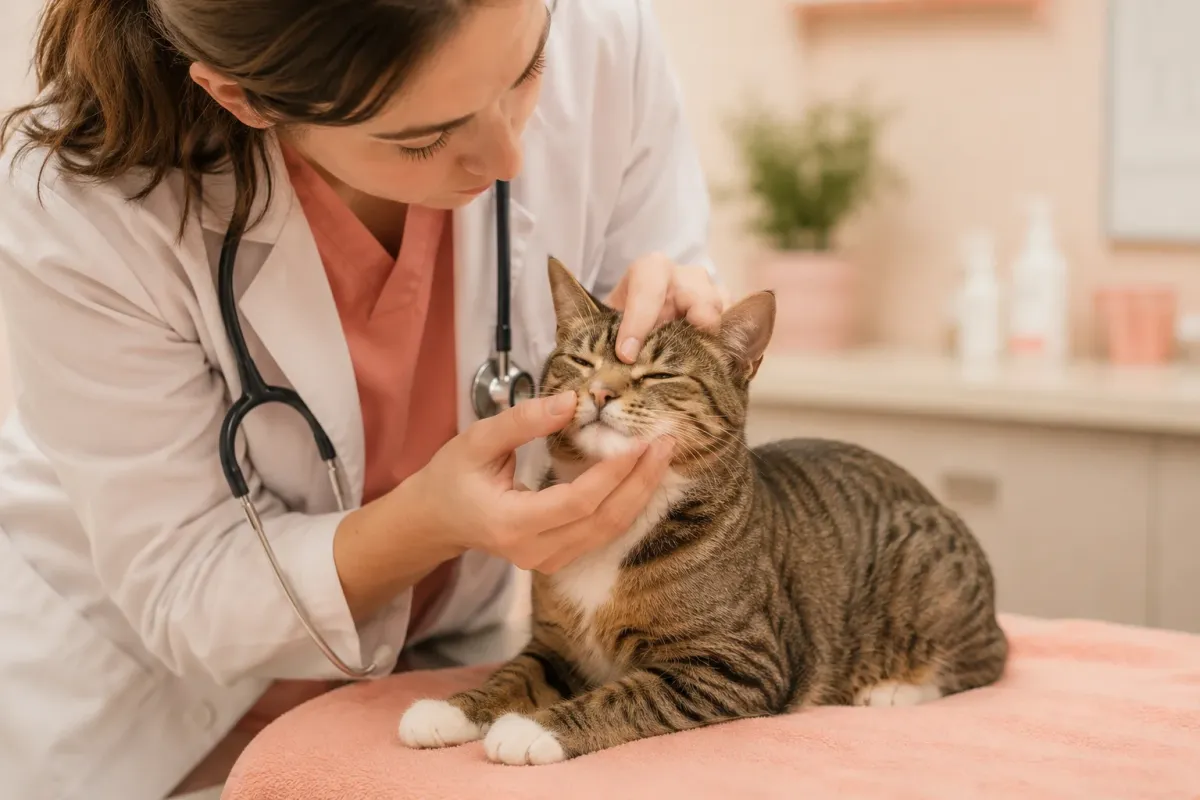
- Routine vet checkups should include a look in the mouth every time, which is one of the simplest ways dental disease gets caught before it becomes a painful, expensive problem.
Why "anesthesia-free" cleanings are not a shortcut
Anesthesia-free dental cleanings, sometimes offered by groomers or mobile services, scrape visible tartar off the crown of the tooth while a cat is awake and restrained. Veterinary dental organizations, including the American Veterinary Dental College, do not recommend them: without anesthesia there is no way to clean or examine below the gumline, where periodontal disease and tooth resorption actually live, and restraining an anxious cat for a procedure near the mouth carries its own stress and injury risk. A cleaner-looking tooth from an anesthesia-free session can mask real disease underneath rather than treat it.
Does dry food actually clean a cat's teeth?
This is one of the more persistent myths in cat care. Most standard kibble shatters on contact rather than scraping the tooth clean the way it is often marketed to do, and there is limited evidence that ordinary dry food meaningfully reduces plaque compared to wet food. Specific dental diets, formulated with a texture and fiber structure designed to scrape the tooth as it is chewed, are a different story and are among the products that can carry the VOHC seal for a reason. Food texture alone, of either kind, is not a substitute for brushing or professional cleanings.
Are some cats more prone to dental problems?
Yes. Breeds with a flatter face and more crowded teeth, such as Persians and other brachycephalic breeds, tend to have a higher rate of dental crowding and disease simply due to how the jaw and teeth are shaped. Purebred cats generally, and cats with a history of poor nutrition or neglect before adoption, also tend to show dental disease earlier and more severely, which is worth mentioning to a vet as part of a cat's history.
What a professional cleaning actually involves
A veterinary dental cleaning is done under general anesthesia and typically includes a full-mouth X-ray, since most of what matters, tooth resorption and bone loss around the root, cannot be seen or assessed from the surface. Tartar is removed above and below the gumline with an ultrasonic scaler, each tooth is individually probed and assessed, and any tooth found to be resorbing, fractured or too diseased to save is extracted in the same visit. Because it requires anesthesia and a full assessment, it is a more involved and more expensive procedure than a human dental cleaning, and frequency is usually decided case by case with a vet rather than on a fixed yearly schedule.
Dental health tends to matter even more as cats get older. Our guide to senior cat care covers the wider list of checkups worth prioritizing after age ten.
When to see a vet
Book a dental check sooner rather than waiting for the next routine visit if you notice:
- Noticeably worse breath than before
- Any drooling, pawing at the mouth, or dropped food
- Visible red or bleeding gums
- A sudden preference for wet food over dry, or slower eating generally
A mouth that is left untreated does not just risk the teeth. Chronic oral infection can let bacteria into the bloodstream, which is one more reason dental care is treated as core health care, not a cosmetic extra.
Frequently asked questions
How common is dental disease in cats?
Very. By some estimates, the majority of cats over the age of three have some degree of dental disease, most commonly periodontal disease from plaque and tartar buildup along the gumline.
What are the signs of dental problems in cats?
Bad breath that is noticeably worse than usual, drooling, pawing at the mouth, dropping food while eating, a preference for wet food over dry, and red, swollen or bleeding gums are the main signs to watch for.
How do I start brushing my cat's teeth?
Introduce it gradually: let your cat lick cat-specific toothpaste off a finger for a few days, then move to gentle rubbing along the gumline, then a soft cat toothbrush. Keep sessions short and end on a positive note every time.
Can I use human toothpaste on my cat?
No. Human toothpaste often contains fluoride and sometimes xylitol, both unsafe for cats. Only use toothpaste made specifically for pets.
What is tooth resorption in cats?
Tooth resorption is a common, painful condition largely specific to cats, where the tooth's own structure breaks down starting at the root, often below the gumline where it cannot be seen. In most cases, extraction is the only fix once it has progressed.
Do dental treats actually help?
Treats and diets carrying the Veterinary Oral Health Council (VOHC) seal have been tested to show a real reduction in plaque or tartar. Most general "dental" marketing claims without that seal have not been independently verified.
How often does a cat need a professional dental cleaning?
It varies by cat, but a vet should check the mouth at every routine visit and recommend a professional cleaning, done under anesthesia, when tartar, gum disease or resorption is found. Cleanings performed under anesthesia are the only way to properly assess and treat below the gumline.
Are anesthesia-free dental cleanings safe for cats?
Veterinary dental organizations, including the American Veterinary Dental College, do not recommend them. Without anesthesia there is no way to clean or examine below the gumline, where most dental disease actually develops, and restraining an anxious cat carries its own risk.
Does dry food clean a cat's teeth?
Not meaningfully in most cases. Standard kibble tends to shatter rather than scrape the tooth clean. Dental-specific diets, formulated with a different texture and fiber structure, are the exception and are among the products that can carry the VOHC seal.
Sources
- Cornell Feline Health Center: Feline Dental Disease How common gingivitis, periodontitis and tooth resorption are, and how brushing prevents them.
- Veterinary Oral Health Council What the VOHC seal means and which products have earned it.
- American Veterinary Dental College: Anesthesia-Free Dentistry Why cleaning without anesthesia cannot treat disease below the gumline.
- AAFP: Practice Guidelines Clinical guidance for feline practitioners, including dental care.
General information, not veterinary advice. If your cat's behavior has changed suddenly, speak to a vet rather than an article.
How this guide was researched and checked is set out in how our guides are written.

Want an answer in seconds?
The calculators handle age, due dates and portions without an account.