Why Do Cats Purr? 8 Reasons, Including Stress & Pain

On this page
Cats purr to show contentment, to bond with people and other cats, and to ask for food or attention. They also purr when they are stressed, sick or hurt, because purring seems to help them calm themselves. Some scientists think purring may even help cats heal, but that idea is not yet proven. [Scientific American; International Cat Care]
So what does cat purring mean for your own cat? Usually something good, but not always. This guide explains why cats purr, how a cat makes the sound, and how to read the purr together with the rest of your cat's body, with a link to the study or expert source behind each claim.
Key facts about cat purring:
- A cat purrs on both the in-breath and the out-breath, so the sound never stops for air.
- Domestic cat purrs sit between 25 and 150 Hz, far lower than most human speech.
- A 2023 study found that pads inside a cat's vocal folds let its larynx purr even without signals from the brain.
- Hungry cats can hide a cry-like sound inside their purr that people find hard to ignore.
- A purring cat is not always a happy cat. Look at the whole body.
What is a cat purr?
A purr is a low, steady, rhythmic rumble that a cat makes with its mouth closed. Unlike a meow, which only happens as the cat breathes out, a purr carries on as the cat breathes in and out, which is why it sounds like one long, unbroken hum. [Scientific American]
Purrs are quiet by design. Most can only be heard from close by, which makes them a private signal between a cat and whoever is touching it. Some cats are much louder than others: a rescue cat called Merlin set a world record in 2015 with a purr measured at 67.8 decibels, about as loud as a normal conversation. [Guinness World Records]
Every cat's purr sounds a little different. Some rumble deeply, some whir softly, and some mix in chirps or small meows.
How do cats purr?
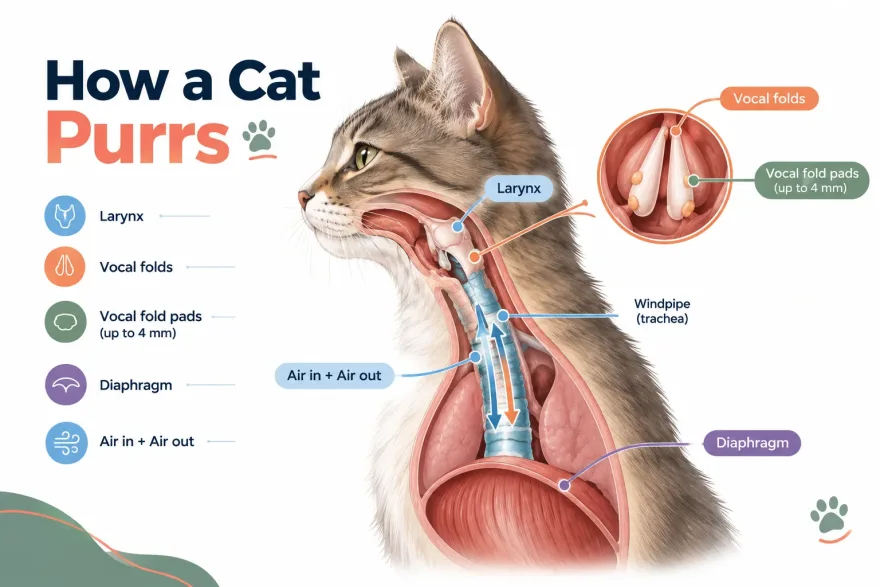
A cat purrs by making its vocal folds vibrate, the same tissue it uses to meow. The vibration starts in the larynx, or voice box, and air moving in and out of the lungs keeps it going. The chest and diaphragm carry the vibration, which is why you can feel a purr across your cat's whole body, not just at its throat.
The older theory: muscles and brain signals
For decades, the accepted explanation was that a cat's brain sends a fast, repeating signal to the muscles of the larynx, making them tighten and relax about 20 to 30 times a second to open and close the airway. UC Davis feline geneticist Leslie Lyons described this view in Scientific American, putting the purr at a steady 25 to 150 Hz. [Scientific American]
The 2023 discovery: pads inside the vocal folds
In 2023, a team led by voice scientist Christian Herbst at the University of Vienna tested that idea on the larynges of eight domestic cats. With no brain signal and no muscle activity at all, all eight still produced purr-like sounds at 25 to 30 Hz, the typical purring range. [Herbst et al., Current Biology, 2023]
Under the microscope, the team found pads of connective tissue up to 4 mm across inside the vocal folds. These pads seem to make the folds heavier, so they vibrate slowly and make a very low sound, even though a cat's vocal folds are short. The university compared the mechanism to human "vocal fry", the low, creaky voice some people slip into at the end of a sentence. [Herbst et al., Current Biology, 2023]
The researchers were careful to say this does not fully rule out the muscle theory. The most likely answer is that the padded vocal folds make the basic sound and the muscles help control it.
Where do cats purr from?
From the larynx, in the throat. Rest a finger gently on the front of your cat's neck while it purrs and you will feel the vibration strongest there. The chest and belly hum too, because the lungs and diaphragm drive the air that powers the sound.
Why do cats purr? 8 reasons backed by science
Cats purr for many reasons, and the same sound can mean very different things. Lyons argues that purring is better understood as communication, and possibly self-healing, than as a simple sign of happiness. [Scientific American] Here are the eight main reasons.
1. To show contentment and trust
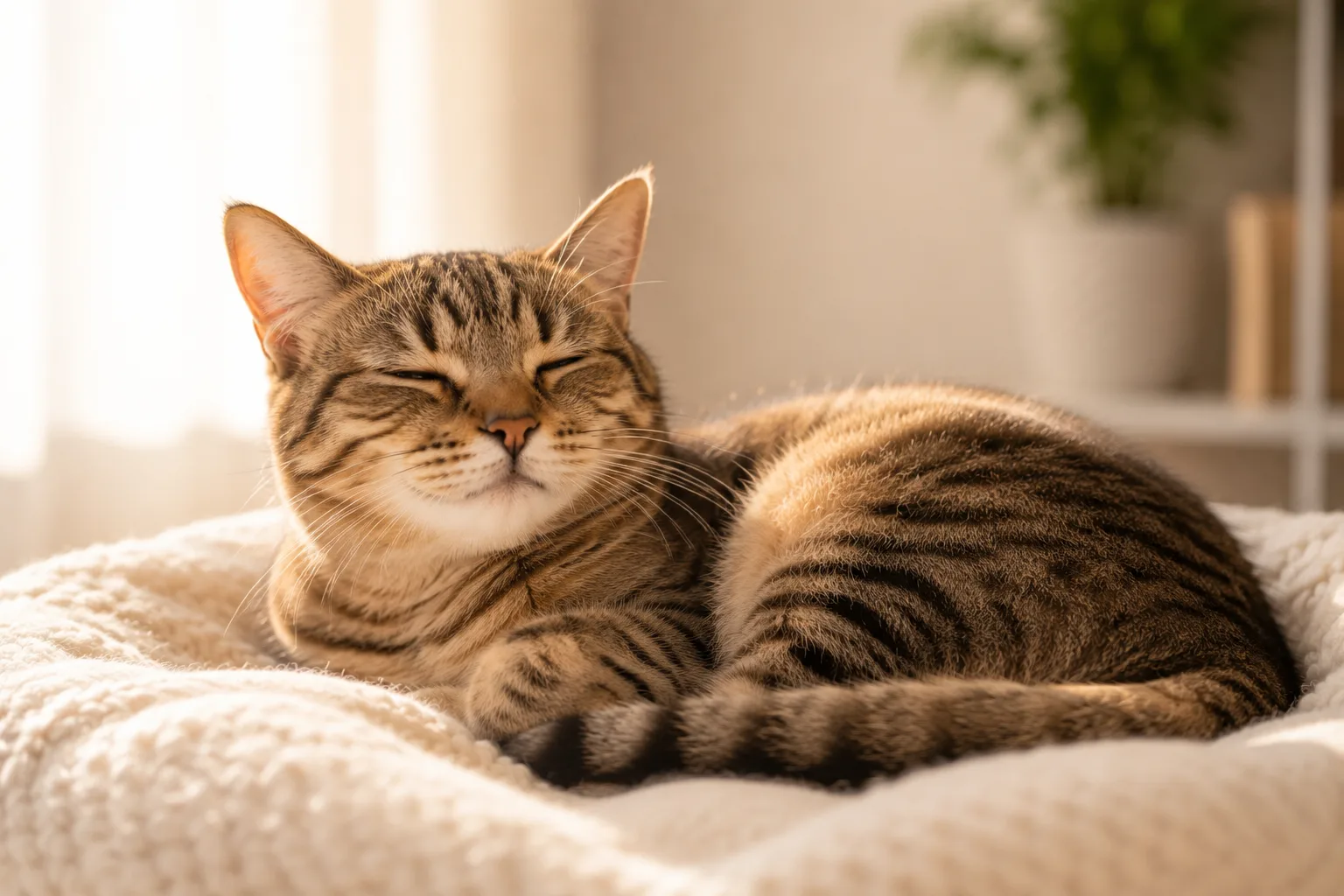
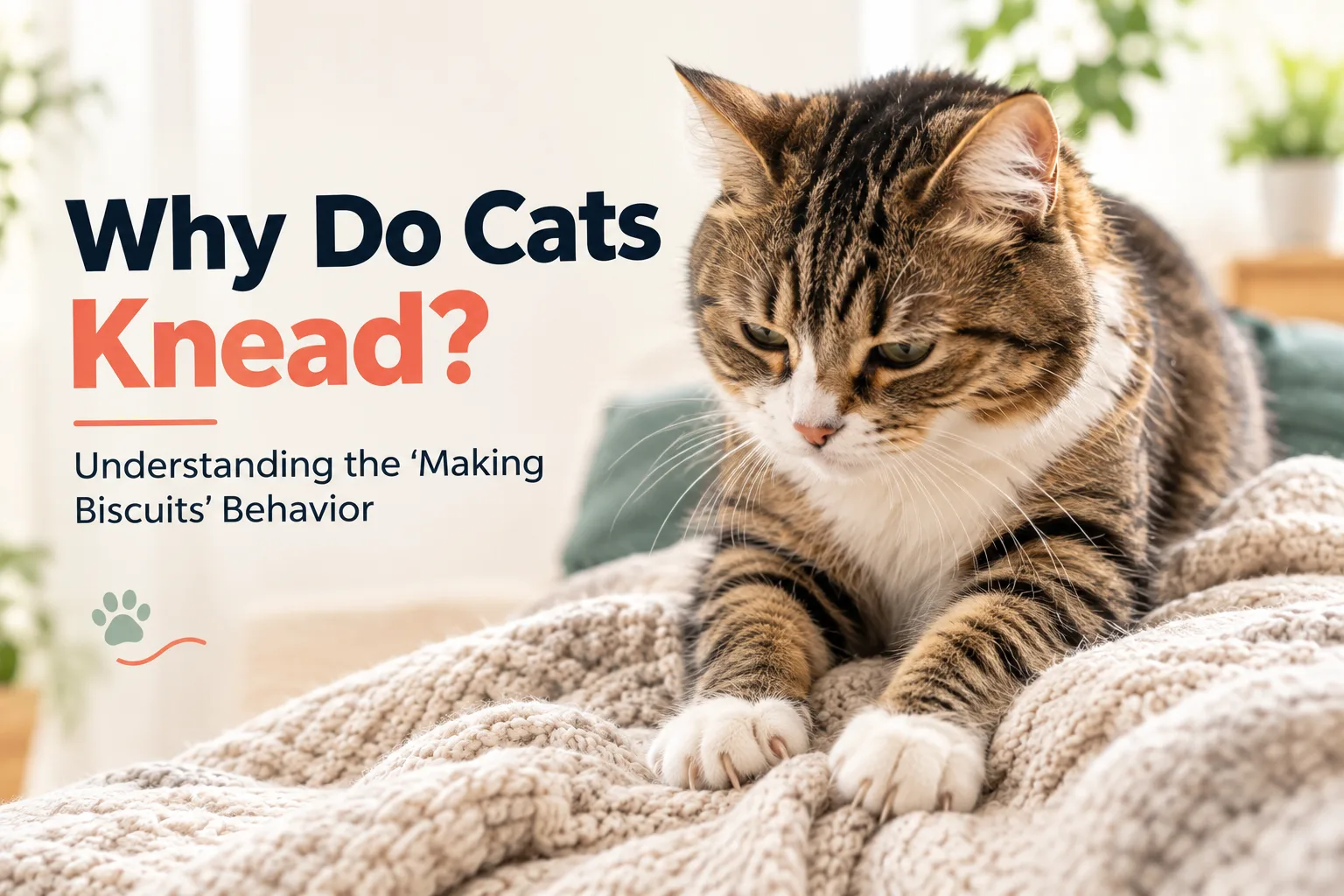
This is the purr everyone knows. Your cat is curled on your lap or beside you on the bed, eyes half closed, body loose, maybe kneading with its front paws. Purring is most noticeable when a cat is being petted, stroked or fed. [Scientific American]
Why do cats purr when you pet them? Gentle stroking along the head and back feels like the grooming cats give each other, and purring back keeps that pleasant, social moment going. Why do cats purr on you? A cat lying on your chest or lap is relaxed enough to rest in an open position, and a purr, which only carries a short distance, is the ideal signal at that range.
What to do: enjoy it. Keep petting slow and gentle, and let your cat decide when the session ends.
2. To ask for food or attention: the solicitation purr

If your cat wakes you at dawn with a loud purr near your face, you have met the solicitation purr. In 2009, Karen McComb and her team at the University of Sussex published a study called "The cry embedded within the purr" in Current Biology. [McComb et al., Current Biology, 2009]
They recorded 10 cats purring while asking for food and while relaxed. The food-seeking purrs carried a higher, cry-like sound inside the low rumble, at around 380 Hz. When 50 people listened, both cat owners and non-owners rated those purrs as more urgent and less pleasant, and when the team removed the cry digitally, the urgency dropped. [National Geographic]
In short, many cats learn which purr gets their owner out of bed. What to do: if you do not want a 5 a.m. alarm, avoid feeding straight after a solicitation purr. An automatic feeder set for a fixed time can break the habit.
3. To talk to their mother and kittens
Purring starts at the very beginning of life. When the mother returns to the nest, she purrs to signal that all is well, and her kittens suckle and purr at the same time. [International Cat Care] Many researchers think this is where purring began, and that adult cats carry the same "all is well" signal into their bond with people.
4. To calm themselves when stressed
Many cats purr in the carrier, the waiting room or on the exam table, where they are clearly not enjoying themselves. Lyons points to vet visits as one of the clearest signs that purring is not only about pleasure. [Scientific American] She compares it to a person humming: we hum when we are happy, but also when we are nervous and trying to calm down. [NPR]
What to look for: a stressed purr usually comes with a crouched body, a tucked tail, flattened or swivelling ears and wide pupils. What to do: speak softly, keep handling gentle, and give your cat a covered hiding spot, such as a towel over the carrier.
5. To cope with pain or injury
Cats are experts at hiding pain, and purring can be part of that mask. Cats purr when they are sick or injured, and International Cat Care notes two leading explanations: the purr may have healing properties, or it may be self-soothing when the cat feels at its most vulnerable. [International Cat Care]
What to do: never take a purr as proof your cat is fine. If it is purring but also hiding, limping, not eating or squinting, contact your vet. The pain signs are covered below.
6. While giving birth
Owners and vets commonly report cats purring through labour and while their kittens are born. It fits the same self-soothing pattern, and it means the first sound and feeling her kittens meet is a purr. If your cat is expecting, our cat pregnancy calculator estimates her due date so you can prepare a quiet nesting spot in time. Our guide to how long cats are pregnant covers each week and when labor needs a vet.
7. Near the end of life
This is the hardest reason to read about. Some cats purr in their final hours, or while being put to sleep by a vet. The purr does not mean the cat is happy, and it does not mean it is in more pain. It most likely means the cat is comforting itself, as it has done all its life, and your calm voice and touch can still help. If you are reading this because your cat is near the end, we are sorry. Your vet can guide you on keeping your cat comfortable.
8. Possibly to heal (a hypothesis, not a fact)
Cats purr in the 25 to 150 Hz range, and Lyons notes that sound frequencies in this range have been shown to improve bone density and promote healing. [Scientific American] Bioacoustics researcher Elizabeth von Muggenthaler, who recorded the purrs of dozens of wild and domestic cats, presented the idea in 2001 that purring could be a low-energy way for a resting cat to keep its bones and muscles strong.
It is a fascinating theory, but no study has shown that a cat's own purr heals its bones, or that it heals people. Treat it as an open question, and never use a purr in place of vet care.
What does it mean when a cat purrs? Read the whole cat
The purr alone will not tell you much. To understand what it means when a cat purrs, look at where your cat is, what just happened, and what the rest of its body is doing.
| Situation | What the purr usually means | Other signs to look for |
|---|---|---|
| On your lap, being stroked | Contentment and trust | Slow blinks, kneading, loose body, still tail |
| By the food bowl or your bed at dawn | Asking for food or attention | Rubbing your legs, staring, meows mixed into the purr |
| Nursing kittens | Bonding and "all is well" | Mother lying on her side, kittens kneading |
| At the vet or in the carrier | Calming itself under stress | Crouched body, flat ears, wide pupils |
| After an injury or while unwell | Coping with pain | Hiding, squinting, hunched posture, not eating |
| Dozing or in light sleep | Deep relaxation | Slow breathing, soft face |
| Purring, then a sudden bite | Overstimulated by petting | Tail twitching, skin rippling, ears turning back |
So, when a cat purrs, what does that mean? Your cat is either sending you a signal or calming itself, and its ears, eyes, tail and posture tell you which. Our checklist of the signs your cat is happy shows what a relaxed body looks like.
Why do kittens purr?
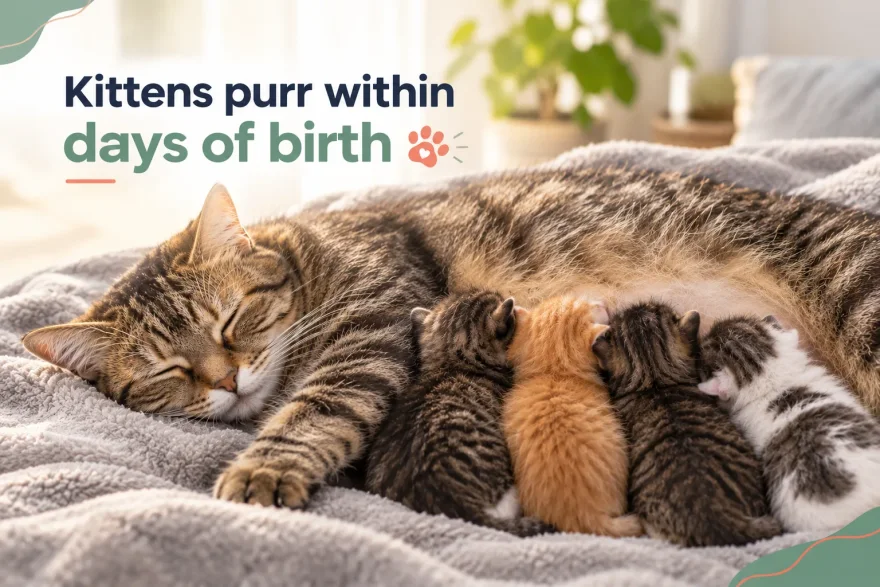
Kittens purr while they are being nursed as a sign of contentment, and the mother purrs back to reassure them. [International Cat Care] Newborn kittens cannot yet see or hear, so a vibration they can feel is the ideal signal: it tells the mother her kittens are feeding, and it helps them stay close to her in the nest.
What does it mean when a kitten is purring? In a kitten that is nursing, cuddling or sleeping somewhere warm, purring almost always means comfort and safety. In a kitten that is also crying, refusing to feed, cold to the touch or unusually sleepy, it can be a sign of trouble. Kittens become sick quickly, so call a vet the same day if you see those signs.
Do cats purr on purpose?
Partly. Asked whether purring is voluntary, Lyons told NPR it may be both voluntary and involuntary, much like blinking. [NPR] The solicitation purr is the best evidence that cats can shape it: they learn which purr gets results and use it more.
Are cat purrs good for people?
Many owners say a purring cat helps them relax, and one well-known study is often quoted as proof. A University of Minnesota team led by Adnan Qureshi analysed 4,435 US adults: 3.4% of people who had owned a cat died of a heart attack during the follow-up, against 5.8% of those who never had. [Qureshi et al., 2009]
That headline needs care. The clearest link was with past cat ownership, not current ownership. [Qureshi et al., 2009] A later review of pet and heart research found the results inconsistent and pointed out that pet ownership is also a marker of better income and family stability. [Schreiner, 2016] No study has shown that the purr itself lowers blood pressure or heals people.
The honest summary: living with a cat may help you relax, and lower stress is good for your heart. Enjoy the purr, but do not treat it as medicine.
Why is my cat purring? When to worry
Purring is normal and usually a good sign. A cat that suddenly purrs much more than usual is often just very relaxed or very hungry. But because cats also purr when they hurt, a purr should never stop you from checking for pain.
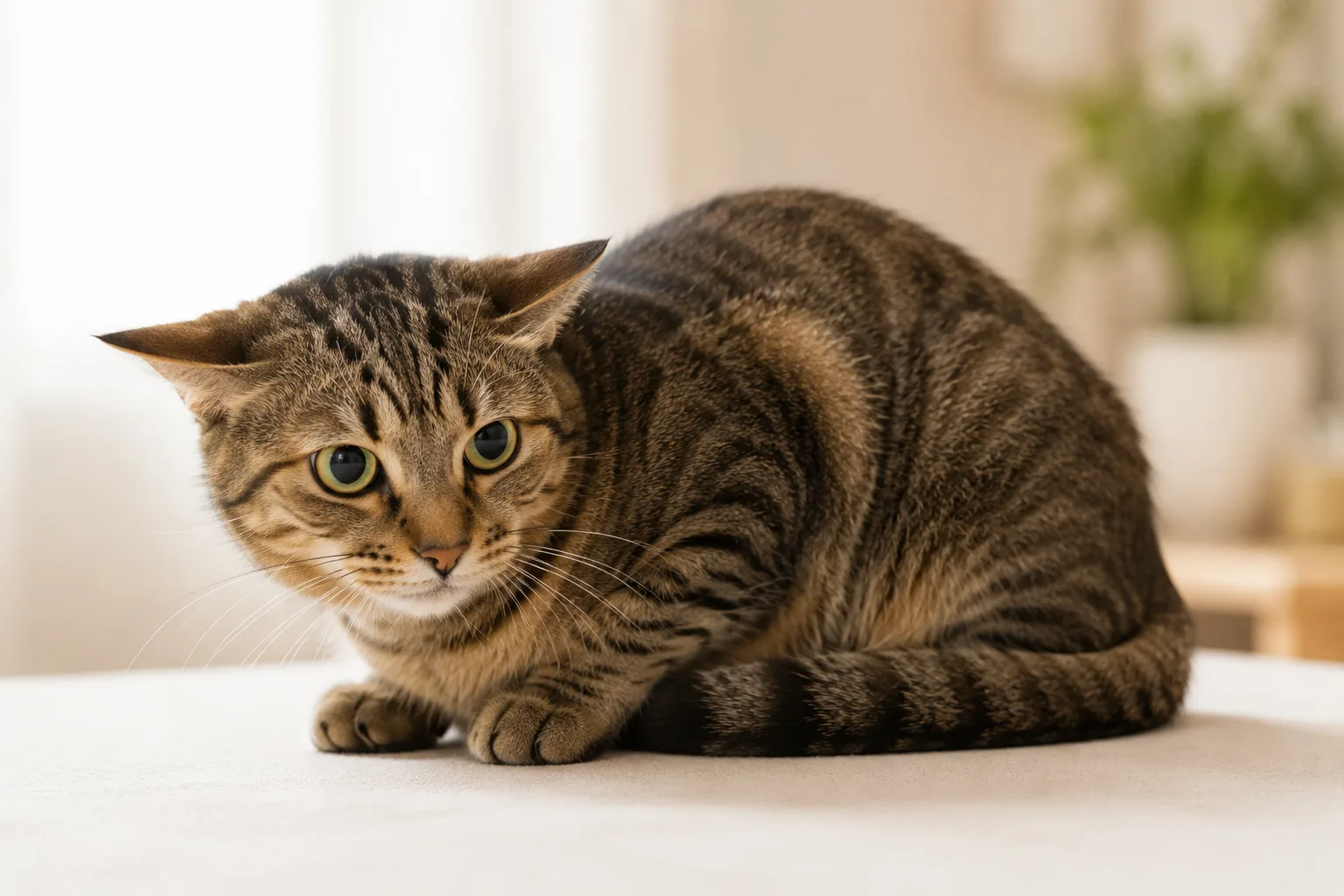
Vets use the Feline Grimace Scale, developed at the Université de Montréal and validated in Scientific Reports in 2019. It scores five facial changes linked to acute pain: [Evangelista et al., Scientific Reports, 2019]
- Ears: flattened, or pulled apart and turned outward
- Eyes: squinted or partly closed
- Muzzle: tense and oval instead of round and relaxed
- Whiskers: straight and pushed forward
- Head: held low, below the line of the shoulders
The scale is designed to be used by cat owners as well as vets. [Feline Grimace Scale]
Call your vet if your cat is purring and also:
- shows any of the five facial signs above
- hides more than usual or stops greeting you
- stops eating or drinking, or eats much less
- changes how it uses the litter box, or strains to pee
- breathes fast, with its mouth open, or with visible effort
Also call if a cat that always purred suddenly stops. A change in a familiar habit is often the first clue that something is wrong, and our guide to the early signs a cat is unwell covers the others to watch for.
Is my cat purring or congested?
A purr is a smooth, even rumble that rises and falls gently with breathing. Rattling, wheezing, snoring, whistling or bubbly sounds are not purring, especially if your cat is also sneezing, has a runny nose or eyes, or breathes with its mouth open. These can be signs of a respiratory infection or another breathing problem and need a vet check. Our guide to why cats sneeze explains which breathing signs are urgent.
Why doesn't my cat purr?
Some cats purr rarely or very quietly, and a few hardly purr at all. That is normal and does not mean your cat is unhappy. These cats often show affection in other ways: slow blinks, head-butting and rubbing against you, following you from room to room, kneading, or sleeping near you. The time to pay attention is when a cat that used to purr suddenly stops.
Which cats can purr?
Purring is not unique to pet cats: it is found in other members of the cat family too. [International Cat Care] Many small and medium wild cats purr, such as the cheetah, lynx and puma, while the big roaring cats, like lions and tigers, do not produce the same continuous purr on both the in-breath and the out-breath.
The bottom line
Cats purr to connect with us, to ask for things and to comfort themselves. Research from 2023 suggests that special pads in their vocal folds let even a small cat make this deep, steady sound with little effort. The healing theory is still unproven, and a purr is not always a sign of happiness.
The best way to understand your cat's purr is to read it together with its eyes, ears, tail and posture. If you have just brought a cat home, our complete guide for new cat owners covers what else is normal in the first weeks.
This article is general information and does not replace advice from a veterinarian. If you think your cat is unwell or in pain, contact your vet.
Frequently asked questions
Why do cats purr?
Cats purr to show contentment, to bond and to ask for food or attention. They also purr to calm themselves when stressed, sick or hurt. Purring may also support healing, but that is still a theory.
What makes a cat purr?
Any strong feeling or need can start a purr: comfort, hunger, wanting attention, stress or pain. Physically, air moving through the larynx makes the vocal folds, which contain small pads of connective tissue, vibrate about 25 to 30 times a second.
When a cat purrs, what does that mean?
It depends on the situation. A purr on your lap with relaxed eyes means contentment. A purr by the food bowl means "feed me". A purr with a hunched body and squinted eyes may mean pain.
Do cats purr on purpose?
Partly. Purring can happen automatically, like blinking, but cats can also control it. Many learn to change their purr, adding a cry-like sound when they want food.
Why do cats purr and then bite?
This is usually petting-induced overstimulation. Your cat enjoyed the stroking at first, then reached its limit. Watch for a twitching tail, rippling skin or ears turning back, and stop petting before the bite.
Do cats purr when they sleep?
Many cats purr while dozing or in light sleep, which usually means deep relaxation. The purr often fades as the cat drifts into deeper sleep.
Can a cat's purr heal bones?
Not proven. Purr frequencies overlap with vibration levels studied for bone healing, but no study shows that a purr heals a cat's or a person's bones. If your cat is injured, see a vet.
Is a purring cat always happy?
No. Cats also purr when stressed, sick or in pain, and some purr while giving birth or near the end of life. Always check your cat's body language and behavior along with the purr.
Sources
- Herbst et al. (2023), Current Biology: Domestic cat larynges can produce purring frequencies without neural input Eight cat larynges purred at 25 to 30 Hz with no neural input; vocal fold pads up to 4 mm.
- McComb et al. (2009), Current Biology: The cry embedded within the purr The University of Sussex study of the solicitation purr.
- National Geographic: Cats manipulate their owners with a cry embedded in a purr Coverage of the McComb study: 10 cats, 50 listeners, a cry near 380 Hz.
- Scientific American: Why do cats purr? (Leslie Lyons, UC Davis) Purring during petting, nursing, vet visits and injury; the 25 to 150 Hz range; the healing hypothesis.
- NPR: Why do cats purr? (interview with Leslie Lyons) Purring compared to humming and to blinking.
- Evangelista et al. (2019), Scientific Reports: Feline Grimace Scale Development and validation of the five-point facial pain scale.
- Feline Grimace Scale, Université de Montréal How owners and vets use the scale.
- Qureshi et al. (2009): Cat ownership and the risk of fatal cardiovascular diseases 4,435 adults; the lower risk was linked to past cat ownership.
- Schreiner (2016), Current Cardiovascular Risk Reports: Pets and cardiovascular risk Review finding the evidence on pets and heart health inconsistent.
- International Cat Care: Why do cats…? Purring between mother and kittens, purring when sick or injured, and purring in the wider cat family.
- International Cat Care: Cat communication Kittens purring while nursing, and the mother purring back.
- Guinness World Records: Merlin, loudest purr A purr measured at 67.8 decibels in 2015.
General information, not veterinary advice. If your cat's behavior has changed suddenly, speak to a vet rather than an article.
How this guide was researched and checked is set out in how our guides are written.

Want an answer in seconds?
The calculators handle age, due dates and portions without an account.